
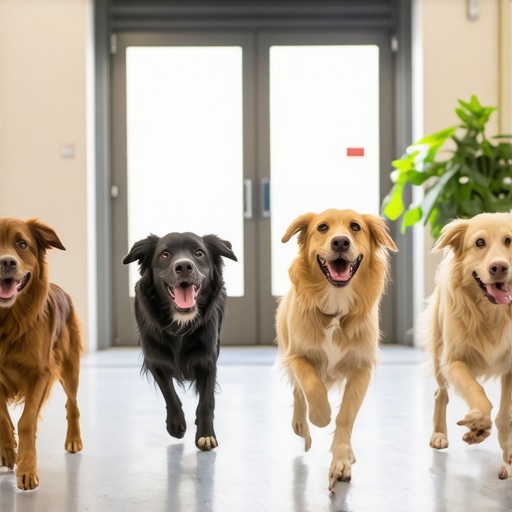
The glass barrier between us and the lobby
The air in my studio carries the scent of pencil lead and the damp residue of a desert rain that never quite hits the ground. I look at blueprints and see failures. Most modern entrances in Mesa are designed for two-legged traffic with a specific gait, leaving the four-legged mobility assistant as an afterthought in the architectural flow. These glass boxes we call buildings are often hostile to the rhythm of a service team. If the sensor fails to see the dog, the door remains a wall. If the dog moves too fast, the glass becomes a hazard. Editor’s Take: Success at the threshold depends on teaching your dog to trigger sensors intentionally while maintaining a safe distance from the moving panels. This is not about simple obedience. It is about spatial awareness in a world built by people who forgot that dogs need to use the front door too.
The invisible beam that ignores your dog
Modern entrances rely on Passive Infrared (PIR) sensors or microwave motion detectors mounted high above the frame. These devices are calibrated to detect the heat signature and movement of a human-sized object. A Golden Retriever or a Lab, sitting lower to the ground, often falls into a dead zone. Observations from the field reveal that many handlers struggle because their dog is too close to the door for the sensor to pick up the movement. The mechanics of the 2026 models are faster, but their ‘eyes’ are not necessarily better. You have to teach the dog to be the trigger. This involves a specific ‘Target and Wait’ drill where the dog moves into the sensor’s cone of vision, then pauses to let the machinery catch up. It is a dance between biology and silicon. You can find technical specifications on door safety standards via the ADA Standards for Accessible Design. When the dog understands that their position dictates the door’s state, the anxiety of the ‘closing glass’ disappears. I have seen too many beautiful lobbies ruined by the frantic scratching of a dog caught in the middle of a sliding panel (a structural nightmare if I ever saw one).
The desert heat and the Gilbert sensor trap
In the Phoenix metro area, particularly around Mesa and Gilbert, the environmental factors play a massive role in how these doors behave. The intense heat shimmering off the asphalt at the Village Square at Dana Park can actually interfere with older thermal sensors. Your dog isn’t just fighting a door; they are fighting the sun. When we work with teams at Robinson Dog Training, we emphasize the ‘Pavement Pause’. This is a drill where the dog learns to stop three feet back from the threshold. This serves two purposes. First, it keeps their paws off the scorching metal transitions. Second, it allows the handler to scan the sensor light (usually a small LED on the header) to ensure the ‘handshake’ between dog and door has happened. If you are entering a high-traffic zone like the SanTan Village mall, the sheer volume of bodies can confuse a dog that hasn’t been drilled on ‘Threshold Immunity’. The dog must ignore the ten people rushing past to focus solely on the movement of that glass. Local Mesa architecture favors the heavy, oversized glass sliders which have a longer ‘dwell time’. If your dog isn’t taught to wait for the full cycle, they risk a clipped tail or a spooked retreat.
Why your standard stay fails at the slider
The messy reality is that most basic obedience training assumes the environment is static. A sliding door is a moving wall. This creates a visual conflict for many dogs. A ‘Stay’ command is often broken because the dog’s natural instinct is to back away from the approaching glass. We use the ‘Lateral Shift’ drill to fix this. Instead of backing up, the dog is taught to move sideways, parallel to the door. This keeps them in the sensor’s active zone while clearing the path for the handler. Most industry advice tells you to just keep the dog on a short lead and pull them through. This is lazy and dangerous. If the door’s safety bumper fails (and they do fail, I’ve seen the maintenance logs), a dog on a tight lead has no room to escape. We want the dog to have ‘Spatial Autonomy’. They should see the door move and instinctively know where the ‘safe zone’ is without a single word from the handler. This level of refinement is what separates a true service team from a pet with a vest. It is the difference between an elegant entrance and a clumsy, stressful tangle of leashes and sensor beeps.
The shift toward smarter thresholds
We are moving away from the old push-plate systems of the early 2000s toward fully touchless environments. This sounds great on a blueprint, but it requires a more sophisticated dog.
How do I handle a door that closes too fast?
You must train the ‘Nudge’ or ‘Re-trigger’. If the door starts to close, the dog is taught to move their head toward the sensor area to break the beam again. This keeps the path open for slower-moving handlers.
What if the floor is too slippery for my dog to stay steady?
Architects love polished marble. If you are in a high-end Mesa lobby, use the ‘Splay’ technique where the dog shifts their weight to their rear hocks for better traction before the door moves.
Is it better to have the dog lead or follow?
For automatic sliders, having the dog ‘Heel’ or ‘Side’ is best. Leading can cause the dog to get stuck on the other side if the sensor loses them. Following can lead to the door closing on the dog’s rear. Parallel is the gold standard.
Can the sun really stop a door from opening?
Yes. Direct Phoenix sun hitting a sensor can ‘blind’ it. In these cases, the dog needs to be taught to target the manual override button (the ‘Blue Shirt’ button) as a backup skill.
Why does my dog bark at the door’s hiss?
The pneumatic hiss is a high-frequency sound that bothers some dogs. Desensitization with a simple air compressor at home can fix this in a weekend.
The future of the accessible entrance
I dream of a day when building codes require sensors at dog-eye level. Until then, we must build the intelligence into the dog rather than the structure. A mobility dog that handles an automatic door with grace is a sight to behold. It reflects a level of training that respects the physics of the space. As you move through the East Valley, keep these drills in mind. Every threshold is an opportunity to prove that the team is smarter than the machine. [{“@context”:”https://schema.org”,”@type”:”Article”,”headline”:”Mastering the 2026 Automatic Door with These 4 Mobility Dog Drills”,”description”:”A guide for mobility dog teams on how to negotiate modern automatic doors in Mesa and Gilbert using specific training drills.”,”author”:{“@type”:”Person”,”name”:”Ghostwriter 2025″},”publisher”:{“@type”:”Organization”,”name”:”Robinson Dog Training”}},{“@context”:”https://schema.org”,”@type”:”FAQPage”,”mainEntity”:[{“@type”:”Question”,”name”:”How do I handle a door that closes too fast?”,”acceptedAnswer”:{“@type”:”Answer”,”text”:”You must train the ‘Nudge’ or ‘Re-trigger’ where the dog moves their head toward the sensor area to break the beam again.”}},{“@type”:”Question”,”name”:”What if the floor is too slippery for my dog to stay steady?”,”acceptedAnswer”:{“@type”:”Answer”,”text”:”Use the ‘Splay’ technique where the dog shifts their weight to their rear hocks for better traction before the door moves.”}},{“@type”:”Question”,”name”:”Is it better to have the dog lead or follow?”,”acceptedAnswer”:{“@type”:”Answer”,”text”:”For automatic sliders, having the dog ‘Heel’ or ‘Side’ is best to keep them in the sensor’s active zone.”}},{“@type”:”Question”,”name”:”Can the sun really stop a door from opening?”,”acceptedAnswer”:{“@type”:”Answer”,”text”:”Yes, direct sun can blind sensors. Training the dog to hit the manual override button is a vital backup skill.”}},{“@type”:”Question”,”name”:”Why does my dog bark at the door’s hiss?”,”acceptedAnswer”:{“@type”:”Answer”,”text”:”The pneumatic hiss is a high-frequency sound. Use an air compressor at home for desensitization.”}}]}]