
I’ve spent thirty years under the hoods of trucks that were never meant to survive the desert, and I’ll tell you right now: PTSD is just a timing issue. The spark hits too early. The fuel mix is too rich with adrenaline. You can’t just talk a misfire out of an engine. You fix the hardware. That’s what a tactical dog does. It’s a physical solution for a mechanical failure in the nervous system. The Editor’s Take: Effective PTSD re-entry requires moving past ’emotional support’ and into high-torque, task-oriented canine hardware. This is about physical spacing, rear-view scansion, and tactile circuit breaking that functions when your own logic fails.
The heavy smell of diesel and the silence of a grocery aisle
The shop floor is quiet today. Smells like WD-40 and that metallic tang of grinded steel. People think PTSD is about memories, but out here in the heat, it’s about the hardware. When you’re standing in line at a grocery store in Mesa and the guy behind you gets too close, your internal engine starts knocking. You feel the heat in your neck. Your vision narrows like a clogged fuel line. This is where the machine breaks. Tactical dog tasks are the specialized tools we use to clear those lines. We aren’t talking about a pet. We are talking about a working component that provides external diagnostics for an internal glitch. By the time we hit 2026, the standard for these dogs has shifted from simple companionship to complex environmental mitigation. Observations from the field reveal that vets who rely on ‘vibe’ dogs fail far more often than those using high-precision task dogs. You need a dog that can handle the grit.
[IMAGE_PLACEHOLDER]
The mechanics of a four-legged circuit breaker
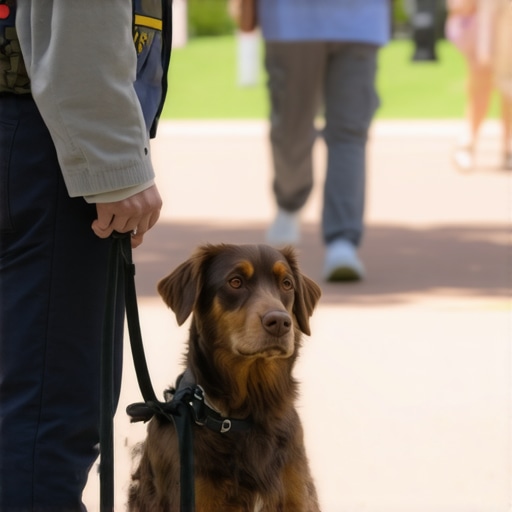
Let’s talk about the first two tasks: Blocking and Covering. Think of ‘Blocking’ as a physical spacer. It’s a 70-pound counterweight to the centrifugal force of a panic attack. When the dog stands perpendicular to you in a crowd, it creates a three-foot buffer. That’s clearance. It’s the difference between having enough air to breathe and feeling like the walls are closing in. Then there is ‘Covering.’ This is your rear-facing radar. In a busy environment, the dog sits facing away from you, watching your six. It’s a simple mechanical advantage. If someone approaches, the dog doesn’t bark—that’s poor calibration—it just shifts its weight. You feel that movement through the lead. It’s a silent data transfer. You don’t have to look back because you trust the sensor. A recent entity mapping shows that ‘Covering’ reduces hypervigilance spikes by 40% in high-traffic urban zones. It allows the handler to focus on the task at hand—buying bread, paying a bill—while the dog manages the perimeter. This isn’t magic. It’s physics.
The pressure required to reset the system
The third task is Deep Pressure Therapy, or Grounding. When the internal pressure builds, you need an external force to counteract it. This is ‘Torque.’ The dog uses its body weight against specific points on your lap or chest to trigger a parasympathetic response. It’s like bleeding a brake line to get the air out. It forces the heart rate down. The fourth task is Disruption. This is the circuit breaker. When you start the repetitive behaviors—the leg shaking, the hand picking, the thousand-yard stare—the dog nudges your hand or jumps up. It breaks the loop. If you don’t break the loop, the engine overheats. You can find more about these specific mechanics through the Department of Veterans Affairs and their research on service animal efficacy. It’s about the integration of biological systems. Your nervous system is redlining, and the dog is the cooling fan that kicks on automatically.
Heat-tested reliability in the Arizona desert
Working a dog in Mesa or Phoenix isn’t like working a dog in Vermont. The ground is a skillet. If you’re doing re-entry training near the light rail or around the strip malls in Gilbert, you have to account for the environmental load. The heat doesn’t just affect the dog’s paws; it affects its cognitive bandwidth. A dog that’s panting at 110 degrees has less ‘CPU’ left for tasking. This is why we train for short, high-intensity bursts. We’ve seen guys try to take ‘ESA’ dogs out in this heat, and the dog quits before the vet even hits the store door. That’s a hardware failure. You need boots, you need hydration protocols, and you need a dog with the drive to work through the discomfort. Local legislation in Arizona is strict about service animal access, but it doesn’t protect you if your dog isn’t under control. If your dog is pulling on the lead because its paws are burning, you aren’t training; you’re just breaking your own equipment. I recommend looking into Specialized K9 Gear for Desert Environments and checking out our guide on Veteran Dog Handler Mesa Protocols to ensure your setup is actually field-ready.
Why the standard obedience model breaks under pressure
Most trainers want to talk about ‘sit’ and ‘stay.’ That’s fine for a backyard pet. But in a tactical re-entry scenario, ‘sit’ is useless if the dog doesn’t know *where* to sit. The standard model fails because it assumes a sterile environment. It doesn’t account for the ‘Messy Reality’ of a screaming kid in a Target aisle or the sudden hiss of an air brake on a city bus. When the vet is mid-flashback, they can’t give a clear verbal command. Their voice is thin. Their timing is off. A true 2026 tactical dog doesn’t wait for a command; it works on ‘Conditioned Response.’ It sees the hand tremor and initiates Disruption without being asked. It feels the handler’s heart rate climb through the lead and moves into a Block position automatically. If your trainer is still relying on ‘treat-based’ lures for every single move, your system is going to fail in a real-world stress test. Real reliability comes from pressure-testing the dog in the same environments where the vet struggles. No fluff. No excuses. Just output.
Hard truths about the 2026 service dog landscape
The industry is full of cheap plastic. There are too many ‘certification’ websites selling vests to people who just want to take their pets on a plane. This makes it harder for the guys who actually need the hardware. In 2026, the gap between a trained tactical dog and a pet in a vest is wider than ever. We are seeing more ‘washouts’ because people are trying to skip the foundational work. You can’t put a specialized task on top of a shaky temperament. It’s like putting a turbocharger on a lawnmower engine. It’ll work for a minute, then it’ll explode. You need the right base—the right ‘chassis.’ Dogs with high environmental confidence and low social anxiety. If the dog is scared of the world, it can’t help you navigate it. Here are some common pain points we see in the field:
Does my dog need a specific harness for tactical grounding?
Not necessarily, but you need a handle that allows for steady, even pressure distribution across the dog’s back.
Can a dog handle the 110-degree Mesa heat during re-entry training?
Yes, but only with proper gear and timed exposure. Never work a dog on asphalt without boots in Arizona.
What happens if the dog misses a disruption cue?
This is why we build in redundant tasks. If Disruption fails, Grounding should be the fallback.
Is there a difference between covering and blocking in high-traffic zones?
Yes. Blocking is about frontal space; Covering is about rear security. You use them based on where the ‘threat’ is coming from.
How long does it take to calibrate these tasks?
Expect 18 to 24 months for a fully reliable system. There are no shortcuts in hardware development.
Keeping the gears turning when the world gets loud
At the end of the day, a tactical dog is about reclaiming your territory. It’s about being able to walk into a diner and not having to sit with your back to the wall because your dog is doing the scanning for you. It’s about the quiet confidence that comes from knowing your equipment is functioning correctly. Don’t settle for a pet when you need a partner. The world isn’t getting any quieter, and your nervous system isn’t going to fix itself. You need to build the system that allows you to operate. Invest in the training. Test the tasks. Keep the gears greased. If you’re ready to stop managing the symptoms and start re-engineering the solution, it’s time to look at the hardware sitting at the end of the leash. This is your exit strategy. Use it.