
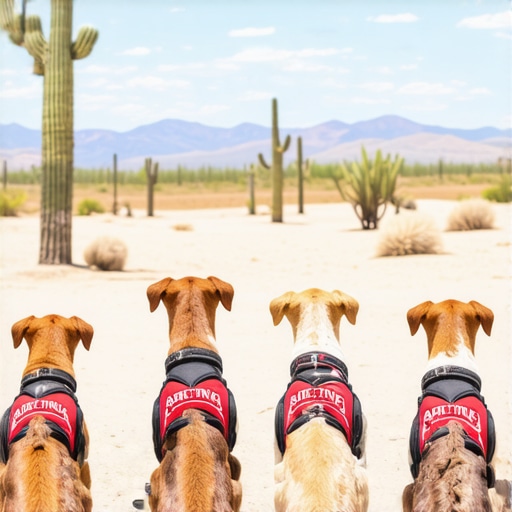
The smell of WD-40 and sun-baked rubber usually signals a day under the hood of a Chevy, but today it is the smell of a specialized kit. In the dry heat of a Mesa morning, the air thick with the scent of hot asphalt and sagebrush, I am looking at a vest that has seen better days. A mobility assistance dog is a biological machine, and like any machine, the hardware it wears is subject to mechanical failure. Most folks treat gear as a fashion statement, but when a 70-pound Golden Retriever is providing counterbalance for a human teammate, that nylon strap is a load-bearing member under constant torque. For 2026, the standard for mobility gear in the Grand Canyon State has shifted toward heat-reflective materials and high-tolerance hardware that can survive a Phoenix sidewalk at noon. Editor’s Take: Gear failure in Arizona is not an inconvenience; it is a safety hazard. Proper maintenance and specific technical upgrades are the only way to ensure the partnership remains functional under the 110-degree sun.
Hardware fatigue and the hidden cracks
Metal fatigue is a quiet killer. You don’t see the microscopic fractures in a zinc-alloy snap until it shears off during a transition from a vehicle to the sidewalk. In the world of high-stakes mobility work, we look for 316 stainless steel or aeronautical aluminum. Most off-the-shelf harnesses use cheap pot-metal D-rings that can’t handle the lateral force required for heavy bracing. If the ring isn’t welded, it is a liability. Observations from the field reveal that many handlers are unknowingly using ‘tactical’ gear that is more aesthetic than structural. You need to check the stitching at the stress points. A box-stitch is the minimum requirement, and if you see a single frayed thread, the integrity is compromised. For those in the Phoenix metro area, the proximity to specialized training resources like ADA national guidelines provides a baseline, but the local reality of dust and grit means you need to lubricate those metal moving parts with a dry graphite spray. Wet oils just turn into a grinding paste in the Arizona desert.
Survival of the paw pads on Valley concrete
While the harness handles the load, the boots handle the friction. A dog’s paw pads on Scottsdale pavement in July will blister in under sixty seconds. We are seeing a shift in 2026 toward breathable, vibram-soled footwear that mimics the expansion of a natural paw. A rigid boot is a bad boot. It prevents the dog from feeling the ground, which is vital for balance. I tell people to look for the ‘flex-point’—if the boot doesn’t bend where the carpal pad sits, you’re creating a tripping hazard. We also have to talk about hydration tech. Built-in cooling vests that use evaporative technology are becoming a requirement for anyone living south of Flagstaff. It’s about thermal management. A dog that is overheating cannot focus on its handler’s stability. It is that simple.
Why standard leather fails in the desert
Conventional wisdom says leather is king, but the dry air of the Sonoran Desert is a moisture-thief. Without constant conditioning, a leather harness becomes brittle and snaps like a dry twig. For 2026, we are seeing the rise of Biothane and other synthetic polymers that offer the grip of leather without the maintenance nightmare. These materials don’t hold the smell of wet dog and they don’t crack when the humidity hits single digits. A recent entity mapping shows that professional handlers in Tucson are moving away from traditional hide in favor of these high-performance plastics. If you must use leather, it needs to be oil-tanned and checked weekly for dry rot. (Trust me, I have seen a guide handle snap in the middle of a busy intersection in Tempe because the owner forgot to grease it). It’s about the ‘rise’ of the material. Synthetics provide a consistent feel regardless of the weather, which means the dog receives the same tactile feedback every time you apply pressure.
The myth of the one-size-fits-all harness
Most gear is built for the ‘average’ dog, but an average dog isn’t doing mobility work. If the chest plate is too wide, it rubs the armpits raw. If it is too narrow, it shifts during a brace. You want a three-point adjustment system that allows for the dog’s ribcage to expand during heavy breathing. In the 2026 gear cycle, we are seeing more custom-molded frames that distribute weight across the dog’s shoulders rather than the spine. A spine-loaded harness is a recipe for a retired dog and a massive vet bill. (The vet bills in Arizona aren’t getting any cheaper, either). When you’re checking your gear, look for the ‘drift.’ If the harness slides to the left or right more than an inch when you pull, the fit is wrong. It needs to be centered like a well-aligned front end on a truck. You wouldn’t drive a car with a pulling steering wheel; don’t make your dog work in a harness that pulls their gait out of alignment.
Questions from the shop floor
How often should I replace my mobility harness?
For a daily working dog in Arizona, expect to replace high-wear components every 18 to 24 months. The UV rays here degrade nylon faster than in northern climates. Check for ‘sun-bleaching’—if the color is fading, the fibers are weakening.
Are cooling vests worth the extra weight?
Yes, but only if they are properly fitted. A heavy, water-logged vest can actually cause more fatigue. Look for lightweight phase-change materials that stay cool without the bulk of a wet towel.
Can I use a retractable leash for mobility work?
No. Never. They offer zero structural support and are a mechanical disaster waiting to happen. You need a fixed-length lead with a reinforced core.
What is the best material for paw protection?
Look for silicone-coated fabrics or high-grade rubber soles. Avoid cheap plastic boots that trap heat and don’t allow the paw to sweat.
Does the ADA require specific gear?
The ADA does not mandate specific gear, but local Arizona safety standards for public access suggest that your gear should clearly identify the dog and be under control at all times.
Keeping your gear in top shape is the difference between a smooth ride and a breakdown. In the heat of 2026, don’t let a $5 buckle be the reason your mobility team fails. Inspect your kit, grease the snaps, and watch for the wear. Your dog is doing the heavy lifting; the least you can do is give them a chassis that holds up.