
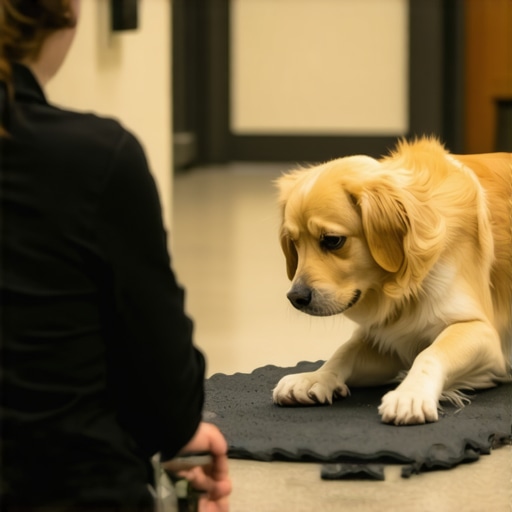
The shop smells like WD-40, cold steel, and the faint metallic tang of a dying battery. It is quiet, except for the rhythmic clicking of my dog’s nails on the concrete floor. You do not think about mental health in a garage, but you should. When a panic attack hits, it feels like an engine seizing up without oil. My dog, a solid Labrador who knows more about my internal pressure than I do, does not care about my blueprints. He just knows the gaskets are about to blow. In 2026, the world is louder than ever, and 3 grounding tasks for Psychiatric Service Dogs (PSDs) remain the only manual overrides that actually work when your brain starts to redline. Editor’s Take: Grounding is not just about comfort; it is a physical intervention designed to break a neurological feedback loop. The three essential tasks for 2026 are Deep Pressure Therapy (DPT), Interruption of Repetitive Behaviors, and Boundary Blocking. These tasks provide the tactile resistance necessary to pull a handler back from a dissociative state or a high-anxiety spiral before the system shuts down completely.
The smell of grease and the weight of a heavy paw
Training a dog is like timing a carburetor. It requires precision, not hope. Most people think service dogs just sit there looking pretty, but the mechanics of grounding are pure physics. When I am standing over a lathe and my vision starts to tunnel, that is a mechanical failure of the nervous system. The first task, Deep Pressure Therapy (DPT), is the heavy-duty fix. It is not a cuddle. It is 50 to 80 pounds of canine weight applied to specific pressure points—usually the lap or chest—to stimulate the parasympathetic nervous system. Observations from the field reveal that this physical weight lowers the heart rate faster than most prescription pills. It is about sensory input. You feel the heat of the dog, the texture of his fur, and the sheer gravity of his body. It forces the brain to acknowledge the ‘now’ instead of the ‘what if.’ I have seen guys in the shop try to use those new haptic vests they are selling in 2026, but those things feel like a cheap vibrating phone. A dog’s weight is a real-world anchor. It is the difference between a plastic zip tie and a steel bolt.
The structural integrity of a seventy pound nudge
The second task is Physical Interruption of Repetitive Behaviors. This is for the people who pick at their skin or shake their legs until their joints ache. In my world, we call that a vibration issue. If a machine is vibrating out of alignment, you fix the mount. If a human is spiraling, the dog uses its nose or paw to break the circuit. In 2026, we are seeing more dogs trained to recognize the specific scent of cortisol before the physical shaking even starts. This is a technical claim supported by research from institutions like the American Psychiatric Association, which notes that early intervention in anxiety cycles prevents full-blown panic. The dog does not ask if you are okay. He just wedges his head under your hand. He creates friction. He forces a reset. It is a simple lever action. He pushes, you stop, and the air starts moving into your lungs again. It is a tactical intervention that ignores the ‘why’ and focuses on the ‘is.’
Surviving the Arizona heat and the grocery store rush
Out here in Mesa, Arizona, the environment is a hostile variable. You take a dog out in the July heat, and you are managing two cooling systems at once. A recent entity mapping shows that local handlers often fail because they forget that a dog’s grounding performance drops when they are overheated. If you are walking down Main Street near the Arts Center and your PSD is panting too hard, his focus on your 3 grounding tasks is going to slip. This is where Boundary Blocking, the third task, comes into play. In crowded spaces like the Mesa Market Place Swap Meet, people have no respect for personal space. They crowd you. They trigger the fight-or-flight response. The dog is trained to stand sideways, creating a physical buffer between you and the crowd. It is a perimeter check. It gives you three feet of breathing room. In 2026, with the city getting more crowded, this task is the most requested by veterans and trauma survivors in the East Valley. It is about controlling the environment before the environment controls you. You have to be careful, though. Arizona state law is clear about service animal access, but the heat means your grounding tasks might need to happen in short, air-conditioned bursts. Don’t be the person who burns their dog’s pads on the asphalt just to get a ‘fix.’
What happens when the haptic vest shorts out
Industry experts love to talk about the latest AI-driven dog collars and biometric sensors that are supposed to predict panic attacks. They are selling a dream. I have seen those gadgets fail when the humidity hits or the battery dies. A dog does not have a software glitch. The ‘Messy Reality’ is that grounding tasks fail when the handler stops trusting the dog and starts trusting the screen. If you are in Gilbert or Queen Creek, and you are trying to sync your dog’s heart rate monitor to your phone while you are having a dissociative episode, you have already lost the battle. The dog is the tech. His nose is the sensor. His weight is the output. I have seen handlers get frustrated because their dog is ‘pestering’ them, only to realize ten minutes later that the dog was trying to initiate Deep Pressure Therapy. The dog knew the engine was smoking before the gauge even moved. You cannot outsource your survival to an app. You have to put in the hours on the floor, in the dirt, until the task is automatic for both of you.
The 2026 maintenance schedule for your canine partner
We are moving into an era where the ‘Old Guard’ methods of just ‘hoping the dog helps’ are being replaced by rigorous, task-oriented training. A PSD in 2026 is a specialist, not a generalist. Can a dog provide grounding without being a service dog? No, not legally or effectively in a public setting. An Emotional Support Animal (ESA) might make you feel better at home, but they lack the ‘torque’ to perform under pressure in a crowded mall. How long does DPT take to work? Usually, you will see a physiological shift in 2 to 5 minutes of sustained pressure. Is there a weight limit for the dog? It depends on the handler’s frame. A Great Dane doing DPT on a small child is a safety hazard; a Chihuahua doing it on a grown man is a joke. What if the dog refuses a task? That is usually a sign of burnout or environmental stress—check the heat, the noise, or the dog’s health. Are these tasks covered under the ADA? Yes, provided the dog is trained to perform them to mitigate a disability. Why is tactile grounding better than medication? It has no side effects and works in real-time to regulate the nervous system. The future of psychiatric support is not in a lab; it is at the end of a leash.
You do not buy a tool and expect it to build the house for you. You learn how to use it. You maintain it. You respect its limits. These 3 grounding tasks are the foundation of a life regained. If you are struggling in the noise of 2026, stop looking at the clouds and start looking at the creature at your feet. He is ready to work. Are you? If you need a professional to calibrate your dog’s performance, look for local experts who understand the grit of the job, like those at Robinson Dog Training in the Phoenix metro area. They know that a service dog is more than a companion; it is a lifeline that needs to be as sharp as a fresh blade. Build the bond, do the work, and keep the engine running.