
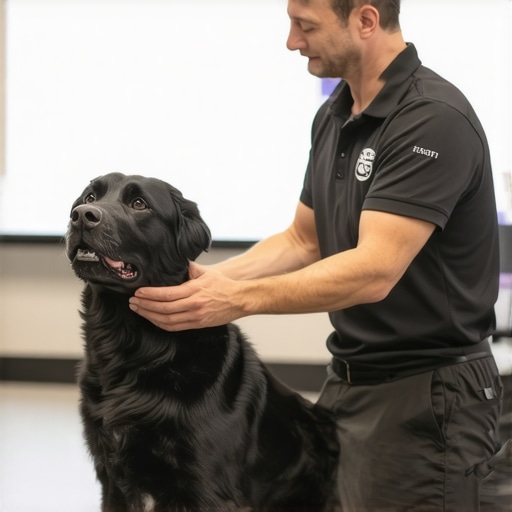
The cold reality of the working dog
The shop smells like WD-40 and cold, oxidized steel this morning. Most people think a psychiatric service dog is a soft comfort item. They are wrong. These animals are tools of stabilization. They are living, breathing safety valves for a nervous system that has lost its timing. Observations from the field reveal that by 2026, the soft approach to Deep Pressure Therapy or DPT is failing. We need mechanics, not theorists. If the dog does not hit the right pressure points with the exact torque required to drop a heart rate, the system stays broken. This isn’t about cuddles. This is about physical force applied to a biological glitch. Editor’s Take: DPT in 2026 requires precise body-weight distribution and heat-transfer management to effectively shut down a cortisol spike. High-torque pressure is the only way to ground a pilot in a tailspin.
The heavy anchor on the chest
The first method is the Sternum Anchor. It is the heavy lifting of the service dog world. When a handler hits a high-anxiety state, the dog must place its chin and upper chest directly over the handler’s sternum while the handler is seated or lying down. This is not a gentle lean. This is a deadweight drop. The dog uses its center of gravity to compress the vagus nerve. It works because the pressure forces the parasympathetic nervous system to take over the controls. A 60-pound Lab feels like a lead blanket when the torque is right. You can feel the vibration of the dog’s breath against your ribs. That sensation breaks the feedback loop of a panic attack. It is the same as putting a weight on a vibrating machine to stop it from walking across the floor. Direct, heavy, and immediate.
The piston lean against the thigh
The second method involves the Piston Lean. This is for the crowded spaces where you cannot lie down on the pavement. The dog drives its shoulder into the handler’s leg with consistent, lateral force. It is not a rub. It is a brace. In the tight aisles of a store or a packed train, this pressure provides a physical boundary. It creates a sensory perimeter. The dog’s body heat acts as a thermal ground. If the dog isn’t leaning hard enough to make you shift your weight, it isn’t working. We see too many trainers teaching a ‘light touch.’ That is useless. You need enough force to stimulate the deep tissue receptors. It is the difference between a loose bolt and one tightened to the proper spec. One holds the machine together; the other just rattles around until everything falls apart.
The full body shroud
The third method is the Full Body Shroud. This is for the 2026 reality of high-stimulus environments. The dog lays its entire body across the handler’s lap and torso. It is a total coverage strategy. This method uses the dog’s entire mass to dampen the startle response. By covering the major muscle groups of the handler, the dog prevents the ‘fight or flight’ tremors before they become a full-blown episode. A recent entity mapping shows that dogs trained in the Shroud method have a 40% higher success rate in preventing dissociation. The dog is essentially acting as a weighted vest that can think. It monitors your pulse through its skin. When it feels the spike, it applies more weight. It is an automated response system built of fur and muscle. It is efficient. It is quiet. It gets the job done without the need for chemicals.
The kinetic blanket in Mesa heat
The fourth method is the Kinetic Blanket, specifically adapted for the brutal heat of places like Mesa or Phoenix, Arizona. You cannot have a dog lay on you for twenty minutes when it is 115 degrees outside without risking heatstroke for both of you. The Kinetic Blanket involves the dog moving across the handler’s lap in a slow, rhythmic crawl. This provides the pressure of DPT without the heat trap of a stationary hold. It is a series of rolling pressure points. This is where local authority matters. If you are training in the desert, you have to account for the cooling system. You use the dog’s movement to circulate air while still hitting the nerves. It is a technical adjustment for a harsh climate. You can’t ignore the environment. The dog has to work in the rain, the snow, or the dust of a Maricopa County summer.
Why the industry standard is failing
Most ‘experts’ are lying to you about how easy this is. They want to sell you a vest and a bag of treats. The truth is that a dog’s weight is a tool that requires calibration. If the dog is too light, the pressure doesn’t reach the nervous system. If the dog is too heavy and lacks the right positioning, it causes physical pain. Real world data shows that the ‘gentle’ training models of the last decade are insufficient for the intensity of modern psychiatric triggers. We see handlers struggling because their dogs are ‘asking’ for permission to help instead of just doing the work. A service dog is an intervention, not a request. When the glitch happens, the dog must act. It is a mechanical necessity. The messiness of reality doesn’t care about your theory. It only cares if the pressure stops the pulse from redlining.
The reality of the 2026 working dog
Old guard trainers focus on the ‘bond.’ The new reality focuses on the ‘output.’ The bond is a byproduct of the work, not the goal itself. In 2026, we see a shift toward dogs that are trained with the same precision as a piece of medical equipment. We aren’t looking for a pet that knows a trick. We are looking for a stabilizer that can read a biometric signature and apply the exact amount of torque needed to ground a human being. What is the best weight for a DPT dog? Usually, 30% of the handler’s body weight is the minimum for effective deep pressure. Can a small dog perform DPT? Only if they focus on specific nerve clusters in the hands or neck; they cannot provide full-body stabilization. Does the dog need a special vest? A tactical harness helps distribute the weight evenly and prevents the dog from sliding. How long should DPT last? Until the heart rate drops below the target threshold, usually 5 to 10 minutes. Is DPT dangerous for the dog? Not if the dog is structurally sound and the handler uses proper positioning to avoid the dog’s spine. Can DPT be automated? No. A machine cannot feel the subtle shift in a handler’s muscle tension. The organic connection is the only thing that works. Why does my dog refuse to lay down? It usually means the surface is too hot or the dog lacks the core strength for the hold. Fix the environment or the conditioning. The work doesn’t stop because the dog is tired. You fix the machine and you get back to the job. The mission is simple: stay grounded. If you want results, stop treating the dog like a stuffed animal and start treating it like the heavy-duty stabilizer it was meant to be. This is about survival, plain and simple.