
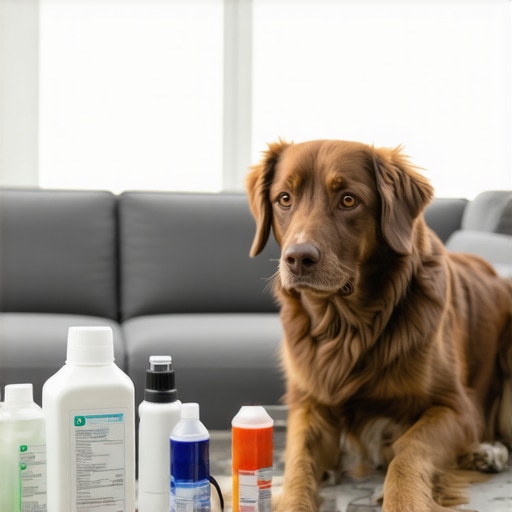
The smell of hot asphalt and missed alerts
The air in Mesa during July doesn’t just shimmer; it vibrates with a dry heat that ruins more than just your car’s cooling system. It ruins the mechanical precision of a dog’s nose. I spend my days under hoods, smelling burnt oil and the sharp tang of WD-40, but I spent my nights trying to figure out why my own Diabetic Alert Dog (DAD) was missing the drops. Editor’s Take: Effective scent work in 2026 requires treating the dog’s nose like a high-performance engine that needs clean fuel and specific timing, rather than a magical intuition. Most owners think the dog just ‘knows’ when blood sugar is crashing. That is a lie that leads to dangerous nights. If the ‘sensor’—that wet nose—is clogged with dust or the ‘data’—the scent sample—is contaminated, the machine fails. It is as simple and as brutal as a snapped timing belt on the US-60 during rush hour.
The contamination of the fuel line
You wouldn’t put diesel in a gasoline engine and expect it to purr. Yet, I see owners in 2026 collecting scent samples while they are wearing heavy perfume or after they just bleached the kitchen counters. The canine olfactory bulb is a delicate piece of hardware. When you capture a ‘low’ scent on a cotton swab while your hands still smell like Lemon Pledge, you aren’t training the dog to find isoprene or whatever chemical signature your body leaks during a hypoglycemic event. You are training them to find ‘Lemon Pledge plus a hint of sweat.’ This is the first catastrophic mistake. The dog gets confused. In the field—which for us is the real world of grocery stores and offices—there is too much noise. If the training sample isn’t ‘grade A’ pure, the dog’s internal algorithm decides the signal isn’t worth the effort of an alert. We need to talk about the physical state of the sample. It cannot be ‘stale.’ If you are using a scent sample from 2024 to train a dog in 2026, you are asking a modern computer to run on a floppy disk. The chemical profile shifts. It degrades. (I’ve seen guys try to fix a radiator with duct tape; this is the same level of lazy.)
The Arizona heat trap and scent evaporation
Living in the Phoenix valley, from the suburban sprawls of Gilbert to the edges of Queen Creek, we deal with a specific atmospheric pressure that kills scent work. Scent is a physical particle. In high humidity, it lingers. In the 4% humidity of an Apache Junction afternoon, that scent vanishes before it even hits the dog’s nostrils. If you aren’t hydrating the dog’s nose—literally wiping it with a damp cloth—you are asking a dry filter to catch microscopic particles. It won’t happen. Local owners often forget that the ‘scent trail’ inside a house in Mesa, where the AC is blasting at 72 degrees, is entirely different from the scent profile when you walk out into 110-degree heat. The dog’s brain has to recalibrate the ‘torque’ required to find that smell in the heat. This isn’t theoretical. It’s about the density of the air. If you train only in the cool morning, your dog is useless to you during a mid-afternoon grocery run at the Fry’s on Main Street.
Rewarding the ‘ghost’ alert
The third mistake is the one that really grinds my gears: rewarding the dog when you ‘think’ they might be smelling something. It’s called ‘anticipatory rewarding.’ You’re feeling a bit shaky, you look at the dog, the dog wagged its tail, and you give it a treat. You just broke the machine. You rewarded a tail wag, not a scent detection. In my shop, I don’t charge a customer until the car actually starts. You shouldn’t ‘pay’ the dog until the alert is clear, distinct, and verified by a glucose monitor. By 2026, we have high-speed CGM (Continuous Glucose Monitors) that are almost real-time, yet people still rely on the ‘vibe’ of the dog. This creates a feedback loop of false positives. The dog isn’t stupid; it learns that looking at you with ‘sad eyes’ gets it a piece of freeze-dried liver. That’s not a Diabetic Alert Dog. That’s a con artist with fur. You have to be clinical. You have to be cold. If the dog doesn’t hit the specific ‘mark,’ no payout. It’s the only way to keep the calibration tight.
The 2026 reality check for handlers
The ‘Old Guard’ trainers used to say it was all about the ‘bond.’ That’s soft talk for people who don’t want to do the work. The bond matters, sure, but the chemistry matters more. We are seeing new synthetic scents entering the market for training, but they often lack the ‘complexity’ of a real human sweat sample.
Why does my dog alert on my spouse instead of me?
Usually, this is a ‘cross-contamination’ issue where the dog has associated the smell of the house or a specific shared detergent with the alert. It’s a calibration error.
How often should I refresh my scent samples?
Every thirty days, minimum. Think of it like an oil change. After a month, the volatile organic compounds (VOCs) in that cotton ball have shifted.
Can the heat in Phoenix actually break my dog’s nose?
Temporarily, yes. Olfactory fatigue is real. If the dog is panting to stay cool, it isn’t sniffing. Panting bypasses the scent receptors.
Is 2026 tech better than a dog?
Tech is more consistent, but dogs are faster. A well-tuned dog can catch a drop 15 to 20 minutes before a CGM registered it in the interstitial fluid.
What is the biggest ‘distraction’ for a DAD in public?
Other dogs. Not because they want to play, but because the ‘territorial scent’ of another animal is like a loud radio station drowning out your low-blood-sugar whisper.
Keeping the sensor clean
Maintenance isn’t a one-time thing. You don’t fix a truck and then never check the fluids again. You have to ‘stress-test’ your dog. Hide a sample in a room and see if they find it without you prompting them. If they can’t find it when you aren’t looking, they aren’t working the scent; they are working you. In the heat of Arizona, or the hustle of any city, a Diabetic Alert Dog is a piece of life-saving equipment. Treat it with the same respect you’d give a sharp chisel or a well-balanced wrench. Keep the samples pure, keep the nose hydrated, and for the love of all that’s holy, stop rewarding the dog for just being cute. Get the mechanics right, and the dog will keep you alive. “