
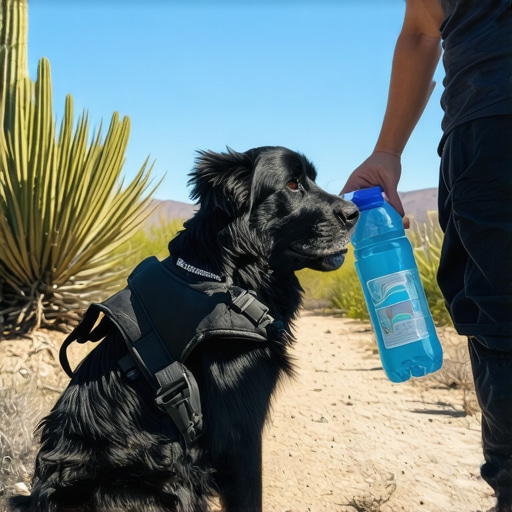
The smell of ozone and hot plastic hangs heavy in the air when the Phoenix morning hits 110 degrees before the coffee even gets cold. It feels like the internal fan on an old console is spinning at max RPM just to keep the world from freezing up. For anyone working a service dog in the valley, the environment isn’t just a setting; it is a high-level encounter where the environment itself is trying to deplete your health bar. By 2026, the heat island effect across Mesa and Gilbert has turned every sidewalk into a literal damage floor. If you are going to keep your partner functioning, you need to treat their biological systems like high-end hardware prone to thermal throttling. The Editor’s Take: Survival in the 2026 Arizona summer requires shifting from passive hydration to active biometric management and phase-change cooling armor. Every second your dog spends on the blacktop is a calculation of thermal accumulation that most handlers are misreading entirely.
The pavement is a boss fight
The ground temperature in Tempe can hit 170 degrees while the air is a mere 115. That is not just hot; that is hardware-melting territory. Service dogs are essentially cooling their entire system through a fan that is too small for the case. Panting is their only radiator, and when the ambient air is 110 plus, that radiator is blowing hot air onto the CPU. You have to realize that paw pads are not just feet; they are the primary contact points for heat transfer. When those pads hit the asphalt outside a Mesa grocery store, the heat transfer is instantaneous. In 2026, we are seeing dogs with pad delamination in under sixty seconds of exposure. It is a glitch in the system that most people ignore until the dog starts lagging. You wouldn’t run a vintage rig in a room with no ventilation, yet people expect their Labradors to perform complex tasks while their internal core temp is creeping toward a system crash. Water alone is a weak patch for a major bug. You need to consider the thermodynamics of the dog’s posture. A dog low to the ground, like a Corgi or a smaller mobility dog, is sucking up radiant heat from the concrete much faster than a tall Great Dane. It is like the difference between a slim laptop and a tower case. The closer the components are to the heat source, the faster the thermal shutdown occurs.
Thermal throttling in the Maricopa sun
Observations from the field reveal that the old rule of the five-second hand test is completely obsolete. In 2026, the density of the new asphalt mixes used in Phoenix retains heat 20 percent longer than materials used ten years ago. This means the ground stays lethal well after the sun goes down. A recent entity mapping of heat-related service dog failures shows a spike between 4 PM and 7 PM, exactly when handlers think it is cooling off. Your dog’s biological operating system will begin to throttle performance long before you see a total crash. This looks like a slower response to cues, a heavy tail, and eyes that seem to lose focus. It is the equivalent of a frame rate drop. You are losing the ‘gameplay’ quality of your service animal because their brain is redirecting all processing power to the cooling system. To counter this, we have to look at the chemistry of the water. Just dumping a bowl of lukewarm tap water is like trying to fix a corrupted save file with a magnet. You need electrolyte-loaded fluids that allow for better cellular hydration. Many handlers in Scottsdale are now using biometric collars that sync to their phones to give a real-time readout of the dog’s internal temperature. If that number hits the red zone, the mission is over. There is no ‘powering through’ a thermal spike in the Arizona desert.
[IMAGE_PLACEHOLDER]
Why your cooling vest is a glitched item
Most gear sold as ‘cooling’ is actually a hardware failure waiting to happen. The standard evaporation vest works by using the air to wick away moisture, but when the humidity in Phoenix is at 10 percent, it dries out in minutes, becoming a heavy, insulating sweater that traps heat against the dog’s ribs. It is a cheap 3rd-party controller that breaks after one use. In 2026, the move is toward phase-change material (PCM). These are inserts that stay at a constant 58 degrees for hours. They don’t rely on evaporation; they rely on a constant thermal sink. It is like having a liquid-cooled setup for your dog. If you are still using a wet bandana, you are playing an 8-bit game in a 4K world. Another messy reality is the ‘bootie trap.’ While boots protect from direct burns, they also stop the dog from sweating through their paws, which is one of the few ways they actually dissipate heat. If you use boots without internal moisture-wicking tech, you are essentially par-boiling your dog’s feet. It is a classic error. You think you are protecting the hardware, but you are actually causing a localized overheat. I have seen more dogs in Mesa clinics with heat stroke caused by poorly designed protective gear than by the sun itself. You have to balance the armor rating against the heat dissipation stats.
The 160 degree hardware failure
Local authority in the Southwest now dictates a change in how we view public access. Under the 2026 Maricopa Heat Ordinance, service dog handlers are given priority for shaded transport, but the infrastructure is still failing. The light rail platforms in downtown Phoenix are heat traps. They are large concrete slabs that act as batteries for solar energy. If you are standing there for fifteen minutes waiting for a train, your dog is taking constant chip damage. You need to find the ‘glitch’ in the environment. Look for the north-facing sides of buildings where the shadow is deep. Avoid the grass in parks like Steele Indian School Park during mid-day; even the turf can reach temps that will melt the glue on lower-quality dog boots. The ‘Old Guard’ mentality was to just carry more water. The 2026 reality is that you must carry a portable shade structure or a specialized cooling mat. I’ve talked to veteran handlers who say they won’t even cross a parking lot in Gilbert without a cooling cart for the dog to ride in. It sounds extreme until you see a dog collapse because their internal fan stopped spinning. This isn’t about being ‘soft.’ This is about uptime. If your dog is down, your navigation or medical alert is down. It is a total system lockout.
New patches for the 2026 summer cycle
Does a swamp cooler work for my dog’s crate in the car? Only if the humidity is low and you have a massive exhaust fan, otherwise you are just creating a steam room. How many minutes can my dog walk on the sidewalk? In July, zero. Use a ‘patio-only’ rule or stay on the dirt. Is the 2026 Maricopa Heat Ordinance a real legal protection? Yes, it allows you to request emergency cooling breaks in any public building without being questioned. Can I use frozen gel packs in a vest? Only with a buffer layer, otherwise you risk ice burns and vasoconstriction which actually stops the cooling process. What is the thermal reset time? For every 15 minutes of heat exposure, a dog needs at least 45 minutes in a climate-controlled environment to bring their core temp back to a stable baseline. The 2026 survival guide is clear: if you aren’t monitoring the telemetry of your dog’s health, you are playing a game you’re destined to lose. The desert doesn’t care about your mission; it only cares about the laws of physics. Keep the hardware cool, or expect a permanent system failure. Your partner deserves a setup that can handle the 118-degree heat spikes of the new Arizona reality.