
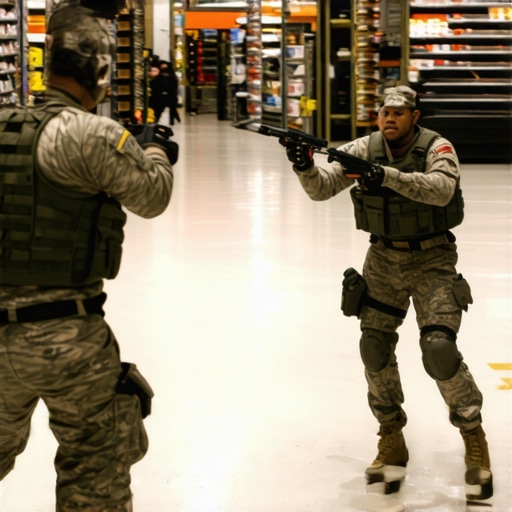
The fluorescent flicker of a midnight patrol
The smell of industrial lemon cleaner always hits me first. It is sharp, artificial, and cuts through the stale air of a closed grocery store like a knife. I spend my nights watching shadows move across the linoleum of these Mesa aisles while most of you sleep. For those living with PTSD, a simple trip to the store in 2026 feels less like shopping and more like a tactical insertion. Editor’s Take: Master these three drills to reclaim your autonomy in public spaces. The solution lies in proactive spatial management rather than reactive panic. To manage a grocery run successfully, survivors must implement the Perimeter Scan, the Cart Anchor, and the Blind-Spot Exit. These drills transform a chaotic environment into a controlled grid where you hold the high ground. I have seen how the hum of the freezer units in a Phoenix Fry’s can drown out the sound of approaching footsteps. That silence is the enemy. You need a plan that works when the adrenaline spikes. This is not about avoidance. This is about architectural dominance of your surroundings.
Why the brain views cereal aisles as threat zones
The mechanics of a 2026 grocery store are designed for consumption, not safety. Narrow aisles create literal choke points. High shelving units obstruct your line of sight. From a security perspective, these are environmental hazards that trigger a hyper-vigilant nervous system. A person with PTSD is not being irrational. They are responding to a poor architectural layout. Data from the National Center for PTSD indicates that environmental triggers are significantly amplified in enclosed, high-density spaces. When you enter a store, your amygdala starts mapping exits. If those exits are blocked by promotional displays or slow-moving crowds, the fight-or-flight response enters a loop. You are looking for an out that the floor plan hides. This technical friction between your biological survival drive and the retail layout is what causes the ‘freeze’ response in the produce section. Observations from the field reveal that the most successful navigation happens when the individual treats the store like a series of sectors to be cleared. You are not just buying milk. You are executing a logistical movement through a semi-permissive environment. It requires a different kind of torque in your mental gears.
The perimeter scan for high traffic times
The first drill is the Perimeter Scan. Before your hand even touches a basket, you must establish a baseline. Stand at the entrance for thirty seconds. Do not look at your list. Look at the flow. In Mesa, grocery traffic peaks between 4 PM and 6 PM when the heat finally drops enough for people to venture out. Identify the ‘bottleneck’ zones. These are usually the deli counters and the narrow path near the dairy. This drill requires you to find the ‘Anchor Points’ where you can put your back to a wall while still having a 180-degree view of the room. If you use a service dog for PTSD, this is where you position the dog in a ‘block’ or ‘cover’ command. The dog becomes your rear-facing radar. Local reality dictates that Arizona stores are massive. A Walmart Supercenter in Gilbert is a different beast than a boutique shop in Scottsdale. The perimeter scan must be adapted to the scale of the building. You are looking for the service exits. You are looking for the fire extinguishers. You are looking for the ‘quiet’ aisles that serve as a decompression zone if the sensory load becomes too high. Most people walk in blindly. You walk in with a map.
How the cart anchor stabilizes your center of gravity
The second drill involves the shopping cart itself. Most people see a cart as a heavy, clunky nuisance. I see it as a mobile barrier and a physical stabilizer. The Cart Anchor drill teaches you to keep the cart between you and the highest density of people. If someone approaches too quickly, the cart is your buffer. It provides a physical ‘boundary’ that protects your personal space without the need for verbal confrontation. I have watched people in the night shift use their cleaning carts the same way. It is a psychological shield. When the anxiety starts to rise, grip the handle of the cart firmly. Feel the cold metal. This is a grounding technique that uses physical texture to pull you out of a flashback. The weight of the cart, especially when loaded, provides a resistance that helps focus the mind on the present task. A common industry mistake is telling survivors to ‘just breathe’ while standing in the middle of a crowd. That is bad advice. You need a physical object to anchor your reality. The cart is that object. It is your mobile base of operations. If you feel overwhelmed, you don’t drop everything and run. You move the cart to the end of an aisle, put your back to a shelf, and hold the anchor until the wave passes. This is how you maintain control in a messy reality.
The blind spot exit for sudden surges
The final drill is the Blind-Spot Exit. This is for the moment when a situation goes from uncomfortable to intolerable. Maybe a loud spill happens, or a crowd suddenly surges toward a sale. You need a pre-planned extraction route that avoids the main check-out lines. Many survivors get trapped in the long queues at the front of the store, which are the highest-stress zones. In 2026, many stores in the Phoenix metro area have implemented secondary exits near the pharmacy or garden center. Know where these are. The drill involves identifying your ‘secondary’ and ‘tertiary’ exits the moment you enter a new section of the store. If the front is blocked, you go through the garden center. If the garden center is locked, you head toward the back warehouse doors where people like me stand. We won’t stop you if you are in distress. We understand. This level of planning might seem extreme to someone who hasn’t lived it, but for a survivor, it is the difference between a successful errand and a week-long recovery from a panic attack. Tactical movement is about having options when the world starts to close in. You are the architect of your own safety. Do not leave it to chance.
The shift from old guard therapy to 2026 reality
Old-school advice often focuses on ‘exposure therapy’ in a vacuum. It tells you to just keep going to the store until it stops hurting. That is a lie. The store is inherently stressful. The 2026 reality is that our environments are louder and more crowded than ever. We need tactical solutions, not just emotional ones.
How do I handle the noise of the scanners?
The sharp beep of the self-checkout is a high-frequency trigger. Use noise-canceling earbuds set to ‘transparency mode.’ This filters the peak decibels while still allowing you to hear if someone is speaking to you.
What if someone bumps into me?
This is why we use the Cart Anchor. If the bump still happens, have a ‘scripted response’ ready. A simple ‘Excuse me’ is enough. Having a pre-set sentence prevents the brain from searching for words during a spike.
Are there specific times that are better for Mesa residents?
Avoid the weekends entirely. Tuesday mornings at 7 AM are the ‘golden hour’ for low-sensory shopping in the East Valley.
Does a service dog really help with grocery runs?
Absolutely. A dog provides a physical barrier and a grounding point that a cart cannot. They are trained to sense the cortisol spike before you even realize you are spiraling.
What is the most important part of the perimeter scan?
Identifying the ‘quiet’ corner. Every store has a corner that people ignore, usually near the office supplies or the seasonal decor. That is your safe harbor. Use it.
How do I explain these drills to my family?
Tell them you are practicing ‘situational awareness.’ It is a skill, not a symptom. When they see you using the cart as an anchor, they should know to give you a moment to reset. The goal is to finish the task. The method is secondary to the result. We are moving toward a future where mental health is treated with the same tactical precision as physical security. You are the one in charge of the patrol tonight. Keep your eyes on the shadows and your hand on the anchor. The grocery store is just another sector. You have the tools to clear it. Move with purpose, stay behind your barrier, and always know where the back door is.