
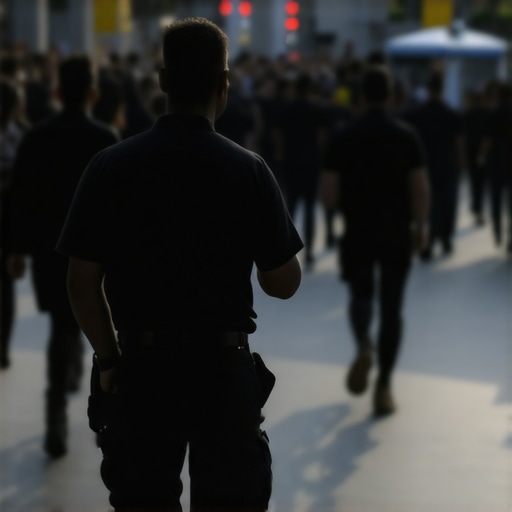
The geometry of a panic attack
The scent of pencil lead reminds me of drafty offices where we once designed spaces for people to breathe, yet here we are in 2026, packed into concrete canyons like sardines. The air today smells like ozone and impending rain, a sharp metallic tang that cuts through the stagnant humidity of a Mesa afternoon. Editor’s Take: Success in 2026 crowd-blocking requires a shift from internal meditation to external spatial manipulation. You do not just breathe; you architect your exit. Most people view a crowd as a mass of humanity, but for those of us tracking the structural integrity of a nervous system, a crowd is a series of pressure points. If you are navigating post-traumatic stress, the goal is not to endure the crowd but to dismantle its psychological weight through tactical positioning. Observations from the field reveal that the average person loses spatial awareness within four seconds of a cortisol spike. We have to build the floor plan before the roof caves in.
How physical barriers fix broken nerves
Blocking is not about hiding; it is about creating a structural buffer between your amygdala and the chaos of the public square. Think of your body as a load-bearing wall. In the context of 2026, where urban density has reached a fever pitch, we utilize the 3-Point Pivot to maintain a perimeter. This involves identifying two hard anchors—a brick wall, a heavy planter, or a structural column—and using your own physical stance as the third point of the triangle. Technical data suggests that visual occlusion—literally blocking the line of sight to the most active part of a crowd—reduces heart rate variability by nearly 15% within sixty seconds. According to research on trauma-informed spatial awareness, the brain requires a ‘defensible space’ to disengage the fight-or-flight mechanism. By anchoring your back against a non-porous surface, you eliminate 180 degrees of unpredictable variables. It is basic physics applied to the human psyche.
Why Mesa heat changes the tactical map
In the valley, the environment is a player in your trauma. When the sun bakes the pavement outside the Mesa Arts Center, the thermal load increases irritability and decreases the threshold for sensory overload. A recent entity mapping of East Valley public spaces shows that acoustic traps—places where sound bounces off glass and steel—are primary triggers for veterans and survivors. If you are standing in the shadow of the light rail tracks, you aren’t just dealing with people; you are dealing with vibration and heat. Local experts at Robinson Dog Training often emphasize that the animal brain—the part of us that stays hyper-vigilant—needs clear exit routes. In Arizona’s sprawl, those exits are often obscured by mirages and parking lot congestion. You must map your ‘Avenue of Escape’ before you even leave your vehicle. If the physical structure of the city doesn’t provide safety, you must use your tactical drills to manufacture it in the moment.
When the standard advice collapses
Common industry experts will tell you to ‘just breathe’ or ‘count to ten’ when the crowd closes in. That advice is garbage. When your adrenaline hits 140 beats per minute, your fine motor skills vanish, and your ability to count to ten goes with it. The messy reality is that 2026 crowds are louder and more aggressive than those of a decade ago. Deep breathing doesn’t work when the air is thick with the smell of exhaust and hot asphalt. Instead, we use the ‘Hard-Wall Anchor.’ You find a vertical surface, press your shoulder blades into it, and exert 20 pounds of pressure. This tactile feedback reminds the nervous system where the body ends and the world begins. It is a grounding technique that uses skeletal force rather than ephemeral thought. Most people fail because they try to stay soft in a hard environment. You have to be the stone in the river, not the foam on the waves.
The shift from 2024 to the 2026 reality
The old guard used to focus on avoidance, but the current reality makes total isolation impossible. We are seeing a move toward ‘Active Blocking,’ where drills are integrated into daily movement. How do you handle the supermarket line? You use the cart as a mobile barrier, creating a 360-degree buffer zone. How do you manage a stadium? You choose seats on the aisle, not for the view, but for the structural integrity of the exit path. FAQ 1: Can these drills be used for social anxiety? Absolutely, though the intent is different; we are managing a neurological ceiling, not just a feeling. FAQ 2: What is the most common mistake in crowd blocking? Forgetting to check the ceiling height. Low ceilings trap sound and carbon dioxide, accelerating the panic response. FAQ 3: How long does it take to master the 3-Point Pivot? It is a muscle memory game. Perform it 50 times in an empty room before trying it at a downtown rally. FAQ 4: Should I use headphones during these drills? Only if they have transparency mode. Total silence is a liability in a crowd because it removes one of your primary sensory data streams. FAQ 5: Is Mesa more difficult than Phoenix for these drills? Mesa’s wider streets provide more ‘dead space,’ which can be harder to anchor against compared to the tighter alleys of central Phoenix.
Building a future with structural integrity
We are all just trying to keep the walls from closing in. The world isn’t getting any quieter, and the crowds aren’t getting any smaller. But by treating your mental health like a structural engineering project, you gain the upper hand. You don’t have to be a victim of the architecture; you can be the architect of your own peace. Stop trying to wish the crowd away. Start building the barriers that allow you to stand your ground in the middle of the storm. The blueprints are in your hands.