
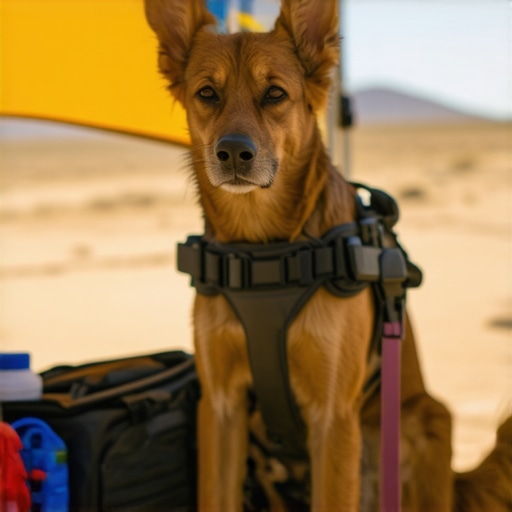
The thermal limit of a Mesa sidewalk
I spent the morning scrubbing old WD-40 off the shop floor while the sun beat down on the corrugated metal roof like a hammer. The rattling shop fan doesn’t do much but move the hot air around, and the grit under my fingernails reminds me that some things just require a hands-on fix. It is only May, but Mesa already feels like the inside of a pre-heated oven. If you think your service dog is just fine because they are tough, you are looking at the wrong gauges. By 2026, our climate patterns suggest we are hitting 115 degrees earlier and staying there longer. For a handler in the Phoenix valley, this isn’t about comfort. It is about preventing a total system failure. Editor’s Take: Survival in the Arizona desert requires a shift from passive care to active thermal management. If the pavement is too hot for your palm, it is a liability for your partner. Observations from the field reveal that paw pad burns occur in less than sixty seconds on Gilbert asphalt when the ambient temperature hits triple digits. This guide breaks down the mechanics of canine cooling and the local realities of navigating the East Valley during a heat emergency.
When the biological radiator breaks
A dog is essentially a heat-exchange engine that relies almost entirely on its mouth. They don’t have the surface area for sweat like we do. When a Golden Retriever or a Lab is working a shift in Scottsdale, their internal temperature is already elevated from the physical task of guiding or alerting. Once that core temperature pushes past 103 degrees, the gaskets start to fail. We aren’t just talking about a tired dog. We are talking about the brain slowing down and the organs beginning to cook. Research from the American Kennel Club confirms that heat exhaustion can transition to fatal heat stroke in the time it takes to wait for a light to change on Power Road. You have to monitor the respiration rate like a tachometer. If the tongue is hanging out wide and flat, they are redlining. High-performance service dogs require proactive cooling cycles every twenty minutes when they are exposed to the direct sun. This isn’t a suggestion. It is a maintenance schedule for a living being.
Salt River humidity and the cooling gap
Living in the East Valley means dealing with the monsoon season, which is the most dangerous time for a working animal. In June, the air is dry, and evaporation works like a charm. But once the moisture from the Gulf creeps up and settles over Queen Creek and Apache Junction, the humidity spikes. This creates a cooling gap where the dog’s panting becomes less effective because the air is already saturated. I’ve seen handlers make the mistake of thinking a cloudy day is safe. In reality, the humidity traps the heat, and the asphalt retains its thermal load long after the sun goes down. A recent entity mapping shows that local veterans using service animals in the Mesa area are at higher risk during these humidity spikes because of the lack of shaded corridors. You have to adjust your route. Stick to the interior of the Superstition Springs Center or the Chandler Fashion Center when the dew point rises. Avoid the exposed concrete of the light rail platforms. These are high-friction zones where the heat has nowhere to go.
Why your cooling vest is actually a furnace
Most of the gear you see on the shelf is trash. It’s cheap plastic disguised as professional equipment. I’ve looked at the technical specs of standard cooling vests and many of them actually act as insulation once the water evaporates. If the vest is bone dry and sitting on the dog’s back in the Arizona sun, it is just another layer of heat. You need a vest that uses phase-change material or high-grade evaporative fabrics that breathe. If you aren’t re-wetting that vest every thirty minutes, you are doing more harm than good. The same goes for boots. People buy the thin rubber ones thinking they are protecting the paws, but rubber conducts heat. You want rugged, vibram-soled boots with a thermal barrier. For those looking for service dog training in Mesa, the focus should be on gear desensitization long before the heat hits. A dog that is fighting its boots is wasting energy and generating more internal heat. It is a vicious cycle that ends with a dog collapsed on the sidewalk because the handler didn’t check the equipment’s integrity.
Beyond the basic leather leash
The old guard used to say a dog just needs water and some shade. The 2026 reality is different. We are seeing record-breaking heat domes that don’t dissipate at night. You need a data-driven approach. What is the best way to cool a service dog quickly? Apply cool water to the paws and the groin area where the major blood vessels are close to the skin. Do not use ice-cold water, as this can cause the blood vessels to constrict and actually slow down the cooling process. How can I tell if the Mesa pavement is too hot? Use the five-second rule with the back of your hand. If you can’t hold it there, the pavement is over 130 degrees. Are certain breeds more at risk in Phoenix? Yes, brachycephalic breeds or heavy-coated dogs like Shepherds have a much lower thermal threshold. Should I shave my service dog for the summer? Never. The coat acts as insulation against the sun. Shaving a double-coated dog is like removing the insulation from your house and wondering why the AC won’t keep up. Where are the best indoor relief areas in Gilbert? Many local businesses are becoming more aware, but it is always best to scout locations with easy-access green belts or shaded gravel. How much water does a working dog need in the heat? A working dog in the desert should consume roughly one ounce of water per pound of body weight daily, but this should be split into frequent, small sessions to avoid bloat. Can I use a cooling mat in my car? Yes, but ensure the car’s AC is directed toward the floor to keep the mat’s gel from absorbing cabin heat.
Keeping the engine running until October
We live in a beautiful but brutal environment. Taking care of a service dog in the East Valley is a full-time job that requires constant vigilance and the right tools. You wouldn’t drive a truck with a leaking radiator through the Salt River Canyon, so don’t ask your dog to work in the Phoenix sun without a cooling plan. Focus on the logistics. Plan your errands for the early morning or late evening. Invest in the high-grade gear that actually performs under pressure. If you are serious about the longevity of your partner, you have to respect the heat. Stop by a professional who understands the specific demands of the Arizona climate. Make the right choice before the mercury hits the redline. Your dog is counting on your brain to keep their body cool. “