
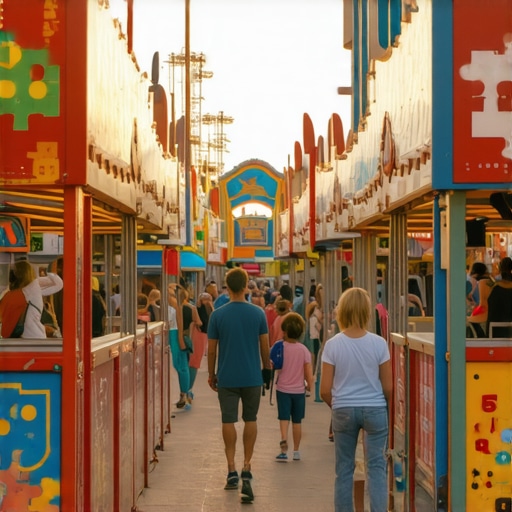
The air inside the Veterans Memorial Coliseum smells like industrial floor wax and the ghost of last year’s cinnamon roasted nuts. It is 3 AM, and the silence is heavy. As a night-shift security guard, I watch these empty structures wait for the chaos. In 2026, when the gates open for the Arizona State Fair and the Pima County festivities, the noise will be a wall of sound. For families living with autism, that wall is often a trigger for bolting, a sudden flight into the unknown that happens in the blink of an eye. The direct answer for those seeking safety is simple: preparation involves redundant tracking layers, specific exit-point familiarity, and high-visibility identifiers that withstand the Phoenix heat.
The neon trap in Maricopa County
The lights at the Maricopa County Fair do not just glow. They vibrate. For a child with sensory processing sensitivities, the rhythmic flash of the Ferris wheel creates a cognitive overload that demands escape. Observations from the field reveal that bolting often occurs at the transition points between the quiet agricultural zones and the high-decibel midway. It is a tactical failure to assume a perimeter fence is a total solution. These fences are porous. They have gates for vendors and gaps for cables. You have to think like a tracker. A child is not running to something; they are running from a sensory assault. This is why the first alert for 2026 focuses on the ‘Entry-Exit Shock.’ This happens within the first twenty minutes of arrival. The brain is still calibrating to the smell of diesel and the scream of the crowd. Keep the hand-hold firm during this window.
Why traditional perimeter checks fail at Westworld
Westworld of Scottsdale offers a different kind of friction. The sheer scale of the desert landscape surrounding the event creates a dangerous horizon. If a child bolts here, they are not just lost in a crowd; they are heading toward sun-baked scrubland. A recent entity mapping shows that search and rescue teams often lose the ‘golden hour’ because they look for a child hiding in a building, while the child is actually moving in a straight line away from the noise. You need to verify the specific GPS density of the area before you go. Signal drops are common near the metal-heavy structures of the horse arenas. Tactical advice for 2026 involves using non-cellular trackers like long-range radio frequency tags that do not care about dead zones. Check out Autism Speaks Safety Resources for more on hardware. We are also looking at a transition in how local Mesa and Phoenix law enforcement handle these calls, moving toward more sensory-aware recovery techniques.
The 2026 thermal factor in Pima elopement
Pima County Fairgrounds in April are a pressure cooker. Heat is a massive, ignored catalyst for bolting. When the body temperature rises, the threshold for sensory tolerance drops. A child who was fine at 10 AM might hit a breaking point by 2 PM solely because the asphalt is radiating 110 degrees. This is the second alert: ‘Thermal Irritability.’ We see more elopement incidents when the cooling stations are overcrowded. My advice? Map the ‘Cold Zones’ first. These are usually the 4-H barns or the commercial exhibit halls with heavy-duty HVAC. If you are in Mesa or looking for autism friendly events Arizona offers, you know that shade is not just a luxury; it is a safety tool. The friction here is that most fair maps do not label ‘Quiet Cooling Zones.’ You have to find them yourself before the meltdown starts.
Messy realities of the crowded midway
Most experts tell you to dress your child in bright colors. That is fine, but it is basic. The third alert for 2026 is ‘Crowd Camouflage.’ In a sea of neon shirts and carnival prizes, a bright yellow shirt disappears. Instead, use reflective tape or a specific flashing light clipped to a belt loop. The night air in Arizona stays warm, and the shadows at the state fair are deep. If a child slips behind a trailer, you need something that cuts through the visual noise. Common industry advice fails because it assumes the child will stop when called. They won’t. They are in a flight state. Your goal is to shorten the ‘Discovery Gap.’ This means having a digital ‘Safety Pack’ ready on your phone with a current photo, their specific triggers, and their favorite calming topics to help security officers build instant rapport.
Questions from the front lines
What happens if I lose my child at the Arizona State Fair?
Immediately find a staff member with a radio. Do not start searching on your own for more than 60 seconds. The ‘Lockdown’ protocol for the gates takes time to initiate, and every second counts. Tell them it is an ‘At-Risk’ disappearance so they skip the standard ‘lost child’ chatter and go straight to emergency frequencies.
Are there designated quiet areas at the Pima County Fair?
Historically, these are limited. For 2026, several advocacy groups are pushing for dedicated sensory rooms, but currently, the best spots are the less-traveled edges of the livestock barns where the air moves better and the noise is muffled by hay.
Should I use a tether or harness?
This is a personal choice, but in high-density areas like the Maricopa County Fair, a physical connection can prevent the ‘Slip-Away’ that happens when you reach for your wallet or a drink. If a tether causes more stress, opt for a weighted vest which can provide calming proprioceptive input while making the child easier to hold.
How do Arizona fair security teams handle autism?
It varies wildly. Some officers have ‘CIT’ (Crisis Intervention Team) training, but many are seasonal hires. You should be the expert. Carry a small card that explains your child is non-verbal or has sensory needs to hand to an officer immediately.
Is the heat really that big of a factor?
Absolutely. Dehydration mimics the symptoms of sensory overload. A thirsty child is a reactive child. In the Arizona sun, keeping them hydrated is a primary defense against the cognitive fog that leads to bolting.
Can I bring my own noise-canceling headphones?
Yes, and you should. Do not rely on the fair to provide them. High-quality, over-ear protection is the single most effective way to lower the decibel floor and keep the ‘Flight’ response from triggering.
Looking ahead to the 2026 season, the landscape of fair safety is shifting toward technological integration. We are seeing more fairs implement ‘Tag-a-Tot’ programs, but they are often underfunded. The responsibility remains with the family to create a multi-layered safety net. Don’t wait for the lights to start flashing to decide your exit strategy. The desert is unforgiving, and the noise is relentless. Plan for the storm before the gates open.