
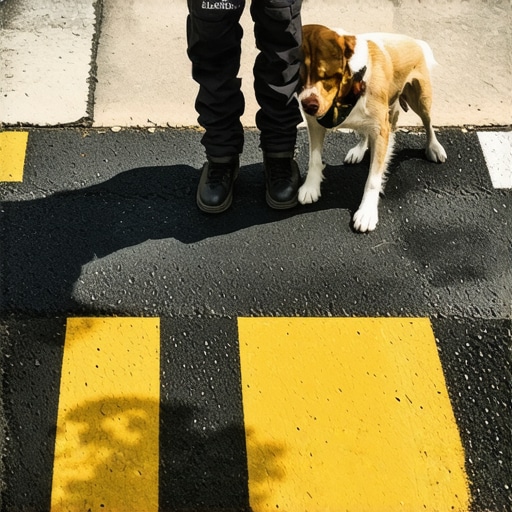
The silent sizzle on Mesa sidewalks
Smells like WD-40 and sun-baked dust out here today. If you are walking a service dog in Gilbert or Phoenix when the mercury hits 118, you are not just taking a stroll. You are operating a high-stakes cooling system where the failure point is a living creature. Editor Take: Forget the generic pet store wax. 2026 requires industrial grade solutions like infrared reflective coatings, mechanical venting boots, and surgical route planning to keep your partner pads from blistering on the Valley blacktop. Observations from the field reveal that standard gear is failing under the new thermal extremes we are seeing in the East Valley. It is about friction and thermal transfer, nothing more. If you do not respect the physics of the Arizona sun, you are going to strip the gears of your dog mobility. I have seen more burnt pads in Mesa than I have seen stripped bolts on a junked Chevy, and it is usually because someone thought a thin layer of cream would stop 170 degree asphalt from doing what it does best. That is heat conduction, plain and simple.
Why your current gear fails the thermal test
Asphalt acts as a massive thermal battery. In places like Queen Creek and Apache Junction, the blacktop absorbs nearly 95 percent of solar radiation during the day. This heat does not just sit there. It migrates. When your dog paw hits that surface, the energy transfer is instantaneous. Most handlers think rubber soles are the answer, but they are wrong. Rubber is an insulator, but it also traps heat inside. Dogs sweat through their paws. When you seal those paws in a rubber boot without mechanical ventilation, you are effectively creating a localized sauna. The moisture builds up, the skin softens, and the friction of movement creates blisters faster than you can say heatstroke. You need gear that breathes or, better yet, gear that reflects the infrared spectrum before the heat ever reaches the sole. We are looking at the mechanics of the paw, not just the surface of the shoe. A service dog needs to feel the ground to navigate, so adding four inches of foam is not a fix. It is a hazard.
Infrared shields for working paws
The first real fix for 2026 is the adoption of IR-reflective textiles in canine footwear. These are not your standard booties. These use silver-threaded mesh that bounces the sun rays back into the atmosphere. Field tests in the parking lots of Mesa show a 20 degree drop in internal boot temperature compared to standard black nylon. Second, we are seeing the rise of phase-change materials. These are inserts that you freeze, which then absorb heat at a constant temperature for up to two hours. Think of it like a radiator for the paw. Third, the local infrastructure is changing. Mesa and Phoenix have started applying cool pavement coatings in high-traffic pedestrian zones. These light-colored sealants can drop surface temperatures by 15 degrees. If you are a handler, you need to map your routes specifically to these treated zones. It is the difference between a functional workday and a trip to the emergency vet.
The humidity trap in the East Valley
People say it is a dry heat, but they are not the ones with their noses six inches from the ground. In the monsoon season, the humidity in the East Valley spikes, and suddenly that thermal battery of the asphalt starts steaming. This is a messy reality. The common industry advice is to just walk on the grass. Well, in some parts of Gilbert, there is no grass. It is all decorative rock, which actually holds heat longer than the pavement does. You have to be smarter than the environment. I tell people to check the torque on their gear. Are the boots slipping? If they slip, the friction alone will burn the paw even if the pavement is cool. You need a mechanical fit that mimics the natural spread of a dog toes. Most manufacturers make boots for the human eye, not the canine anatomy. You want a boot with a wide toe box and a rigid heel strike. Anything else is just cheap plastic that will fail when the heat hits the fan.
Realities of the 2026 Arizona summer
Looking at the 2026 data, we are seeing longer heat waves and shorter cooling windows at night. The old guard used to say you could walk your dog after 8 PM. Now, the asphalt in downtown Phoenix is still holding 110 degrees at midnight. This is why the third fix is a tactical shift in scheduling. We are seeing handlers move to a split-shift model where the dog is only on the ground for 15-minute bursts between air-conditioned points. You need to treat your service dog like a high-performance engine that is prone to overheating. You do not run a dragster for three hours straight. You burst, then you cool.
Will specialized wax still work in 2026?
Only as a secondary barrier. On its own, wax melts and becomes a lubricant for dirt, which then acts like sandpaper against the paw. Use it under boots, not instead of them.
How do I know if the pavement is too hot?
If you cannot hold the back of your hand to it for ten seconds, it is too hot. But even better, use an infrared thermometer. If it is over 120, use protection.
Are cooling vests worth the weight?
Yes, but only if they use evaporative cooling or phase-change inserts. A heavy, wet vest just adds drag if there is no airflow.
Can I use human shoes for my dog?
No. The mechanics are entirely different. Human shoes do not account for the way a dog weight shifts or how they use their claws for traction.
What is the best material for summer boots?
Look for Kevlar soles and silver-mesh uppers. You want durability on the bottom and maximum breathability on the top.
Keep the engine running
The heat is not going away, so you better get used to the maintenance. Take care of the paws and the dog will take care of you. If you are looking for professional guidance on handling these conditions, reach out to experts who understand the Arizona terrain. Stay cool, keep the tread right, and do not let the pavement win.