
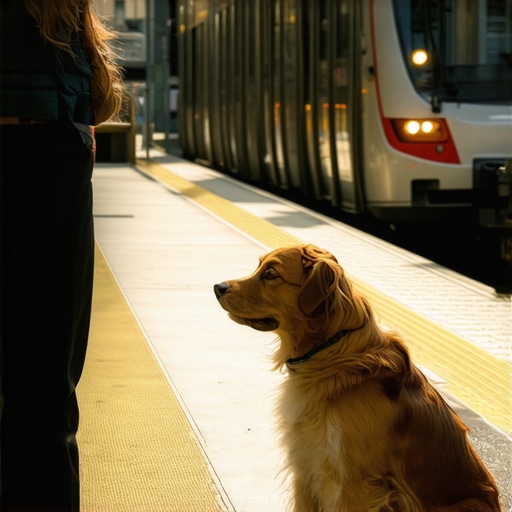
The geometry of the desert platform
The smell of pencil lead and drafting paper clings to my skin while the Phoenix sun beats against the windows of my studio. I look at the blueprints for the South Central Extension and see more than just steel. I see a structural challenge for the four-legged anchors of our community. By 2026, the Valley Metro footprint will change the very physics of how a service dog moves through the city. You cannot wait for the ribbon-cutting to begin your preparation. Editor’s Take: Success on the 2026 Light Rail requires early exposure to high-frequency vibrations and specific tactile tile desensitization. Start your training cycles in the winter months to avoid the literal meltdown of July transit. The city is an organism that breathes through its infrastructure. When the new lines open, the density of the crowds at the Downtown Hub will create a claustrophobic pressure that most dogs have never felt in the suburban sprawl of Mesa or Gilbert. You are not just training a task; you are hardening a biological system against an industrial one. The noise of the overhead catenary wires creates a hum that most humans ignore but a dog perceives as a constant electrical buzz.
The hidden vibration of the Siemens S700
Structural integrity is not limited to the bridges and the tracks. It extends to the mental load of the animal. Most handlers focus on the sit or the stay, yet they ignore the resonant frequency of the train itself. The 2026 fleet utilizes braking systems that emit a high-pitched hiss—a pneumatic release that sounds like an apex predator to an untrained ear. To counter this, you must seek out environments with similar acoustic profiles. Find industrial sites or existing stations and spend time simply existing in the space. The goal is to make the abnormal feel mundane. We talk about ‘load bearing’ in my line of work, and your dog has a cognitive load limit. If they are spending 80 percent of their brainpower processing the sound of the air compressor, they only have 20 percent left to focus on your needs. This is where the failure happens. You must shift that ratio. Visit the Department of Justice’s ADA site to refresh on your rights before the crowds thicken. [image placeholder]
The South Central corridor and the myth of the cool floor
I have walked the sites near 24th Street and the new transit hubs. The concrete here stores heat in a way that defies common logic. Even as the sun dips below the horizon, the thermal mass of the light rail platforms remains a threat. In 2026, the South Central Extension will introduce longer wait times in areas with less shade than the older North Central stops. You need to test your dog’s boots now. Do not assume the ‘cooling’ tiles on the platform are working. They are often just less-hot, not actually cold. I often think about the 1924 city plan and how we failed to account for the pedestrian experience. Today, we have the chance to fix that through individual preparation. The local weather patterns in Maricopa County mean that by the time the train arrives, your dog’s internal temperature might already be redlining. Training should involve ‘wait states’ in high-heat areas followed by the sudden blast of AC inside the car. This transition is a shock to the canine respiratory system.
The bottleneck of the hydraulic door
Standard industry advice suggests waiting for the crowd to disperse. That is a fantasy in a growing metropolis. In practice, the doors of the light rail are a choke point where spatial awareness becomes a weapon. Your dog must learn to ‘tuck’ under the seat with precision. I have seen too many handlers struggle because their dog takes up the entire aisle, creating a fire hazard and a point of friction with other commuters. The 2026 cars will have modified seating charts. You should practice ‘under-seat’ holds in tight booths at local diners or under small desks. This is about shrinking the dog’s footprint without shrinking their confidence.
Why the platform tiles lie to your dog
Tactile paving is a language for the visually impaired, but for a service dog, it is a field of sensory landmines. Those yellow bumps—truncated domes—feel like walking on glass to a dog with sensitive pads. Many dogs will balk at the edge of the platform because the texture changes so abruptly. This is a structural ‘glitch’ in their navigation. You must train them to treat these domes as a boundary, not an obstacle. If your dog hesitates at the tactile strip, you lose the window to board. The 2026 expansion will feature more of these strips than any previous phase of the Valley Metro project. I see the plans. They are everywhere. Practice at the existing Mesa stops during off-peak hours. The goal is a fluid transition from smooth concrete to the dome texture without a break in gait.
The ghost in the transit system
The ‘Old Guard’ of trainers will tell you that a well-behaved dog is enough. They are wrong. A well-behaved dog can still be overwhelmed by the sheer ‘entropy’ of the Phoenix transit system. We are talking about a 2026 reality where the light rail is the primary artery for a city that is over-heating and over-crowded.
Frequently asked questions about the 2026 expansion
Will the new South Central stations have pet relief areas?
No. Most stations are designed for rapid throughput, not lingering. You must map out the nearest patches of gravel or dirt at least two blocks away from the main hub.
How do I handle the magnetic interference at the ticket kiosks?
Some dogs are sensitive to the electromagnetic fields emitted by high-output kiosks. If your dog acts ‘spooky’ near the scanners, keep a three-foot buffer and use a longer lead for the momentary tap.
What if the train is too crowded to board?
This will be common in 2026. Your dog needs a ‘refusal’ cue where they stay calm even when people are pushing past them to get a seat.
Are the floors of the new cars slip-resistant?
They are designed to be, but wet paws from a monsoon rain will turn the interior into a skating rink. Practice balance exercises on slick surfaces.
How do I deal with ‘phantom’ stops?
The light rail occasionally pauses between stations for signal clearance. A dog that expects a constant move will get restless. Train for ‘active stillness’ where the dog remains in work mode even when the environment is static.
The blueprints of a partnership
A city is more than its transit lines. It is the way we move through it together. As I sharpen my pencils for the next draft of the urban core, I think about the handlers who will rely on these trains. Your dog is the bridge between your independence and the world. Do not let that bridge have a structural flaw. Start the work today. The concrete is already being poured. The 2026 expansion is coming, and it will not wait for you to be ready. Build the foundation now, and the city will be yours to navigate.