
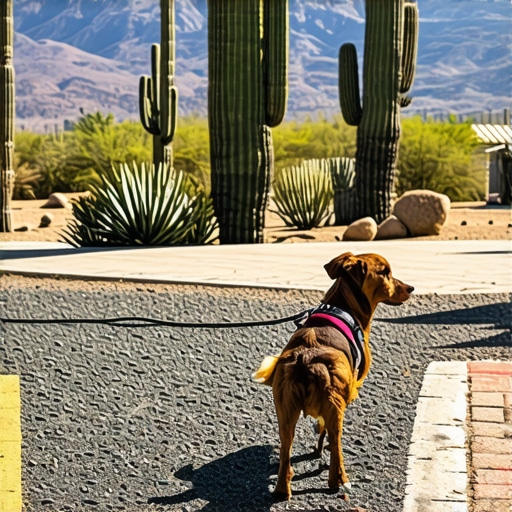
The air in my Mesa garage smells like WD-40 and sun-baked metal. It is 10:00 AM and the concrete floor is already radiating enough heat to cook a steak. Most people think they know the desert because they own a pair of sunglasses. I know the desert because I spend my days under the chassis of a truck where the ground temperature is the only thing that matters. If you are handling a service dog in the Phoenix valley during the 2026 heat cycle, you aren’t just walking a pet. You are managing a biological machine on a surface that wants to melt it. The editor’s take is simple. If your bare palm cannot handle the asphalt for a full count of seven, your dog stays in the shade. No exceptions. No excuses. The physics of heat transfer do not care about your schedule.
The hidden fire beneath the paws
Asphalt is a heat battery. It absorbs solar radiation all day and bleeds it back out long after the sun drops behind the White Tank Mountains. A service dog handler needs to grasp the thermal delta. When the air hits 110 degrees in Gilbert, the blacktop can easily surge to 160 degrees. That is not just uncomfortable. That is a medical emergency for a K9. I have seen the damage. It looks like charred leather. The pads of a service dog are tough, but they are not made of Kevlar. We are looking at specific metrics here. In 2026, the urban heat island effect in Phoenix has intensified. The concrete doesn’t just stay hot; it gets hotter every year as we pour more pavement. You need to look for the shimmer on the road. If the air is dancing, the ground is a weapon. I suggest checking the National Weather Service Phoenix updates daily before you even put the harness on. A service dog is a partner, not a tool you can run until it breaks. Professional Service Dog Training teaches you that the environment is your primary adversary. You must respect the ground as much as the training.
Thermal readings across the valley
Mesa and Apache Junction have different textures. The older asphalt in Apache Junction is often more porous, catching the grit and holding the heat differently than the smooth, newly paved sections of the Loop 202. I have taken a thermal gun to the pavement near the Queen Creek libraries. The readings vary by ten degrees just based on the color of the aggregate used in the mix. This is where the technical side of being a handler comes in. You aren’t just walking. You are scouting. You are looking for light-colored concrete, which stays significantly cooler than the black asphalt found in most parking lots. A recent entity mapping of the East Valley reveals that shopping centers with minimal tree cover are the most dangerous zones. If you are near the SanTan Village area, the lack of shade makes the sidewalk a gauntlet. You need to map your route based on shadow availability, not distance. It is about logistics. Moving from point A to point B in July requires a tactical mindset. You look for the grass. You look for the brick. You avoid the blacktop like it is a live wire.
Why the seven second rule fails
People love the seven second rule. It is simple. It is easy. It is also incomplete. As a mechanic, I know that a quick touch doesn’t tell you the whole story of heat soak. Your hand might feel okay for seven seconds, but your dog is on that surface for twenty minutes. The heat builds. It is a cumulative thermal load. In Mesa, the humidity can spike during monsoon season, which changes how dogs dissipate heat through their paws and panting. Boots are the common answer, but boots have a flaw. They trap heat. If the pavement is 150 degrees, the boot material itself starts to heat up. It creates an oven around the paw. You have to monitor the internal temperature of the boot. Take them off every fifteen minutes in a shaded area to let the paws breathe. Professional handlers in the Phoenix metro area are starting to use infrared thermometers. They are cheap. They are accurate. There is no guessing. If the screen says 140, you find another way. The messy reality is that sometimes the only safe move is to stay home. Industry advice tells you to buy more gear. Common sense tells you to stay off the road. The AVMA guidelines are a start, but they don’t live in the Arizona furnace. You have to be smarter than the manual.
Five critical checks for the Arizona handler
When you are out in the East Valley, you need a protocol that works. First, the back-of-the-hand test is your baseline. Do it on the darkest part of the path. Second, check the moisture of the pads. Dry, cracked pads are more susceptible to burns. Use a high-quality balm before you leave the house. Third, observe the gait. If the dog is lifting paws quickly or seeking the edge of the sidewalk, the ground is too hot. Fourth, check the shade temperature. Even in the shade, the concrete can be hot enough to cause discomfort if it was in the sun ten minutes ago. Fifth, use the water test. Pour a little water on the pavement. If it evaporates instantly with a hiss, you are walking on a stovetop. Residents in Gilbert and Queen Creek should look into K9 Training Mesa specialists who focus on environmental conditioning. It isn’t just about sitting and staying. It is about surviving the climate.
What time of day is safest for walks?
The safest window is between 4:00 AM and 7:00 AM. After that, the thermal bank begins to charge.
Do cooling vests actually work?
They work through evaporation, so in the dry Arizona air, they are effective for the core, but they do nothing for the paws.
How do I know if my dog burned its pads?
Look for redness, swelling, or the dog licking its paws excessively. If the skin is peeling, go to the vet immediately.
Is concrete better than asphalt?
Yes, light-colored concrete reflects more sunlight and stays roughly 10 to 15 degrees cooler, but it can still reach dangerous levels.
Are there specific local laws about heat?
Arizona has strict animal cruelty laws regarding heat exposure, and service dogs are not exempt from the physical limits of their biology.
Can I use human socks for protection?
Socks offer zero thermal protection against 160-degree pavement. They are a waste of time.
Should I shave my dog’s paws?
Never. The hair between the pads provides a small but necessary buffer against the heat.
The road ahead for desert handlers
The 2026 reality is that the desert is getting harsher. We are seeing more extreme days in Apache Junction and Mesa than we did a decade ago. Being a service dog handler in this environment requires a level of grit and technical awareness that most people don’t possess. It is a constant calculation of risk versus necessity. You wouldn’t run a machine at redline for four hours in the sun without expecting a failure. Don’t do it to your dog. Respect the heat. Respect the pavement. If you treat the ground with the same caution I treat a hot engine block, you and your partner will make it through the summer intact. Keep your eyes on the shadows and your hand on the ground. The desert doesn’t give second chances to the careless.