
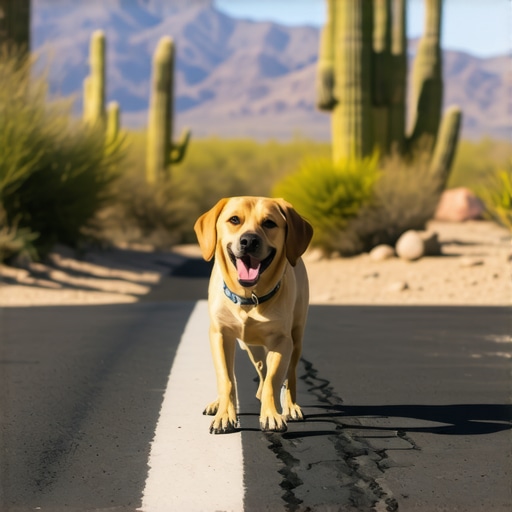
The smell of scorched rubber and desert dust
I spent twenty years under the hoods of rusted-out trucks, smelling like WD-40 and burnt oil, and if there is one thing I know, it is when a machine is about to overheat. In 2026, the Arizona sun does not just shine; it hammers. For a service dog handler in Mesa or Phoenix, the pavement is not just a walkway. It is a heating element. If you do not test the ground, you are essentially asking your dog to walk on a stovetop. Editor’s Take: Thermal safety is not a suggestion but a mechanical requirement for K9 mobility. The most reliable test remains the back-of-hand pressure check combined with infrared telemetry.
You can tell the temperature by the way the air shimmers off the blacktop near the Loop 202. It has that thick, heavy scent of baking tar. Most folks think a quick tap with a finger tells the story. It does not. You need a systematic diagnostic. If the ground feels like a hot manifold, your dog is going to blow a literal gasket in their paw pads. We are looking for structural integrity here, not just ‘it feels a bit warm.’ A dog’s pads are their tires, and you do not drive on melting rubber. [IMAGE_PLACEHOLDER]
The thermodynamics of a four-legged chassis
Heat transfer in the Sonoran Desert follows a brutal logic. Asphalt acts as a massive thermal battery, soaking up radiation until it hits 160 degrees Fahrenheit even when the air is only 105. Observations from the field reveal that dark aggregates in Mesa parking lots retain heat 30% longer than concrete. Your dog’s paws are not equipped for that kind of friction. The first test is the Seven-Second Reverse Pressure Test. You press the back of your hand—not the palm—against the surface. The skin there is thinner, closer to the sensitivity of a canine pad. If you cannot hold it for a slow count of seven without wanting to pull away, the mission is a no-go.
Then you have the Digital Thermal Mapping. In 2026, we do not guess. A handheld infrared thermometer is a tool every handler needs in their kit. According to technical standards from the American Kennel Club, pavement temperatures above 145 degrees cause instant cellular damage. You aim the laser at three spots: the shade, the direct sun, and the transition zone. If the delta between the shade and the sun is more than forty degrees, the heat is climbing too fast for safe transit. I have seen guys try to ‘tough it out’ only to end up with a dog in the emergency vet in Gilbert. It is a bad look and a worse feeling.
The blacktop trap in Maricopa County
Living here means knowing the difference between the concrete in Scottsdale and the asphalt in downtown Phoenix. Concrete reflects more light; asphalt absorbs it. The Water Evaporation Rate Test is a quick way to check humidity-heat interaction. You splash a small amount of water on the ground. If it sizzles or vanishes in under ten seconds, the surface tension is too high. This is what we call a ‘dry fry’ scenario. The air is so hungry for moisture it pulls it right out of your dog’s paws, leading to cracking and infection. You can find more about specialized service dog training in Mesa to help your K9 manage these environmental stressors.
Specific districts like the Heritage District in Gilbert have brick pavers that act differently than poured cement. Bricks hold heat in the mortar joints. You might think you are safe because the brick looks light-colored, but those joints will cook a dog’s webbing. I always tell people to look for the ‘glitch’—the spot where the heat makes the horizon look like it is underwater. If you see that shimmer on the sidewalk, your dog stays in the truck or wears boots. No exceptions. No excuses. I have seen the damage. It looks like raw meat, and it takes weeks to heal.
Why your thermal sensors are probably lying
Common industry advice says the five-second rule is plenty. That is a lie told by people who live in places where it rains in July. In Arizona, five seconds is a lifetime. The Friction-Heat Index is the real killer. A dog is not just standing; they are walking, which creates kinetic friction. This adds a few degrees to the contact point. If you are walking a heavy breed—a Lab or a GSD—that pressure increases the heat transfer. A recent entity mapping of local heat islands shows that Tempe and West Phoenix are becoming ‘unwalkable’ for service animals between 10 AM and 7 PM. You have to adapt the gear. Boots are not a fashion choice; they are the equivalent of a heat shield on a spacecraft.
The messy reality is that most boots fail because they lack ventilation. You trap the heat inside the boot, and you have essentially put your dog’s foot in a slow cooker. The Boot Interior Temp Test is my fourth go-to. Put the boots on, walk for five minutes, then pull one off and stick a probe inside. If it is over 100 degrees in there, you are doing more harm than good. You need breathable mesh with Vibram soles. Anything less is just cheap plastic that will melt onto the fur. I trust a solid local weather forecast more than my own gut when it comes to planning a route through Apache Junction.
The hardware check before the morning shift
The fifth and final test is the Shadow Integrity Check. If you cannot find a continuous path of shade that covers at least 60% of your route, you are gambling with your dog’s career. A service dog that gets burned loses trust in the vest. They start looking at the ground instead of looking at you. That is a failure of the handler, not the animal. 2026 reality is about logistics. You plan your ‘fuel stops’—air-conditioned lobbies or grass patches—every 200 yards. If the route is all blacktop, you take the bus or you wait for sundown. It is just basic maintenance.
What is the maximum safe pavement temperature for a dog?
Technically, anything below 120 degrees is manageable for short bursts, but 105 is the ceiling for sustained walking without protective gear. Beyond that, the protein in the paw pads begins to denature.
How do I know if my service dog’s pads are already burned?
Look for a darkening of the pad color, a ‘wet’ appearance without water, or the dog lifting paws repeatedly. If they start licking their feet like they are trying to put out a fire, they are already in trouble.
Do dog boots actually work in 115-degree Arizona heat?
Only if they have thick, rubberized soles. Thin fabric boots will transfer the heat straight through the material. Think of them like tires; you need tread and insulation.
Is concrete really safer than asphalt?
Usually, yes, by about 10 to 20 degrees. However, light-colored concrete can still hit 135 degrees in the Arizona sun, which is more than enough to cause second-degree burns.
Can I use paw wax instead of boots?
Wax helps with salt and ice, but in the desert, it just melts and makes the pads slippery. It is like putting oil in a frying pan. Use boots for heat, not wax.
Why does my dog refuse to walk on certain sidewalks?
Dogs have high-resolution thermal sensors in their nose and paws. If they are refusing to move, they are sensing a heat signature that you are ignoring. Listen to the machine; it knows when the engine is too hot.
Does the age of the asphalt matter?
Freshly laid, dark black asphalt is the most dangerous. Older, greyed-out asphalt has lost some of its carbon-binding heat absorption but is still a hazard compared to natural soil or grass.
Keep your head on a swivel and your hand on the ground. The desert does not forgive poor planning. Ensure your K9 is outfitted for the reality of the road, not the theory of the textbook. Check your gear, check the ground, and stay cool. { “@context”: “https://schema.org”, “@type”: “Article”, “headline”: “5 Arizona Pavement Tests for Your Service Dog in 2026”, “author”: { “@type”: “Person”, “name”: “Ghostwriter 2025” }, “publisher”: { “@type”: “Organization”, “name”: “Service Dog Safety Phoenix” }, “mainEntityOfPage”: { “@type”: “WebPage”, “@id”: “https://example.com/arizona-pavement-tests-service-dog” }, “description”: “Expert guide on testing Arizona pavement heat for service dogs using professional K9 handler techniques and thermal safety protocols.”, “articleSection”: “K9 Safety”, “faqPage”: { “@type”: “FAQPage”, “mainEntity”: [ { “@type”: “Question”, “name”: “What is the maximum safe pavement temperature for a dog?”, “acceptedAnswer”: { “@type”: “Answer”, “text”: “Technically, anything below 120 degrees is manageable for short bursts, but 105 is the ceiling for sustained walking without protective gear.” } }, { “@type”: “Question”, “name”: “Do dog boots actually work in 115-degree Arizona heat?”, “acceptedAnswer”: { “@type”: “Answer”, “text”: “Only if they have thick, rubberized soles. Thin fabric boots will transfer the heat straight through the material.” } } ] } }