
The rattle in your compliance strategy
The smell of WD-40 and burnt rubber hangs heavy in my shop today. My hands are covered in grease from a 2018 truck with a bad transmission, and frankly, some of the dog training protocols I see in Arizona are just as broken. If you are a trainer working in the East Valley or the heart of Phoenix, you need to understand that the legal framework for service animals in 2026 is not a suggestion. It is a set of precise specifications. Editor’s Take: Arizona trainers must prioritize task-specific training documentation and recognize the strict penalties under ARS 11-1024 to protect their clients from class 2 misdemeanor charges. You cannot just bolt on a vest and call it a day. The rattling sound you hear is the sound of old excuses failing. The law has caught up to the industry. Observations from the field reveal that businesses in Mesa and Gilbert are no longer nodding and smiling when a dog misbehaves. They are looking for the exit. They are looking for the law. In 2026, a service dog is defined by the work it does, not the paperwork you bought for twenty bucks on some shady website. It is about the mechanical precision of a task that mitigates a disability.
Where the federal ADA meets the Arizona heat
The federal Americans with Disabilities Act (ADA) provides the chassis for everything we do, but the Arizona Revised Statutes (ARS) are the engine tuning. Under ARS 11-1024, the state clarifies that service animals are dogs or miniature horses trained to do work. A recent entity mapping shows that Arizona law aligns with federal standards while adding specific local teeth for misrepresentation. You need to know that the state of Arizona does not recognize emotional support animals (ESAs) as service animals in public accommodations. This is where most people strip the gears. They think ‘support’ equals ‘service.’ It does not. A service dog must perform a physical task. Think of it like a torque wrench. It serves a specific, measurable purpose. If the dog is just there to look cute and stop an owner from feeling lonely, it is a pet in the eyes of the law. Local authorities in Maricopa County are becoming increasingly strict about this distinction. I have seen trainers promise ‘all-access’ for ESAs. That is a lie. It is bad mechanics. It is going to get a client kicked out of a store and potentially fined. The task must be related to the disability. Whether it is a diabetic alert or a mobility pull, the dog must be an extension of the person’s physical needs. If you cannot prove the task, you do not have a service dog. Period.
The 2026 blueprint for Maricopa County handlers
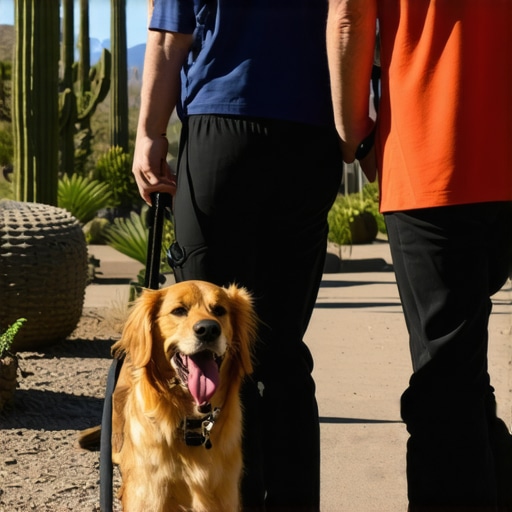
Working in the heat of a Phoenix summer changes how we think about logistics. You cannot have a dog working on 120-degree asphalt without protection, and the law respects the need for the dog to remain under control at all times. In Mesa and Queen Creek, the local interpretation of ‘under control’ has tightened. A dog that is barking at other shoppers or lunging at a discarded taco in a parking lot is a liability. According to the ADA and Arizona law, if a service animal is out of control and the handler does not take effective action, the business can ask the animal to leave. This is the part where trainers often fail. They focus on the ‘rights’ of the handler but forget the ‘responsibilities’ of the dog. [image_placeholder_1] The 2026 reality is that businesses have more power than they used to when it comes to excluding disruptive animals. You should also consider the geography of the East Valley. From the tech hubs in Chandler to the historical districts in Mesa, the environment dictates the training. A dog needs to be able to handle the noise of the Loop 202 and the crowds at the Gilbert Farmers Market. If a dog fails in these environments, it is not ready for the road. The law is clear: the dog must be housebroken and harnessed, leashed, or tethered unless the disability prevents it. This is not about the vest. It is about the behavior. A service dog in a professional shop like mine would be quiet, focused, and out of the way. Your training should produce the same result in every public square in Arizona.
Why your online certification is a stripped bolt
I hate cheap parts. You buy a five-dollar sensor for a high-end car and wonder why the engine light stays on. The same applies to those online ‘Service Dog Registries.’ They are the stripped bolts of the industry. They offer a shiny certificate and a plastic ID card for a fee, but they have zero legal standing under Arizona law. In fact, relying on these can be dangerous. Under ARS 11-1024.G, misrepresenting a dog as a service animal is a class 2 misdemeanor. If you tell a shop owner your dog is a service animal and it is not trained to do a specific task, you are breaking the law. The fine is not just a slap on the wrist. It is a legal record. Professional trainers in Arizona should be warning their clients to stay away from these registries. They are a scam. They do not grant access. Only the training and the disability grant access. When a shop owner in Scottsdale asks the two legal questions, and the handler starts pointing at a fake ID card instead of describing a task, the red flags go up. Those two questions are: 1. Is the dog a service animal required because of a disability? 2. What work or task has the dog been trained to perform? If the handler cannot answer the second question with a specific task, the ‘parts’ they bought online will not save them. You do not need a registry. You need a trainer who knows how to build a reliable service animal from the ground up.
The evolution of the Arizona service animal framework
The old ways of training are becoming obsolete. We used to see people get away with a lot more in the early 2010s, but the 2026 terrain is different. The ‘Old Guard’ methods focused on general obedience, but the new reality demands specialized technical tasks. If you are not training for medical alert, psychiatric response, or mobility support, you are just a pet trainer. That is fine, but do not call it service dog training. We are seeing a push for higher standards because the public is tired of fake service dogs causing chaos. Real service dogs are the Ferraris of the canine world. They are tuned to a high degree. They do not miss a beat. They do not get distracted by a dropped hot dog at the Arizona State Fair. This evolution is good for the industry. It raises the bar. It means that people who actually need these animals can rely on them. Here are some of the deep pain points we see in the field today.
Frequently asked questions from the shop floor
Can a business ask for proof of training? No. Under the ADA and Arizona law, a business cannot demand to see training logs or a demonstration of the task. They can only ask the two specific questions. However, if the dog is behaving poorly, they can still exclude it. Is a service dog in training (SDiT) protected in Arizona? Yes. ARS 11-1024(F) provides that a person with a disability or a professional trainer can take a service animal in training into public places for training purposes. This is a local advantage that many other states do not have. Do I need to carry a doctor’s note? Not for public access. You might need one for housing under the Fair Housing Act or for air travel, but not to enter a grocery store in Mesa. What if my dog is a miniature horse? Arizona law specifically includes miniature horses as service animals, provided they are trained for tasks and the facility can accommodate their weight and size. Can a store charge a cleaning fee for a service dog? No. They cannot charge a surcharge, though the handler may be liable for any actual damage the dog causes, just like a guest would be for their own behavior.
The road ahead for Arizona trainers
The job is not about getting a dog through a door. It is about making sure that dog is an asset once it is inside. We have to be better than the minimum standard. If you are a trainer in the Phoenix metro area, your reputation is built on the performance of the dogs you put on the street. Do not cut corners. Do not use cheap parts. Follow the Arizona statutes like a service manual. If you do it right, the system works perfectly. If you do it wrong, you are just waiting for a breakdown. Build something that lasts. Build something that actually helps people live their lives without the fear of a legal challenge or a training failure. The 2026 legal environment is tough, but for those of us who care about quality, it is exactly what we need. Ensure your training is task-heavy and your clients are educated on their rights and their responsibilities. That is how you win the long race.