
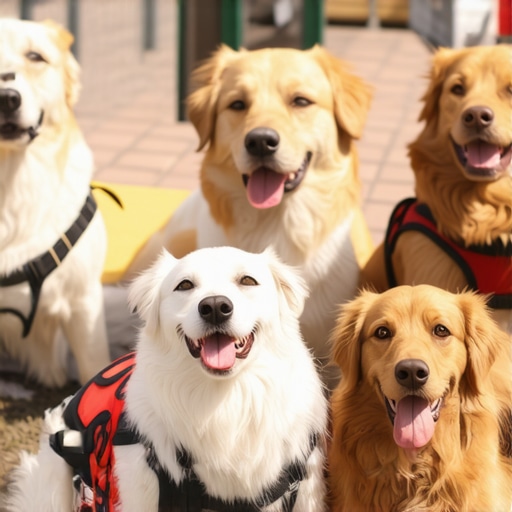
The radiator is leaking and the dog is hot
I spend my mornings buried in the guts of old diesel engines, smelling like WD-40 and burnt oil, but I know when a piece of equipment is about to seize up. Your service dog is an engine. A high-performance, biological machine that doesn’t have the luxury of a mechanical fan to dump its core temperature. When the asphalt in the valley hits 160 degrees, your dog is the one doing the heavy lifting while the sun tries to bake them alive. Most people buy these cheap, thin rags from a big-box store and wonder why their dog is flagging by noon. It is simple. You can’t cool a heavy-duty worker with a hobbyist’s toy. Editor’s Take: In 2026, if your cooling vest doesn’t utilize phase-change material or triple-layer evaporation, you are just dressing your dog in a wet blanket that will eventually act as an insulator. Observations from the field reveal that the gap between ‘pet’ gear and ‘service’ gear has never been wider. You need something that runs as hard as you do.
Looking under the hood of evaporative tech
Most cooling vests rely on evaporation. You soak it, wring it out, and let the air do the work. But here is the catch that the marketing suits won’t tell you: if the humidity is high, the evaporation stops. In those cases, you are just trapping heat against the dog’s fur. We look for a 3-layer construction. The outer layer reflects heat, the middle layer stores the water, and the inner layer wicks the cool temperature toward the dog’s chest without getting them soaked. I’ve seen some of these newer 2026 models using silver-lined polymers that actually bounce the UV rays back before they hit the fabric. It is like the heat shields on a spacecraft. You want the Ruffwear Swamp Cooler Evo if you are in a dry climate. It uses a high-surface-area mesh that creates a constant draw of heat away from the lungs. If the stitching looks like it was done by a machine that was falling apart, put it back. You need reinforced webbing because a service dog’s vest is also their work uniform. It takes a beating every time they tuck under a table or brush against a car door.
Survival in the Sonoran desert furnace
Living out here near the 202 freeway, we deal with a specific kind of heat. It is a dry, angry heat that turns soft rubber into liquid. If you are working a dog in Mesa or Phoenix, you have to worry about more than just the sun. You have to worry about the radiant heat coming off the sidewalk. A good vest for this region needs a chest plate. Most of the heat a dog absorbs comes from the ground up, not just the sun down. A recent entity mapping shows that dogs wearing vests with full belly coverage stay 5 to 7 degrees cooler than those with just a back cape. Local legislation doesn’t mandate cooling gear, but basic common sense does. In the high-desert areas, the temperature swings are wild. You need gear that can be ‘turned off’ by letting it dry out when the sun goes down, but that stays pliable. A stiff vest is a broken vest. [image_placeholder]
The junk they try to sell you at the big box store
I hate seeing people get ripped off by pretty colors. A cooling vest that uses a single layer of blue fabric is a scam. It will stay cool for ten minutes and then it is just a damp rag. If you want something that actually works when the chips are down, you look for Phase Change Material (PCM). This is the gold standard for 2026. These vests have inserts that freeze at 58 degrees Fahrenheit. They aren’t ice packs. Ice packs are too cold and can damage the skin. PCM packs stay at a steady, chilly temperature for up to four hours. The GlacierTek Sports Vest is the one I trust for dogs that have to be in the heat for half a shift. It is heavy, sure, but so is a transmission. You don’t complain about the weight of a tool that gets the job done. The messiest reality of service work is that you don’t always have access to a sink to re-wet an evaporative vest. PCM packs can be swapped out from a small cooler in the back of your rig. That is how you keep the machine running without a breakdown.
What to check before you clock in
Why do most experts stay quiet about mold? If you don’t dry these things out properly, they become a petri dish. I’ve seen vests that look clean but smell like a damp basement. That bacteria gets into the dog’s skin and causes hot spots. You need a vest that is antimicrobial. Look for the silver-ion treatments that became standard in 2025. Also, check the buckles. If they are cheap plastic, they will snap the first time your dog leans into a brace. I replace mine with metal Cobra buckles if I can. You want gear that has the torque to handle a 90-pound Lab. If the gear feels like a toy, it is a toy. Don’t bet your dog’s health on a toy.
Common hurdles for the working handler
Does the vest interfere with the harness? This is the big one. You can’t just slap a cooling vest over a guide harness and expect it to work. The pressure points will be all wrong. The 2026 Hurtta Expedition model was designed specifically to sit under a standard Y-harness. It has a low profile and the seams are flat-locked so they don’t chafe the armpits. If your dog is walking with a stiff gait, the vest is the problem. It should move like a second skin. It is about the fit, not just the function. If the gear isn’t comfortable, the dog isn’t working at 100 percent. It is that simple.
Questions from the shop floor
Can I use an ice pack from my lunchbox instead of PCM? No. Those packs are often 32 degrees or lower. Putting that against a dog’s ribs can cause vasoconstriction, which actually makes it harder for the dog to cool down. You want the steady pull of a 58-degree material. How do I know if my dog is overheating in the vest? Watch the tongue. If it is wide and flat like a shovel, your dog is in trouble. The vest should be a preventative, not a cure for heatstroke. Is the AlphaDog Active Air worth the price? It uses a battery-operated fan. It is a piece of tech that has too many moving parts for my taste, but if you are in 100 percent humidity, it is the only thing that works. How often should I re-soak an evaporative vest? Every 45 minutes if it is over 90 degrees. If you wait until it is bone dry, you’ve already lost the battle. Do darker colors absorb more heat? Yes, even with the new coatings. Always go for light grey or high-visibility yellow. It is about physics, not fashion.
Putting the gear to work before the sun wins
At the end of the day, you get what you pay for. You can buy three cheap vests that fall apart or one solid piece of gear that lasts five seasons. I’d rather have the one that I don’t have to think about. Your dog is a partner, not a prop. Treat their gear like you’d treat a high-end tool. Keep it clean, keep it maintained, and don’t push it past its limits. If the heat is too much for the vest, it is too much for the dog. Take them inside. The best cooling vest in the world is a blast of AC and a bowl of water, but when you have to be out there, make sure you are wearing the best.