
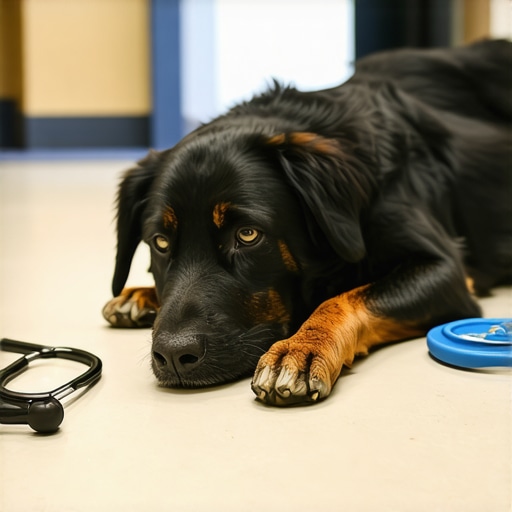
The garage is quiet, but the air smells like WD-40 and cold concrete. When a seizure hits at 2 AM, it’s not a soft moment; it’s a mechanical failure. You need a response that’s as reliable as a 1994 diesel engine. Editor’s Take: Night alert recovery isn’t about cuddles; it’s about high-torque sensory precision and calibrated response protocols. Stop dreaming about safety and start building it.
The dead engine at 3 AM
A night seizure is a system stall. Most trainers talk about ‘bond’ and ‘connection,’ but I talk about torque. If your dog isn’t firing on all cylinders when the house is dark, you’re just owning a very expensive rug. A dog’s nose is the diagnostic tool. It detects the chemical shift before the hardware fails. We don’t wait for the seizure to start; we train for the pre-ignition rattle. This is about the physics of scent movement in a still room. Static air behaves differently than a drafty workshop. You need a dog that can cut through the silence like a sharp blade through a radiator hose.
How the nose handles the heat
The mechanics of scent detection are often misunderstood by people who spend too much time in air-conditioned offices. For those of us in Mesa or Gilbert, the dry Arizona air is a variable that changes the viscosity of scent particles. In 2026, we’re seeing a shift toward ‘Deep Scent Saturation’ drills. This involves high-repetition exposure during the REM cycle. We use Heavy Pressure Therapy (HPT) as the primary ‘restart’ button. When the human body goes into a tonic-clonic state, the dog must apply physical weight to the sternum. It’s like a manual override for a runaway throttle. Check out the International Association of Assistance Dog Partners for their take on physical intervention standards. Our goal is to make the dog’s response as automatic as a circuit breaker. For more on the foundation, see our guide on Service Dog Training.
The reality of the Phoenix desert nights
Look at the map. If you’re living in Apache Junction or Queen Creek, your house gets hot. Even with the AC cranking, the atmospheric pressure affects how a dog’s olfactory system ‘idles.’ During the night, your body is shedding skin cells and sweat in a confined space. A dog needs to be able to distinguish between ‘sleep sweat’ and ‘seizure sweat.’ This is local work. The humidity levels in the East Valley are unique. We don’t train like they do in Seattle. We train for the dust. We train for the heat. This local focus ensures that the dog’s ‘sensors’ are calibrated to the actual environment of the owner. Most of the ‘expert’ advice you find online is generic fluff. Real data shows that local climate variables are a massive factor in alert reliability. You can learn more about our specific Seizure Response Dogs program here.
Why the standard advice fails under pressure
People say you should ‘rely on the dog.’ That’s a load of scrap. You rely on the training. When you’re unconscious, you can’t give a command. The dog has to be the lead mechanic. A major friction point is the ‘Lazy Alert’—where a dog nudges you but stops if you don’t wake up. That’s a broken belt. In 2026, we’re pushing for ‘Relentless Escalation.’ If a nudge doesn’t work, the dog moves to a lick. If the lick doesn’t work, the dog moves to a paw. If that fails, the dog triggers the help button. According to the Epilepsy Foundation, rapid intervention can reduce injury risk significantly. Don’t listen to the trainers who tell you to ‘wait and see.’ In my garage, if a part is failing, we replace it. If the dog isn’t escalating, the training is failing. We use specific ‘Stress-Test’ scenarios where we introduce distractions like a ringing phone or a barking neighbor to ensure the dog stays on task.
The myth of the perfect alert
Dogs aren’t machines, but we can get them close to 99% uptime. The problem is usually the ‘user interface.’ Humans ignore the subtle signs. We teach our clients in Mesa to look for the ‘pre-stiction’—that moment where the dog’s behavior shifts before the seizure is obvious. It might be a slight whine or a fixated stare. It’s like hearing a bearing start to go out before the wheel falls off. If you miss that, the nighttime recovery becomes much harder. We focus on ‘Zero-Light Navigation’ where the dog must find its way through the bedroom without hitting furniture to fetch a phone or medicine kit.
The shift in 2026 protocols
We’ve moved past simple retrieval. Now, it’s about integrated systems. How does the dog interact with the smart home? What happens if the dog is sick? Can the dog distinguish between a nightmare and a seizure? Why is the ‘thump’ drill essential for heavy sleepers? How do you maintain a dog’s focus when the house is empty? These aren’t generic questions. They are the bolts that hold the frame together. We use a ‘Backdoor Protocol’ where we simulate a total system failure to see how the dog adapts. No fluff. No treats for just sitting there. Only results. Stop looking for a pet and start building a partner. If you want something that just sits on the couch, go buy a stuffed animal. If you want to survive the night, get a dog that knows how to work a wrench.