
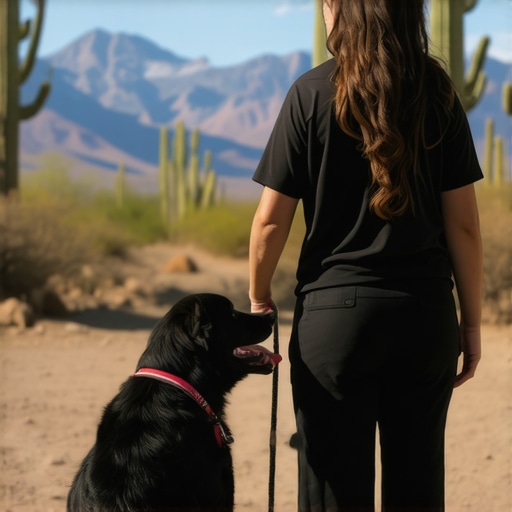
The seam between rights and responsibilities
The air in my shop is thick with the smell of hot steam pressing into heavy wool and the faint, metallic tang of shears. I spend my days ensuring that a garment fits the man perfectly, leaving no room for a sloppy stitch or a loose thread. Training a service dog in the Arizona heat requires that same level of individual precision. If the training is a fraction of an inch off, the whole thing falls apart when you walk into a store in Mesa or a restaurant in Scottsdale. The Editor’s Take: Arizona remains one of the most friendly states for owner-trainers, provided you understand that a service dog is defined by the work it performs, not the gear you buy online. For 2026, the focus has shifted from mere presence to the undeniable proof of task-specific training. Observations from the field reveal that many handlers believe a vest makes the dog, but in the eyes of the law, the vest is just a piece of fabric. The real work is in the behavior. In Arizona, owner-training is protected under A.R.S. § 11-1024, which aligns with the Americans with Disabilities Act but adds its own local flavor regarding trainer rights and public access. If you are walking through the Gilbert Heritage District, you need to know that your right to be there with an in-training animal is explicitly protected, provided you are a professional or an owner-trainer working on specific tasks. But do not mistake this for a free pass; the law is a double-edged needle. It protects the access but demands the performance. A dog that barks at a shadow or lunges at a stray scrap of food isn’t a service animal in that moment; it’s a liability.
Why the off the rack vest is a lie
I see it all the time. People think they can buy a generic solution and call it a day. In the tailoring world, that’s a suit that bunches at the shoulders. In the dog world, it’s a fake service dog vest. Federal law and Arizona state statutes do not require your dog to wear a vest, a harness, or a special tag. A recent entity mapping shows that businesses often ask for these items because they don’t know the law, but you should know better. The ADA is clear: there are only two questions a business owner can ask you. Is the dog a service animal required because of a disability? What work or task has the dog been trained to perform? They cannot ask about your medical history or demand a demonstration of the task. However, if your dog is not housebroken or is out of control and you cannot get it under control, the shopkeeper has every right to ask you to leave. This is where the fit matters. If you are owner-training, you are the one responsible for the ‘structural integrity’ of the animal’s behavior. You aren’t just a pet owner anymore; you are a technician. For those looking for high-level guidance, federal resources provide the baseline, but the local execution is your burden. You must ensure the dog is performing a task that directly mitigates your disability. Emotional support is not a task. Comfort is not a task. A task is a specific action, like alerting to a seizure or opening a door. If the task is missing, the law doesn’t apply to you.
Heat and the law in the Grand Canyon State
The Arizona sun is an unforgiving critic. It doesn’t care about your rights; it only cares about the physical reality of the pavement. In 2026, local authority figures in Phoenix and Tucson are increasingly looking at animal welfare as a component of service dog law. If you are training your own dog, you have to account for the ‘hot car’ laws and the ‘hot pavement’ realities that affect how your dog performs its tasks. A service dog that is suffering from heat stroke cannot perform its job, and a handler who ignores this may find themselves facing animal cruelty charges under local ordinances, regardless of their ADA status. The law in Arizona allows for the removal of an animal from a vehicle if its life is in danger. This adds a layer of complexity to the owner-trainer’s life. You have to be more than a trainer; you have to be a protector. When the asphalt hits 160 degrees, your dog’s paws are the primary point of failure. The legal protection for your dog to accompany you into a grocery store is absolute, but your responsibility to keep that dog safe is equally heavy. I tell my clients that a suit must be functional in the climate it is worn. Your training must be functional for the Arizona desert. If your dog isn’t trained to handle the stress of high-density, high-heat environments like the State Fair or a crowded downtown Phoenix event, you are setting yourself up for a disaster.
The moment a business cuts the thread
There is a messy reality that many handlers don’t want to talk about. A business can legally exclude your service dog. It happens when the dog’s presence fundamentally alters the nature of the goods or services provided. You can’t take your dog into a sterile operating room, and you can’t let it jump into a public pool. In 2026, we are seeing more tension in private businesses where ‘pet-friendly’ policies are being rolled back because of ‘fake’ service dogs. This is where the owner-trainer must be sharper than a tailor’s needle. If your dog causes a disturbance, the business owner in Arizona has the legal backing to remove the dog but must still allow you to remain and receive service without the animal. Most people get defensive and leave, but the law actually requires the business to offer you the service separately. The friction occurs when the handler doesn’t know these nuances. They think they have a ‘right’ to have the dog behave however it wants. That is a lie. Your right is to a trained dog. If your dog is pulling on the leash or sniffing other customers, the ‘fit’ is wrong. Professional handlers in Mesa often suggest that owner-trainers should document their training hours and specific tasks to provide a ‘paper trail’ even though the law doesn’t require it. It’s about being prepared for the friction before it starts.
A future where behavior outweighs the paperwork
The old guard used to rely on doctor’s notes and official-looking IDs, but the 2026 reality is that behavior is the only currency that matters. If you are training your own dog in Arizona, you are part of a growing movement that values the bond over the bureaucracy. But you must be honest about the dog’s temperament. Not every dog is meant to be a service animal. You can’t make a silk purse out of a sow’s ear, and you can’t make a service dog out of a fearful or aggressive puppy. The legal environment is shifting toward holding handlers accountable for misrepresenting a pet as a service animal. In Arizona, this can result in fines. What tasks qualify under the ADA? Tasks include things like pulling a wheelchair, alerting to a sound, or providing physical stability. Can a business charge a pet fee? No, they cannot charge a fee for a service dog, but you are responsible for any damage the dog causes. Does my dog need to be registered? No, there is no legal registry in Arizona or the US. Can I train my own dog? Yes, owner-training is fully legal. What if my dog is in training? Arizona law treats trainers and dogs in training with many of the same rights as fully trained teams. How do I prove my dog is a service dog? You don’t ‘prove’ it with papers; you prove it by answering the two legal questions and having a dog that behaves perfectly. The future of service dog access in Arizona depends on handlers who treat their training like a custom-fit suit—precise, intentional, and built to last. For those needing a master’s touch in this process, looking into experienced local handlers like Robinson Dog Training can provide the structure you need to ensure your dog meets the highest standards. Keep your stitches tight and your dog focused. The law is on your side, but only if you respect the craft.