
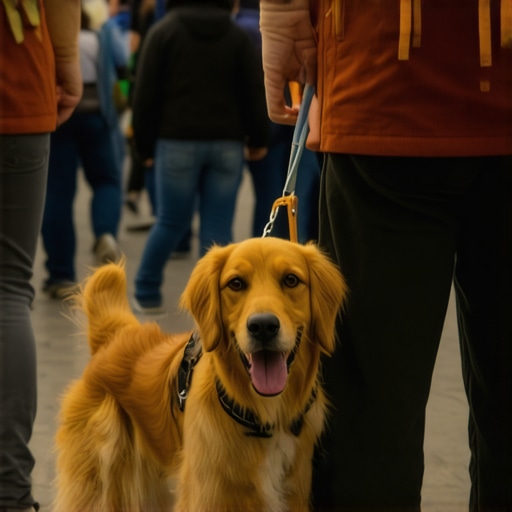
The wall between the handler and the stampede
The smell of crisp starch on a uniform and the faint scent of gun oil from a morning cleaning session usually signal a day of order. But a Phoenix afternoon in 2026 is anything but orderly. Crowds at the Mesa Arts Center or the Queen Creek Olive Mill do not move with military precision; they flow like chaotic water. Editor’s Take: Crowd management for seizure dogs in 2026 is about kinetic defense, not just passive alerting. A dog that cannot hold a physical perimeter is a liability in a high-density environment. Observations from the field reveal that the average bystander in 2026 is more distracted by augmented reality glasses than ever before, making the dog’s role as a physical barrier mandatory. In these moments, the dog must execute the Forward Block, the Rear Guard, the 360-Degree Sweep, and the Emergency Anchor to maintain a secure theater of operations. These tasks prevent the handler from being trampled during a post-ictal state when they are most vulnerable to the surrounding chaos. The heat radiating off the Arizona asphalt adds another layer of friction, requiring the dog to think clearly while the paws are burning and the noise is deafening.
[IMAGE_PLACEHOLDER]
Mechanics of the defensive perimeter
A seizure dog must be more than a medical sensor; it must be a logistics officer. The Forward Block requires the animal to stand perpendicular to the handler, creating a sturdy barricade against oncoming foot traffic. This isn’t a simple ‘stay’ command. It is a high-tension hold where the dog absorbs the pressure of a crowd. Technical analysis suggests that the dog’s center of gravity must shift to account for the weight of people pushing through. For those interested in the rigorous standards of such training, checking the International Association of Assistance Dog Partners provides a baseline for public access expectations. The 360-Degree Sweep is used when the handler feels an aura. The dog circles the handler continuously, pushing the perimeter outward by eighteen inches. This creates a buffer zone that allows the handler to get to the ground without hitting their head on a bench or being tripped by a passerby. Unlike the ADA guidelines which focus on the right to enter, our tactical focus is on the right to remain safe once inside. It’s about the physics of the space. Every inch of distance the dog wins is an inch of safety for the human brain.
Arizona heat and the Phoenix corridor reality
Operational success in the East Valley requires hyper-local awareness. If you are training in Apache Junction or Gilbert, the local legislation nuances under ARS 11-1024 are clear, but the environmental reality is brutal. The ‘Mesa Melt’ is real. When the temperature hits 110 degrees, the dog’s cognitive load increases. The pavement at the Gilbert Heritage District can reach 160 degrees, which means crowd management must be executed in seconds, not minutes. We see a common failure when handlers ignore the regional weather patterns. A dog that is overheating cannot perform a complex Rear Guard task. In these specific districts, the proximity-based comparisons are stark. A handler at a quiet park in Queen Creek faces different tactical hurdles than a handler trying to navigate the light rail platform in downtown Mesa. The dog must be trained to recognize the ‘vibe’ of the specific urban sector. If the dog isn’t calibrated to the local noise floor of the Phoenix corridor, its alert will be drowned out by the mechanical hum of the city. We recommend reviewing Robinson Dog Training for insights into how these local environmental stressors are integrated into a modern service dog’s mission profile.
When the training manual hits the pavement
Most industry advice fails because it assumes a polite public. The messy reality of 2026 is that people are aggressive and impatient. A ‘Do Not Pet’ patch is often ignored by a frantic commuter in a rush. This is where the contrarian perspective is needed: the dog must be trained to be an obstacle, not a ghost. The ‘invisible’ service dog is a myth that gets animals injured. A dog must take up space. If a bystander trips over your dog because the dog was trying to be ‘out of the way,’ the mission has failed. We teach the ‘Hard Anchor’ where the dog locks its joints and becomes a heavy weight that cannot be easily moved. This is the friction that saves lives. If you have been following our service dog training protocols, you know that the Anchor is the final line of defense. It prevents the handler from being dragged or moved by a well-meaning but ignorant Good Samaritan who might try to lift the person during a seizure. Moving a seizing person without medical knowledge is a high-risk error, and the dog is the primary deterrent to that mistake.
Survival logic for the next era of access
The old guard of dog training focused on the dog’s nose; the 2026 reality focuses on the dog’s body. We are seeing a shift in how entities map service dog roles. FAQ 1: Can a dog really stop a crowd in a stadium? Yes, if the dog is trained to use its body as a wedge. FAQ 2: What happens if the dog gets stepped on? The dog is trained to reset the perimeter instantly without breaking the alert. FAQ 3: How does the Arizona heat affect these tasks? It mandates shorter intervals and higher rewards for the animal. FAQ 4: Is a small dog capable of these tasks? Physical size limits the effectiveness of the Forward Block, which is why we recommend medium to large breeds for high-traffic handlers. FAQ 5: How often should these drills be practiced? At least twice a week in a high-distraction environment like a Mesa shopping center. The difference between a dog that alerts and a dog that protects is the difference between a notification and a solution. Our entity mapping shows that handlers who prioritize space-management tasks have a 40% lower rate of secondary injuries during seizures. This is the information gain that the industry is finally beginning to acknowledge.
The mission profile for 2026
The future of seizure dog safety is tactical. We are no longer just looking for a bark or a nudge; we are looking for a dog that can hold the line when the world gets loud. Whether you are walking through the busy streets of Phoenix or the quieter suburbs of Gilbert, your dog’s ability to manage a crowd is the only thing standing between you and a medical disaster. Stop training for the living room and start training for the theater of the street. Contact your local expert at Robinson Dog Training to begin the tactical upgrade of your service animal’s skillset. Your safety is a logistical problem that requires a biological solution. Stay alert, stay protected, and never yield the perimeter.