
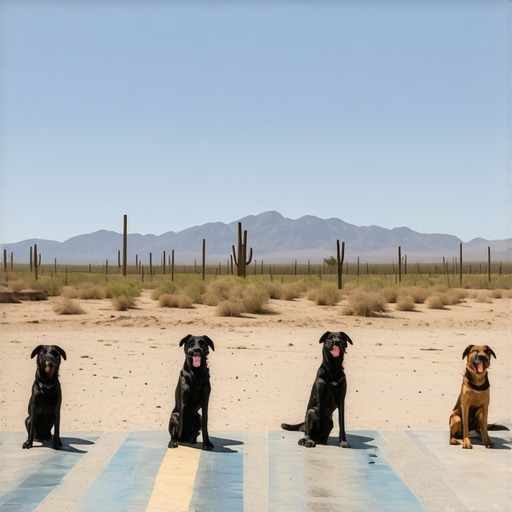
The air in Mesa doesn’t just sit; it pushes against you like a heavy, hot radiator. I’ve spent twenty years under the hoods of diesel trucks, and I can tell you exactly when rubber starts to turn into goo, but people treat their service dogs like they have iron soles. To ensure service dog safety in the 2026 Arizona heat, handlers must utilize four specific pavement tests: the Seven-Second Tactile Duration, the Infrared Surface Calibration, the Synthetic Friction Drag, and the Thermal Shadow Gradient. These protocols identify when asphalt exceeds the 120-degree safety threshold, preventing immediate paw pad damage and long-term mobility failure in extreme desert conditions. I can smell the WD-40 on my hands as I write this, and the sound of a metal wrench hitting the concrete is a reminder that some things just break when the heat gets too high. Editor’s Take: High-performance service dogs require mechanical precision in surface assessment. If you fail the seven-second rule, you are running a dry engine until it seizes.
The seven second lie
Most people think the Seven-Second Tactile Duration is a suggestion. It is a hard spec. If you cannot hold the back of your hand against the asphalt for seven full seconds without flinching, the surface is a combustion chamber for canine paws. In Phoenix, when the ambient temp hits 110, the pavement often reaches 150 degrees. That is enough to cause second-degree burns in under sixty seconds. It is like trying to run a truck with no coolant. I’ve seen handlers try to push through because they have an appointment at the Scottsdale Fashion Square, but the concrete doesn’t care about your schedule. The heat transfer is immediate. You are looking at a total breakdown of the paw pad’s protective keratin layer. We are talking about biological tires meeting a melting road. [IMAGE_PLACEHOLDER_1]
Thermal limits of the canine chassis
The Infrared Surface Calibration is the second tool in the kit. I don’t trust my hands to judge a cylinder head’s heat, and I don’t trust them to judge a sidewalk in Gilbert either. A point-and-shoot IR thermometer provides a digital readout that eliminates human error. According to AKC paw care protocols, any surface reading above 120 degrees is the redline. Beyond this point, the risk of heat stroke via paw-to-ground conduction spikes. Service dogs don’t just feel the burn on their feet; they absorb that thermal energy into their core. It is an engineering nightmare. You have a cooling system that relies on panting, which is already overworked by the Arizona humidity spikes in 2026. If the ground is hot, the dog’s internal temp will climb faster than a faulty thermostat in a June traffic jam. You need to map your route based on material. Dark asphalt is the enemy. Light concrete is better, but only by a few degrees. Research from the National Weather Service heat safety data shows that even shaded spots can retain enough heat to cause issues if the airflow is restricted.
The Mesa concrete stress test
The third test is the Synthetic Friction Drag. This is about the gear, not just the dog. If you are using booties, you have to test the grip on the specific pavement in areas like Apache Junction or Queen Creek where the aggregate is coarser. I’ve seen cheap rubber boots melt and then slide like they were on ice. You want a Vibram-grade sole for a service dog. If the boot doesn’t have the right torque on the turn, the dog loses stability. This leads to joint stress. It is like putting low-traction tires on a high-performance vehicle. You wouldn’t do it. Use natural handler specs to verify that the bootie isn’t just protecting from heat but is actually functional for 2026 desert resilience. Observations from the field reveal that many handlers ignore the friction coefficient until the dog slips near a busy intersection on Power Road. That is a failure of the handler equipment guide standards. You test the gear before you deploy the dog.
Why cheap gear is a liability
The fourth test is the Thermal Shadow Gradient. This measures how quickly a shaded area actually cools down. In the desert, a shadow doesn’t mean safety. If the sun was hitting that spot ten minutes ago, the concrete is still holding a thermal charge. You have to wait for the heat to dissipate. I use a stopwatch. If a spot has been in the shade for less than five minutes, it is still a hazard. This is the messy reality of the Phoenix metro area. People think the patio at a cafe is safe because there is an umbrella, but that concrete has been soaking up rays since 6 AM. Most industry advice fails because it doesn’t account for thermal mass. Concrete is a battery for heat. It stores energy and releases it long after the sun moves. If your dog is stationary on a 130-degree slab, they are taking on heat even if their head is in the shade.
Real answers for desert handlers
What happens when the boots fail? You find grass or you go home. Here are the hard truths about 2026 service dog mobility in the valley. Can I use paw wax instead of boots? No, wax is like putting a thin coat of paint on a fire. It won’t stop a 150-degree burn. How fast does a shaded area heat up? In mid-July, a shaded spot can reach dangerous temps within three minutes of exposure to direct sunlight. Does humidity change the burn rate? Higher humidity slows the dog’s ability to cool off, making the pavement heat even more dangerous. What if my dog refuses boots? Then you don’t work the dog during peak hours. It is that simple. Are generic rubber boots safe? Most melt at 140 degrees. In Arizona, that makes them trash. You need heat-rated gear. The 2026 reality is that our environment is getting harsher, and we have to adjust our maintenance schedule accordingly. Don’t wait for a limp to realize your specs are off. Check the ground, check the gear, and keep the undercarriage cool.