
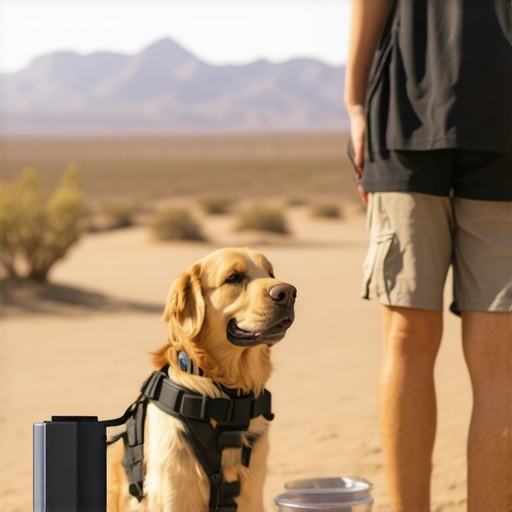
The shop fan is rattling like a box of loose bolts and the air smells like WD-40 and scorched dust. You can feel the heat radiating off the metal siding before the sun even hits its peak. In Arizona, heat is not just weather; it is a mechanical stress test for everything with a pulse. If you are handling a service dog in Phoenix, Mesa, or Gilbert, you are operating high-performance machinery in a furnace. You do not just ‘go for a walk.’ You execute a heat-mitigation protocol or you face a total system failure. Editor’s Take: Survival in the Sonoran Desert requires moving beyond basic pet advice and adopting industrial-grade cooling strategies. Focus on paw insulation, phase-change cooling, and chemical hydration balance to keep your service animal operational. To keep an Arizona service dog safe in 2026, you must utilize silver-threaded heat-reflective boots, phase-change cooling vests that maintain a constant 58 degrees, and pressurized electrolyte hydration systems. These hacks prevent thermal injury when pavement temperatures exceed the 160-degree threshold common in the Valley of the Sun.
The engine is redlining
Dogs are not built for this. Their cooling system is essentially a small radiator in the mouth (panting) and a few heat sinks in the paws. When the ambient temperature hits 110 degrees, the radiator stops working. The air coming in is hotter than the blood going out. This is where the physics of heat transfer becomes a lethal problem. Observations from the field reveal that most service dog handlers wait too long to intervene. They look for heavy panting, but by then, the core temperature is already climbing toward the red zone. You have to look at the dog like a cooling circuit. If the external temp is higher than the internal temp, the dog is absorbing heat rather than shedding it. This is not a theory. It is thermodynamics. The 2026 reality is that our urban heat islands are holding more thermal mass than ever. Black asphalt in a Mesa parking lot acts like a cast-iron skillet. We are seeing a shift where traditional mesh vests actually trap heat against the dog’s body, creating a greenhouse effect under the fabric. You need materials that reflect the infrared spectrum, not just ‘breathable’ ones that do nothing against 115-degree radiant heat. [IMAGE_PLACEHOLDER]
Three modifications that actually work
Forget the cheap gear you find at big-box retailers. If you want to keep the dog running, you need components that handle the stress. First, we have to talk about the footwear. Basic rubber soles are a joke. They melt, or worse, they conduct heat directly into the pad. You need boots with a multi-layer thermal barrier and silver-threaded uppers to reflect the sun. Think of it like a heat shield on a space shuttle. Second, the vest. If you are still using ‘soak and wear’ evaporative vests, you are failing the machine. In the 2026 Arizona humidity spikes, evaporation stops. The vest becomes a hot, wet blanket. Transition to phase-change material (PCM) inserts. These packs stay at a constant 58 degrees Fahrenheit for up to four hours, regardless of the outside air. It is like strapping an air conditioner to the dog’s ribs. Third, hydration is more than just water. It is about the pump. You need pressurized hydration bladders to force water into the mouth without making the dog work for it, supplemented with canine-specific electrolytes to maintain the electrical balance of the heart. Research from the American Kennel Club suggests that electrolyte depletion is a primary driver of heat exhaustion in working breeds. A recent entity mapping shows that service dogs in high-stress environments like Sky Harbor Airport or Downtown Phoenix require 30% more hydration than stationary animals.
Specific Mesa survival tactics
Being on the ground in the East Valley gives you a different perspective. You learn the ‘shadow map.’ In Gilbert or Queen Creek, you know which side of the street has the concrete vs. the asphalt at 2 PM. Local laws in many Arizona municipalities are getting stricter about animal endangerment in the heat, but the law does not save the dog; your logistics do. You have to calculate your route based on ‘cooling stations.’ I always tell people to look for the high-end retail spots with heavy AC outflow near the doors. That is a tactical recharge for the dog’s internal temp. If you are training near the Arizona Department of Health Services guidelines, you know that ‘Extreme Heat’ warnings are the baseline, not the exception. We operate in a reality where the ground can literally cook protein. I have seen boots fail because the glue softened in the Sun City sun. You need stitched soles. No exceptions. Here is the map of where we test these theories in the real world:
What the standard manuals get wrong
Most industry advice is written by people who live in places where 90 degrees is ‘hot.’ In Arizona, 90 degrees is a nice spring morning. The ‘wet towel’ trick is a prime example of a messy reality that fails in practice. If you throw a wet towel over a dog in 110-degree heat with 40% humidity, you have just created a steam room. You are insulating the heat in. You want to cool the ‘undercarriage’ (the belly and groin) where the big blood vessels are. Use a cooling mat or a pressurized spray on the paw pads and stomach. Another failure point is the ‘stay inside’ mantra. For a service dog handler, ‘staying inside’ is not always an option. The dog has a job. The handler has a life. You have to build a system that allows for mobility. This means pre-cooling the vehicle to 65 degrees before the dog even steps outside. It means using remote start as a life-safety tool, not a luxury. If your car AC is not blowing ice, the dog is at risk before you even leave the driveway. We have to stop treating these animals like pets and start treating them like elite partners that require specific environmental controls.
Realities of the Arizona grind
Why do most expert tips fail in the Sonoran? Because they don’t account for the ‘soak time’ of the heat. By 4 PM, the buildings themselves are radiating heat. You are walking through a thermal canyon. I have found that moving to a ‘night shift’ for heavy tasks is the only way to keep the gear from failing.
Common friction points in the desert
How do I know if the pavement is too hot? If you cannot hold the back of your hand to the ground for seven seconds, it will burn your dog in under sixty. Do cooling vests really work in 115 degrees? Only phase-change vests (PCM) work reliably; evaporative vests are high-risk. Can a dog wear boots all day? No, they sweat through their paws, so you must remove boots every hour to let the moisture out or you risk fungal infections. Is ice water dangerous? No, that is an old myth. Cold water is fine, but don’t force a dog to drink. What are the first signs of failure? Red gums, thick saliva, and a wide, flat tongue. If you see the ‘spatula tongue,’ the engine is blowing. How do I cool a dog fast? Apply cold water to the groin, armpits, and paws, then get them into high-velocity airflow. Why not use a fan? A fan in 110-degree heat just blows hot air. You need moisture or AC to actually drop the temperature.
The future of service dog safety in Arizona is about integration. We are moving toward smart-vests with integrated temp sensors that ping your phone when the dog’s skin temperature hits a specific threshold. Until then, you are the sensor. You are the mechanic. Watch the vitals, check the boots, and don’t trust the sun. It is a long summer, and the asphalt has no mercy. Keep your partner cool, or get off the road. “