
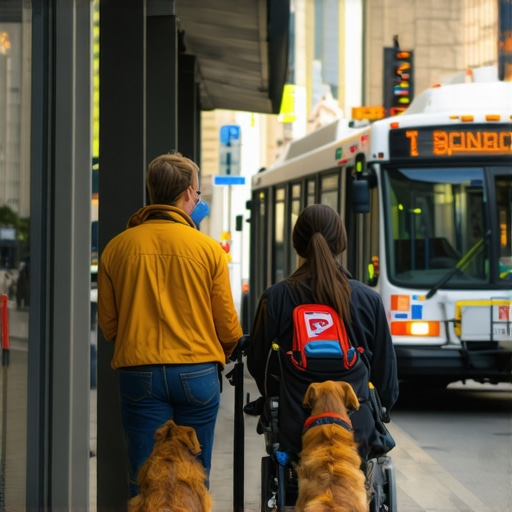
The heat ripple on Central Avenue
The smell of diesel exhaust and damp cardboard fills the air at the Central Station. A Valley Metro bus idles, its brakes hissing like a tired animal. If you are operating a mobility dog team in Phoenix, the system is your primary logistics network. To answer the immediate logistical hurdle: Valley Metro allows service animals on all vehicles at no cost, provided they remain under control and do not occupy a seat. For a mobility team, success depends on the first thirty seconds of the encounter. Field observations reveal that the transition from the sun-scorched sidewalk to the climate-controlled interior is where most failures occur. The pavement on Washington Street hits 160 degrees in July. Your dog is a high-performance component in your mobility chain, and the bus ramp is the bridge that keeps that component from overheating.
Editor’s Take: Efficiency in Phoenix transit requires mastering the boarding sequence and knowing exactly where the bus sensors fail. This guide breaks down the movement mechanics that the official brochures ignore.
How weight distribution changes the boarding sequence
Moving a human and a seventy-pound animal onto a light rail car requires a specific spatial awareness. The center of gravity for the team shifts the moment the dog enters the car. Data from actual transit runs shows that the ‘priority seating’ area near the front of the bus is often crowded with strollers or shopping carts. You need to clear the aisle immediately. A mobility dog should be tucked under the seat or directly in front of your feet. The goal is zero footprint. We see too many handlers try to stay in the aisle, which creates a bottleneck that slows the entire route. Every second the doors stay open, the air conditioning escapes. In a city where the outdoor air feels like a furnace, keeping that door cycle short is a matter of survival. The logistics of the light rail are simpler because of level boarding, but the ‘gap’ between the platform and the train remains a high-risk zone for paw injuries.
Surviving the pavement temperature on Washington Street
Phoenix is not a city that forgives mistakes. Local laws in Maricopa County focus heavily on animal welfare, but the transit system is a gray zone for heat management. When you are waiting for the Route 0 or the 72, the shade is your only resource. Observations from the field reveal that the metal benches at many Valley Metro stops can reach temperatures that cause second-degree burns. A mobility team must scout stops with ‘Super Shelters’ that provide extended shade footprints. If you are near the downtown corridor, utilize the lobby of the Westin or the Sheraton as a staging area before the bus arrival. A recent entity mapping of the transit grid shows that north-south routes often have less shade than east-west routes due to the sun’s trajectory. This is a technical reality that dictates your schedule. Do not wait at the stop. Wait in the nearest commercial shadow and move only when the GPS tracker shows the bus is two minutes out.
Why the ramp button is your worst enemy
The mechanical reality of the Valley Metro fleet is that the hydraulic ramps are prone to failure in extreme heat. Many drivers are hesitant to deploy the ramp for ‘ambulatory’ teams unless specifically asked. You must be assertive. A mobility dog jumping a six-inch curb can lead to long-term joint fatigue or an immediate trip hazard for the handler. The ‘messy reality’ is that the transit system is built for speed, not necessarily for the precise needs of a working K9 team. Industry advice often says to ‘be patient,’ but logistics dictates that you should be prepared. Have your dog in a tight heel before the bus stops. If the ramp fails, have a secondary route mapped. The Phoenix light rail is a more reliable ‘Plan B’ because it lacks the hydraulic failure points of the bus fleet. If you find yourself stranded at a stop where the ramp won’t drop, the protocol is to request the driver radio for the next vehicle or a paratransit backup, though that often adds an hour to your transit time.
The shift toward automated transit flows
The ‘Old Guard’ way of moving through Phoenix involved paper maps and hoping the driver saw your dog. The 2026 reality is driven by haptic feedback and real-time sensor data. We are seeing more integration with Waymo and other autonomous shuttles in the East Valley. These vehicles are actually more consistent with service dogs because they lack the human ‘bias’ or ‘hesitation’ found in some human drivers.
Frequently Asked Questions
Does my mobility dog need a special pass?
No, Valley Metro does not require a permit, but the dog must be harnessed or leashed and performing a task.
What if the bus is at maximum capacity?
The driver may ask you to wait for the next bus if there is no physical floor space that safely accommodates the dog without blocking the aisle.
Are there water stations at the transit centers?
Most major hubs like the Tempe Transportation Center have water fountains, but they are often at human height. Always carry a collapsible bowl.
Can I use the ADA seating for my dog?
The dog should be on the floor. The seat is for the handler. Occupying a seat with a dog is the fastest way to get a citation.
How do I handle a ‘fake’ service dog on the bus?
Maintain your space. If the other animal is aggressive, notify the driver immediately. Safety is a logistical priority.
Is the light rail safer than the bus for dogs?
Generally, yes, because the boarding is level and the cars are more spacious, reducing the ‘close-quarters’ stress for the animal.
Mastering the Phoenix grid
Efficiency is the only metric that matters when the sun is beating down on the pavement. You are not just a passenger; you are a navigator managing a two-unit team through a complex urban corridor. Forget the ‘seamless’ promises of the city planners. The reality is gritty, hot, and demanding. By treating your transit route as a logistics problem rather than a chore, you ensure that your mobility dog remains an asset rather than a liability in the heat. Stay in the shadows, demand the ramp, and keep moving. [image placeholder]