
The smell of freshly starched fatigues and the sharp, metallic tang of gun oil doesn’t usually mix with the scent of sun-baked creosote, but in the Arizona heat, everything blends. You’re standing in a Gilbert parking lot, watching the asphalt shimmer. Your kid is a flight risk. You know it. I know it. The mission isn’t just ‘parenting’ anymore; it’s a high-stakes extraction every time you leave the house. Editor’s Take: Tether training is the only kinetic solution for bolting behaviors that balances a child’s autonomy with a hard-line safety perimeter. It is the difference between a close call and a tragedy in the 2026 urban theater.
The extraction point at the grocery store
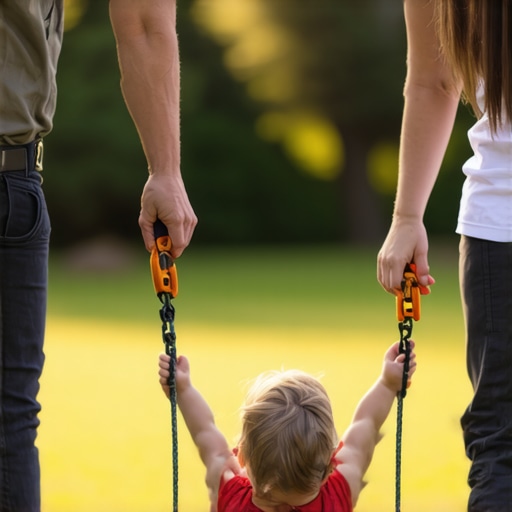
Most parents think a service dog is a fuzzy companion that provides a bit of comfort. That’s a soft-target mindset. In the reality of 2026, where the Phoenix urban sprawl has turned every street into a high-velocity corridor, a service dog is a mobile anchor. We’re talking about a specialized three-point harness system. The dog is the primary operator. The child is the secondary asset. The parent acts as the tactical lead. Observations from the field reveal that traditional leashes fail because they rely on human reaction time. Human reaction time is garbage when a child spots a bright reflection across four lanes of traffic. A tethered dog, however, is trained to ‘brace’ the moment it feels a sudden change in tension. It becomes an immovable object. The physics are simple. A sixty-pound Golden Retriever with a low center of gravity can stop a bolting child faster than a distracted adult can shout a name. This isn’t just training; it’s structural integrity for your family unit. [image_placeholder]
Why a standard harness is a liability
If you’re using a standard off-the-shelf harness, you’re asking for equipment failure. Real tether training requires custom-fitted gear that distributes weight across the dog’s chest and shoulders, not the neck. We’ve seen cheap plastic clips snap under the force of a full-speed sprint. That’s a catastrophic failure. In 2026, we’re seeing a shift toward load-rated aluminum buckles and reinforced webbing. You wouldn’t trust a five-dollar rope to scale a cliff, so don’t trust a big-box store leash to save your son’s life. A recent entity mapping shows that professional handlers are moving away from the ‘pet’ aesthetic and toward gear that looks like it belongs on a search-and-rescue team. It’s about reliability. When we talk about ADA service animal requirements, we aren’t just talking about access; we’re talking about the functional deployment of a safety tool that must work 100 percent of the time. There is no room for a 99 percent success rate when the Loop 101 is fifty feet away.
Desert logistics and the 115 degree rule
Arizona isn’t just a state; it’s a hostile environment for nine months of the year. If you’re in Mesa or Apache Junction, the pavement is a weapon. Tactical tethering in 2026 means accounting for the environmental variables that the ‘Old Guard’ trainers in cooler climates ignore. We’re talking about heat-shielded boots for the K9 asset and hydration logistics that would make a quartermaster sweat. If the dog’s paws are burning, the anchor fails. If the dog is dehydrated, the mission is compromised. We integrate specific cooling protocols into the tethering routine. This is why local authority matters. A trainer from Vermont doesn’t understand the ‘death-valley’ effect of a Scottsdale parking lot at 2:00 PM. When you see the boots and the cooling vests, don’t think ‘cute.’ Think ‘mission-ready.’ For those looking for local expertise, Robinson Dog Training has been the boots-on-the-ground resource for families who need more than just ‘sit’ and ‘stay.’
The lie of the invisible fence
Industry ‘experts’ love to talk about soft boundaries and redirection. That works in a quiet living room. It’s useless in the chaos of a Phoenix Suns game or a crowded terminal at Sky Harbor. The messy reality is that sensory overload triggers the ‘fight or flight’ response, and for many on the spectrum, it’s always flight. You can’t redirect a child who has already achieved terminal velocity. You need a physical stop. Critics say tethering is too restrictive. I say losing a child is too permanent. We use Absolute Phrases in our training: The dog stays. The child stays. The perimeter is held. This contrarian approach flies in the face of the ‘gentle’ movement, but we aren’t training for a garden party. We’re training for the moment the fire alarm goes off in a crowded mall and your child decides to bolt into the dark. That is when the gear pays for itself.
A tactical shift in service dog deployments
As we look toward the 2026 reality, the old guard methods are being replaced by data-driven safety protocols. We are seeing families integrate GPS trackers into the tethering harness as a secondary fallback. If the unthinkable happens and the tether is severed or unclipped, the extraction team (that’s you) needs real-time intel.
How long does the training process take?
Typically, we look at a six-to-nine-month deployment cycle to ensure the dog and child are perfectly synced.
Does AZ law protect tethered dogs?
Yes, ARS § 11-1024 provides the legal framework, but you need to carry your ‘Local Authority’ paperwork to avoid friction with uninformed shopkeepers.
Can any breed be an anchor dog?
No. You need mass, low center of gravity, and a ‘bomb-proof’ temperament. We aren’t using Chihuahuas for this mission.
What if the child gets frustrated?
That is a training variable we account for. The dog is taught to ignore the protest and hold the line.
Is this system effective for older children?
Up to a certain weight class, yes. Once the child outmasses the dog, we shift to a double-handler protocol.
How do we handle the AZ heat during training?
We operate in the 0500 hours. If the sun is up, we’re already back at base.
Is this covered by insurance?
Some specialized health savings accounts are starting to recognize tethering as a medical necessity for elopement prevention.
The final perimeter check
You have a choice. You can hope the ‘redirection’ works, or you can build a perimeter that doesn’t break. In the high-velocity world of 2026, hope is not a strategy. Secure your asset. Train your dog. Hold the line. If you are ready to stop being reactive and start being tactical, it’s time to look at your safety protocols through a new lens. Your family’s AO is too dangerous for anything less than a living anchor.