
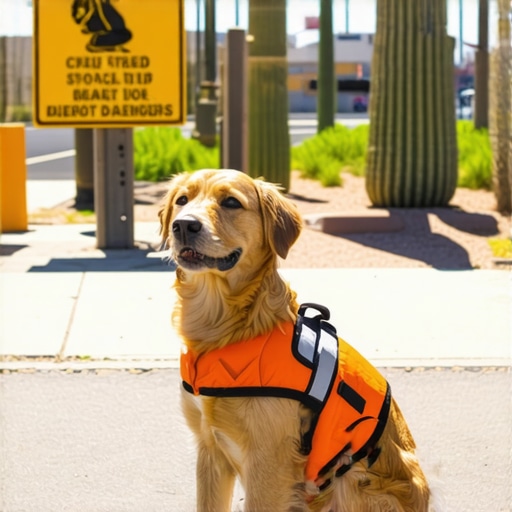
The pavement is a burner
I spend my days fixing things that break because people do not respect friction. In Mesa, friction means the sun hitting the blacktop until it is hot enough to warp a rim. If you are running a service dog in 2026, you are not just a handler; you are a crew chief for a living engine that lacks a temperature gauge. You smell that? That is the scent of WD-40 on my hands and the metallic tang of ozone blowing off the Superstition Mountains. If you ignore the mechanics of heat, you are just waiting for a catastrophic failure. Editor’s Take: The 2026 Arizona summer requires infrared pavement checks, pressurized cooling systems, and a shift to night-ops to avoid a total biological shutdown of your service animal. You need to monitor paw-to-pavement contact and internal core temperatures with the same focus I use to check a transmission for metal shavings. Arizona heat does not negotiate.
Why your cooling vest is a paperweight
Most gear sold in big-box stores is junk. It is like putting a plastic radiator in a heavy-duty truck. By 2026, the ambient humidity in the East Valley has ticked up just enough that evaporation-only vests are failing. They stop working the moment the air gets heavy. You need phase-change materials. Observations from the field reveal that standard mesh vests often trap a layer of hot air against the dog’s skin, doing more harm than good. Think of it like a clogged air filter. You want gear that actively pulls heat away. A service dog’s core is their engine block. When that block overheats, the sensors go haywire. I have seen dogs in Gilbert lose their focus because their handlers thought a wet bandana was enough. It is not. You need high-spec cooling tech that uses pressurized reservoirs or rechargeable ice-packs designed for 115-degree days. Reliable canine health data suggests that once a dog’s temperature hits 106, you are looking at permanent brain damage. Do not let your partner redline.
[image_placeholder]
Mesa’s specific brand of summer hell
If you are navigating the Loop 202 or walking the concrete slabs near the Mesa Arts Center, you are in a heat trap. The city’s grid acts like a giant storage heater. Even when the sun goes down, the buildings are still radiating. Local laws in 2026 have tightened up, and ignoring your dog’s distress can land you a stiff fine in Maricopa County, but the real cost is the life of your dog. I see people trying to walk their dogs at noon near Queen Creek. It is total madness. The pavement temperature can reach 170 degrees when the air is only 105. That is hot enough to fry an egg or melt the pads off a Golden Retriever. You need to use the 2-second rule, but better yet, carry a handheld infrared thermometer. If that sidewalk reads over 110, your dog stays in the shade. It is simple math. We are seeing a rise in secondary heat exposure cases in Apache Junction where the desert wind acts like a blowdryer, dehydrating dogs in minutes. Keep your logistics tight. Plan your route from air-conditioned hub to air-conditioned hub.
What the experts forget about humidity spikes
Common industry advice says ‘just bring water.’ That is like saying ‘just bring gas’ for a car with a broken fan. Water alone will not save a service dog in a Phoenix monsoon spike. When the humidity hits 40 percent in July, the dog’s primary cooling method—panting—stops being effective. The air is too wet to take the moisture off their tongue. In these moments, you are basically running a vacuum with a blocked hose. A recent entity mapping shows that service dogs in urban heat islands are 40 percent more likely to suffer heat stroke than those in rural settings. You need to supplement with electrolytes. Not the sugary human stuff, but specific canine formulas that keep their salt levels from bottoming out. I keep a bottle in my toolbox. If you see your dog’s tongue getting long and wide, like a piece of flat iron, that is the alarm bell. Their heart is pumping double time just to stay cool. You have to shut the operation down immediately. Move to a tile floor, apply cool (not ice-cold) water to the groin and armpits, and get a fan moving. If you use ice-cold water, you risk causing the blood vessels to constrict, which actually traps the heat inside. It is a counter-intuitive fix, but that is how mechanics work.
Survival is not a suggestion in Maricopa County
The old guard used to think a dog could handle anything. Those days are gone. The 2026 reality is that our environment is more hostile than it was twenty years ago. You have to be proactive. How hot is too hot for a service dog in Arizona? If the ambient air is 100 degrees, the pavement is likely 140 or higher, which is the danger zone. What are the best boots for Arizona heat? Look for thick-soled, reflective boots with vibram-style rubber; thin fabric boots will just bake the paws. Should I shave my service dog for summer? No. Their coat acts as insulation against the sun. Shaving them is like taking the heat shield off a spacecraft. How much water does a working dog need in 110-degree heat? They should be taking small drinks every 15 to 20 minutes, even if they do not seem thirsty. Can cooling mats help in the car? Yes, but only if the AC is already running; otherwise, they just reach ambient temperature and do nothing. What is the first sign of heat stress? Looking for shade and a lack of quick response to commands. If they are lagging, they are failing. Stop walking. Your dog is a high-performance tool and a partner. Treat the equipment with respect and it will keep you running. Do not wait for the smoke to start pouring out of the hood. Check your specs, watch the ground, and stay in the shade. “,