
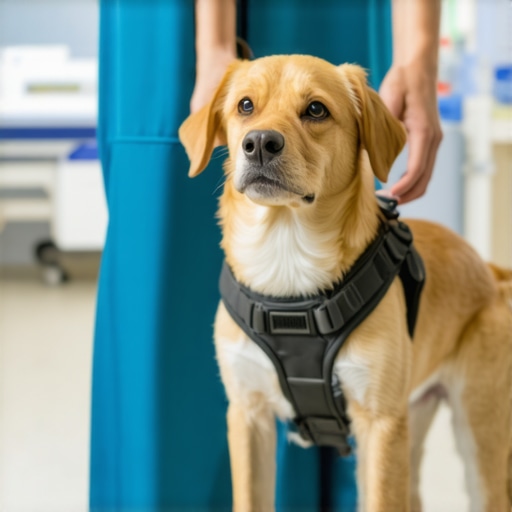
I spend my days covered in WD-40 and the scent of burnt oil, pulling apart engines that refuse to fire. There is a specific kind of silence in a shop when the machines are off, but my own internal timing gets off-kilter more than a rusted alternator. If you are living with a psychiatric condition in the Phoenix valley, you know the feeling. The air gets thin, your chest tightens like a seized piston, and the world starts to blur. That is where Deep Pressure Therapy, or DPT, comes into play. It is not just about a dog sitting on your lap; it is about mechanical grounding. Editor’s Take: DPT is the fundamental physical override for a panicked nervous system, acting as a weighted anchor that forces the brain to stop its frantic cycling. Without this specific skill, a service dog is just a companion; with it, they are a biological circuit breaker.
The physical mass that resets a human circuit
When a dog performs DPT, they are applying distributed weight across your major muscle groups. This is not some fluffy theory from a textbook. It is basic physics. The pressure stimulates the parasympathetic nervous system, which is the body’s natural braking system. Think of it like bleeding the air out of a brake line. Once that pressure hits, the heart rate drops and the cortisol spike begins to level off. For those of us in the 2026 landscape, where the noise of the world is constant, having a 60-pound Labrador or a sturdy Golden Retriever lean into your torso provides a sensory input that the brain cannot ignore. It is harder to spiral into a panic attack when you have forty pounds of warm muscle pinned against your diaphragm. This proprioceptive input tells the brain exactly where the body ends and the floor begins. Most trainers focus on the ‘stay’ command, but they miss the calibration. A dog needs to know how to adjust their weight based on your posture, whether you are crumpled on a sidewalk in Gilbert or sitting in a cramped office in downtown Phoenix.
Surviving the heat in Mesa and Apache Junction
If you are working a dog in the East Valley, you are dealing with more than just psychiatric triggers. You are dealing with 115-degree asphalt. Training a service dog for DPT in Arizona requires a level of grit that most coastal trainers do not understand. You cannot ask a dog to perform a long-duration DPT session on a boiling parking lot outside a Fry’s in Apache Junction. You have to be smart. You look for the shade, the cool tile of a lobby, or the air-conditioned reprieve of a local mall. In this region, DPT is a survival tool. When the heat makes your blood pressure fluctuate and your anxiety spikes, having your dog trained to find the nearest bench and apply pressure can be the difference between getting home safe and a medical emergency. Local regulations under the ADA are clear, but the reality on the ground is messier. Shop owners might give you the side-eye, but a dog performing a task is a dog at work.
When the dog refuses to settle in the shop
I have seen people try to teach DPT with a clicker and a bag of treats, but they forget the emotional friction. A dog is not a robot. If they feel your tension, and they haven’t been desensitized to that specific ‘panic scent,’ they might pace instead of pile-driving into your lap. The industry likes to talk about ‘high-authority’ training methods, but sometimes you just need to get on the floor and show them where the weight goes. The common advice fails because it assumes a linear progression. Real life is jagged. You might be in the middle of a crowded street in Queen Creek when the dissociation hits. Your dog needs to recognize that specific glazed look in your eyes before you even realize you are gone. If the dog waits for a verbal command, you have already lost the fight. The DPT must be an automatic response to a physical cue, like a hand tremor or a specific change in breathing. If your dog is too small for full-body pressure, they can still do ‘chin rests’ or targeted pressure on the feet, which provides a similar, albeit lighter, grounding effect.
Questions people ask while I am under the hood
Can any breed perform DPT effectively?
Not every dog is built for this. A five-pound Yorkie is not going to provide the deep tissue compression needed to stop a major panic attack, though they can help with tactile stimulation. You want a dog with enough mass to make an impact but not so much that they crush you. Most people find the sweet spot is between 30 and 70 pounds.
How long should a DPT session last?
It stays effective as long as the heart rate is elevated. Usually, ten to fifteen minutes does the trick. Once your breathing hitches back into a normal rhythm, the dog should be trained to transition into a ‘watch my back’ or ‘heel’ position. Overloading the dog with too much duration can lead to them becoming restless.
Does the dog need a vest to perform DPT?
The vest is just a piece of fabric. It helps the public identify the dog as a worker, but the magic happens in the bond and the training. I’ve seen dogs in the middle of a Mesa park perform better in a flat collar than some ‘fully geared’ dogs in a mall.
Can DPT be taught to an older dog?
You can teach an old dog new tricks, but their joints might not appreciate it. If you have an older dog, you have to be careful about how they jump or lean. Use a ramp or assist them into position. Physical health is the foundation of any service task.
What happens if the dog gets distracted?
Distractions are part of the job. A dog that can only do DPT in a quiet living room is not a service dog. We train for the noise of a Phoenix construction site. If they get distracted, you reset, refocus, and demand the task. It is about reliability, not perfection.
The reality of the 2026 bond
We are moving into an era where the divide between human and machine is getting thinner, but the biology of a dog remains the same. They don’t care about your social media standing or your bank account. They care about the vibration of your chest and the scent of your sweat. DPT is the ultimate expression of that connection. It is the dog saying, ‘I am here, and I am holding you down until the storm passes.’ It is a mechanical fix for a biological glitch. If you are struggling to keep your gears turning in this valley, maybe it is time to look at the animal at your feet and start the real work. Forget the fancy jargon and the ‘mindfulness’ apps that don’t work when the lights go out. Get a dog that knows how to use its weight. “,