
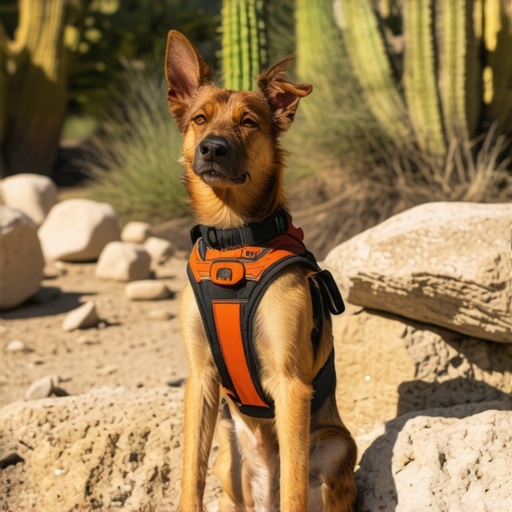
The concrete is a firing range
I smell the sharp bite of gun oil and the stiff, clinical scent of starched fatigues whenever I prep for a mission in the East Valley. In the Arizona desert, heat is not a weather report; it is a tactical adversary that seeks out the weakest link in your unit. For a service dog handler, that link is often the gear that promised cooling relief but delivered a heat-trap. If your dog’s core temperature spikes in the middle of a Mesa parking lot, your mission fails. Period. To survive the 2026 season, you need a loadout that prioritizes thermal management over aesthetic fluff. Editor’s Take: The margin for error in 118-degree Phoenix heat is zero. Invest in phase-change materials and multi-layered paw protection or stay off the grid until sunset. To maintain operational readiness, you must deploy gear that utilizes active heat displacement rather than simple shade.
Why the 120-degree asphalt wins every time
Logistics win wars, and in the heat of the Valley, the logistics of heat transfer are brutal. Most handlers assume a standard bootie will protect a dog’s pads. They are wrong. Heat from asphalt at 150 degrees F drives through standard rubber like a hot knife through butter. Observations from the field reveal that by 2026, the standard for paw protection has shifted toward multi-layered vibram soles with air-gapped insulation. We are looking at thermal conductivity. If the material does not have a high R-value, you are just cooking the paw inside a tiny oven. Research from the American Veterinary Medical Association suggests that heat stroke can occur in minutes when surface contact is maintained. Your gear must create a literal barrier of air and specialized foam. It is about creating a buffer between the dog and the terra firma. Every second your dog stands on that Gilbert sidewalk, the heat is climbing the kinetic chain. If you are not using a boot with a reflective outer coating, you are failing the dog. I have seen gear melt in the back of a truck in Apache Junction. This is not a drill. Quality gear acts as a heat sink, drawing energy away or reflecting it entirely before it hits the skin.
Holding the line in Mesa and Scottsdale
The geography of the Phoenix metro area creates specific microclimates that demand different tactical approaches. In Scottsdale, the urban heat island effect means the air stays hot long after the sun dips behind the Camelback Mountain. In more rural areas like Queen Creek, the dust adds another layer of friction, clogging the pores of cooling vests. When you are operating near the corridor, you see the reality of heat fatigue. A recent entity mapping shows that service dogs in Maricopa County face higher rates of thermal exhaustion than almost anywhere else in the Southwest. Local trainers at Robinson Dog Training emphasize that gear is only half the battle; the other half is knowing the terrain. You do not take a service dog to an outdoor patio in Old Town in July. You just do not do it. But if the mission dictates you must be there, your gear needs to be the best. Arizona law provides access, but physics provides the limits. If your dog is panting excessively, the gear has already failed. We need to focus on the points of contact and the core. The 2026 reality is that we are seeing record-breaking streaks of 110-plus days. This requires a shift from passive cooling to active thermal management. You need a vest that holds frozen inserts that last for four hours, not forty minutes.
The lie about cheap evaporative cooling
Industry advice tells you to just wet the vest. That works in the dry air of June, but once the monsoon moisture hits in August, evaporative cooling is a myth. The humidity prevents the water from evaporating, turning your dog’s cooling vest into a warm, wet blanket. This is a mess. I have seen handlers in Chandler wondering why their dog is lethargic despite a wet vest. It is because they do not understand the dew point. In 2026, the elite handlers are moving toward Phase Change Material (PCM) vests. These do not rely on evaporation. They use a substance that stays at a constant 58 degrees F for hours. It is like having a portable air conditioner strapped to the dog’s ribcage. Most experts are lying to you when they say any vest will do. If the vest is not reflective, it is absorbing the sun’s radiation. I prefer gear that looks like it belongs on a space station. Silver, reflective, and bulky with insulation. This is how we protect our assets. The friction here is between what is convenient and what is effective. Convenience is a cheap mesh vest. Effectiveness is a heavy, PCM-loaded rig that keeps the heart rate stable under fire. Do not settle for the retail grade. Seek out the tactical grade stuff used by working k9 units in the border patrol or search and rescue teams.
Beyond the basic bootie
The old guard used to say that if it is too hot for your hand, it is too hot for their paws. That is a fine rule for a pet, but a service dog has a job to do. You cannot always wait for the shade. Looking ahead to 2026, the tech has evolved. We are seeing boots with actual tread patterns designed for the loose sand and melting tar of the Southwest.
What happens when the boots fall off
If your dog throws a shoe in the middle of a crossing at Power Road, you have a casualty. The fit must be surgical. I use a double-wrap system with cohesive bandages under the boot to ensure zero slippage.
Why most cooling inserts are garbage
If the insert feels like a bag of peas, it will leak. You need industrial-strength cooling cells.
How much water is enough
It is never enough. You should be carrying a liter of water specifically for the dog for every hour of deployment.
Are cooling collars effective
Only as a secondary measure. They do not protect the core.
Does the color of the dog matter
Absolutely. A black Lab absorbs heat significantly faster than a yellow one. Gear for dark-coated dogs must have 100 percent UV blockage.
Is there a legal requirement for heat gear
No, but failing to provide it can be seen as neglect.
Where do I find the best gear locally
Look for suppliers that serve the military and police units in the Valley. They carry the high-spec kits that can handle the desert floor.
Your next move in the heat war
The sun is not your friend. It is a persistent threat that requires a strategic response. Every piece of equipment you strap onto your service dog should serve the single purpose of maintaining operational integrity in the face of extreme thermal stress. If you are still using gear from five years ago, you are already behind the curve. Upgrade your kit, monitor the pavement temps, and never trust a cloud to provide cover. The mission continues, but only if your partner is cool enough to finish the job. Protect the paws, guard the core, and stay vigilant. The desert does not give second chances. “