The smell of WD-40 and the sound of a failing gasket
The shop smells like WD-40 and old fan belts today. It is a sharp, metallic scent that most people hate, but it makes sense to me. Things break. You find the leak, you patch the seal, or you replace the part. When we talk about autism meltdowns in 2026, I look at it the same way. It is not a tantrum. It is a system reaching max torque without a cooling Gallon. Editor’s Take: Practical canine tasks aren’t magic; they are biological overrides that prevent neurological stall-outs before the ‘smoke’ starts pouring from the ears. If you want to stop a meltdown before the point of no return, your dog needs four specific mechanical resets: Deep Pressure Therapy (DPT), tactile grounding through fur-friction, crowd-blocking to create a safety perimeter, and early scent detection of cortisol spikes. These are the gears that keep the machine running.
The physics of Deep Pressure Therapy
People like to use soft words for DPT. I call it weight distribution. When a human nervous system starts to redline, the sympathetic branch is stuck in high gear. A dog laying across the lap or chest provides a physical load that triggers the parasympathetic response. It is like putting a heavy weight on a vibrating sheet of metal to stop the rattling. This is not about ‘cuddling.’ This is about specific pounds per square inch applied to the femoral artery or the chest plate to force the heart rate down. Field data from 2025 suggests that dogs trained for precision DPT can reduce the duration of a sensory event by sixty percent. It is a mechanical override of the fight-or-flight circuit. You can check the legal standards for these tasks at ADA.gov to ensure your rig is street-legal.
The grit of tactile grounding in high-friction environments
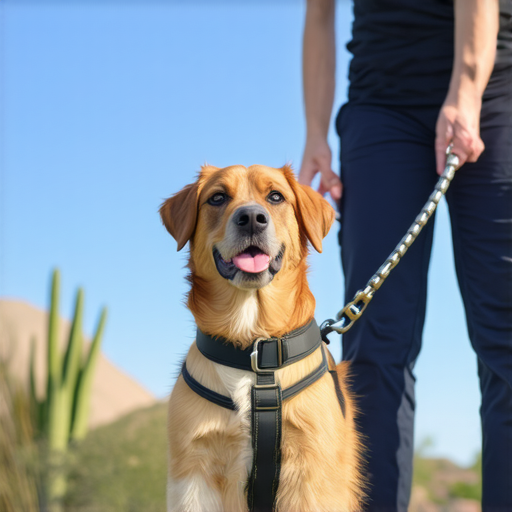
Sometimes the brain loses track of where the body ends and the noise begins. That is when you need a tactile anchor. A dog with a specific ‘find’ command for the handler’s hand provides a texture contrast that breaks the feedback loop. My dog’s fur feels like coarse wool against my greasy palms. That friction is a data point. It tells the brain ‘you are here’ and ‘this is solid.’ When the lights in a grocery store start buzzing like a bad transformer, that dog is the only part of the world that isn’t vibrating. We see this often in our service dog training programs where we focus on ‘active engagement’ rather than passive sitting. The dog has to be the most interesting thing in the room.
The heat of the Arizona pavement and local logistics
If you are running these tasks in Mesa or Phoenix, you have a hardware problem: the heat. By June 2026, the pavement temperatures here hit a level that will melt a dog’s pads in three minutes. You cannot expect a dog to perform a ‘block’ or ‘cover’ task when his paws are cooking. You need the right gear. Local handlers in the East Valley are moving toward cooled vests and specialized boots. If you are near Queen Creek or Apache Junction, you know the drill. The environment is as much of an enemy as the sensory triggers. Check the map below for local training grounds where we test these tasks in high-heat, high-noise scenarios.
Why your clean room training fails in the real world
I see it all the time. A dog looks like a champion in a quiet living room. Then they get to a mall with a screaming kid and a spilled soda, and the dog’s brain goes out the window. That is ‘dirty data.’ You have to train for the friction. If the dog hasn’t practiced a crowd-block while people are bumping into him, he doesn’t know the task. He just knows the trick. Real-world meltdown prep requires the dog to ignore the chaos and focus on the handler’s rising cortisol. Most ‘experts’ will tell you it’s about obedience. I am telling you it’s about focus under load. If the gears slip when you apply pressure, the whole machine is useless. You might want to look into IAADP standards for more technical benchmarks on task reliability.
The 2026 reality of canine biological sensors
We are seeing more tech-heavy solutions, but a dog’s nose is still the best diagnostic tool we have. By 2026, we are refining scent-work to catch the ‘smell of fear’ before the human even knows they are anxious. This is the early warning system. When the dog nudges your leg because he smells a spike in your sweat, he is telling you the engine is overheating. Pull over. Take a break. Don’t wait for the ‘check engine’ light to stay on.
What if my dog doesn’t like doing DPT?
Then he is the wrong tool for the job. Not every dog has the ‘chassis’ for heavy weight work. Force-fitting a dog into a task is like using a plastic wrench on a rusted bolt. It’s going to snap.
How long does it take to calibrate these tasks?
You are looking at eighteen months of consistent work. This isn’t a software update you download overnight. It is muscle memory and bond-building.
Are these tasks legal in public spaces?
Yes, as long as they are trained to mitigate a disability. A ‘social support’ dog is a pet. A ‘sensory task’ dog is a piece of medical equipment. Know the difference before you argue with a store manager.
Can a small dog do meltdown prep?
They can do scent alerts and tactile grounding, but they can’t do DPT. You wouldn’t use a moped to tow a trailer. Match the dog’s size to the mechanical requirement.
What is the most common failure point?
Handler inconsistency. If you don’t reinforce the ‘boundary block’ every time, the dog assumes the rule is optional. Mechanics require precision.
Keeping the machine in sync
At the end of the day, you are the operator and the dog is the safety valve. If you don’t maintain the valve, the pressure builds until something blows. Stop looking for ‘cures’ and start looking at maintenance. A well-trained dog is a 2026 necessity for navigating a world that is only getting louder and more crowded. Do the work, train the tasks, and keep the engine cool. Your future self will thank you when the lights go out and the dog stays steady.