
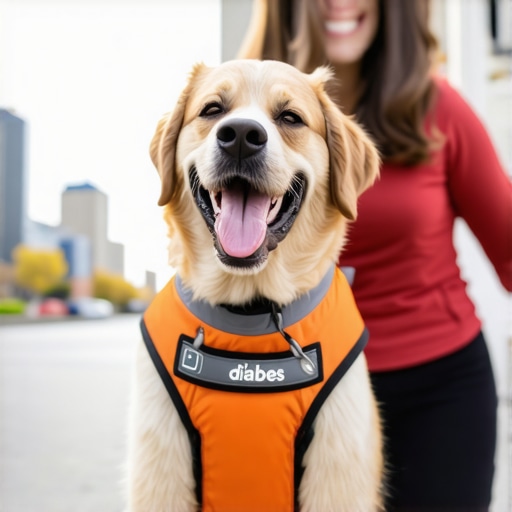
The shop smells like WD-40 and cold, bitter coffee. I spent thirty years fixing engines that people swore were running fine until a piston shot through the hood. That is what a Continuous Glucose Monitor (CGM) feels like when it is lagging. It is a gauge that tells you the oil pressure was low ten minutes ago. If you are a Type 1 diabetic, ten minutes is the difference between a normal afternoon and a trip to the floor. The simple truth is that CGMs read interstitial fluid, not blood. This creates a physiological delay. A 2026 Diabetic Alert Dog (DAD) smells the metabolic shift on your breath before the glucose even leaves your bloodstream. While the sensor is still processing data from the past, the dog is already pawing at your leg for the future. This is the biological advantage.
The twenty minute phantom in your sensor
When you look at a sensor, you are looking at a chemical reaction happening in the fluid between your cells. It is a proxy. It is not the real thing. I have seen guys in the shop trust a digital torque wrench over their own hands and end up with snapped bolts. Same thing happens here. The time it takes for sugar to move from the blood into the interstitial fluid can be anywhere from 5 to 25 minutes. If your sugar is crashing fast, that sensor is showing you a number that no longer exists. A dog, however, is tuned to the VOCs (Volatile Organic Compounds) that your body pushes out through the skin and lungs the second the chemistry shifts. Scientists call it the ‘lag time’ but I call it a failure of design. A study on CGM accuracy shows that during rapid changes, the device can be off by significant margins. The dog does not care about your fluid. The dog smells the exhaust of your engine before the dashboard light even flickers. It is about raw input versus processed data. People ask me why a dog wins in 2026 and it is because the dog does not have to ‘think’ or ‘calculate.’ It just knows.
When the silicon fails in the Mesa heat
Here in Arizona, the heat is a different animal. I have watched sensor adhesives melt right off the arm of a hiker in the Usery Mountain Regional Park while the sun was still climbing. When it hits 110 degrees in Mesa or Gilbert, the electronics in a CGM can get wonky. Sensors are sensitive to temperature extremes. A dog? A dog from Robinson Dog Training is conditioned for the reality of the Southwest. They are not affected by a low battery or a failed Bluetooth connection. I have seen people staring at their phones, waiting for a signal that was blocked by a microwave or a thick wall, while their blood sugar was cratering. The dog does not need a Wi-Fi signal to tell you that you are in trouble. We are talking about a bio-sensor that works in the dark, in the heat, and in the middle of a dead zone. The local reality is that tech is fragile. If you are walking down Main Street in Mesa, you want a partner that can handle the grit, not a piece of plastic that might give up because it got too sweaty.
The messy reality of compression lows and sensor errors
Ever wake up at 3 AM to a screaming alarm telling you that you are at 40 mg/dL, only to prick your finger and see a perfect 100? That is a compression low. You rolled over on your sensor and the pressure tricked the device. It is a false alarm. It ruins sleep and breeds distrust. A dog does not have compression lows. A dog does not get ‘Sensor Error’ messages that require a two-hour warm-up period. I have seen the frustration on the faces of parents in Phoenix who are on their third sensor replacement in a week because the ‘high-tech’ solution keeps failing. A trained service dog provides a level of redundant safety that silicon cannot touch. When the sensor says ‘Wait’ or ‘Calibrate,’ the dog is still on duty. There is a psychological weight to constantly checking a screen. It is like looking at a broken speedometer. After a while, you just stop looking. But you cannot ignore a wet nose on your hand or a persistent bark. The dog forces you to pay attention to the reality of your body, not the suggestion of an algorithm.
Biological sensors do not need charging
The tech industry wants us to think that more data equals more safety. They are wrong. Better data equals more safety. The ‘Old Guard’ relied purely on finger sticks, which was like checking your oil with a dipstick every fifty miles. The CGM was supposed to be a continuous gauge, but it is a gauge with a laggy needle. In 2026, the reality is that the best tool for the job is the one that has been evolving for thousands of years. Dogs have 300 million olfactory receptors. We have six million. They are seeing a world of scent that we cannot even imagine. When we talk about Diabetic Alert Dogs, we are talking about a system that never needs a software update. It does not need a charging cable. It does not need a subscription fee. It just needs a bond and a bit of kibble.
Common questions about the dog vs tech debate
Does a dog replace my CGM? Not necessarily, but it acts as the primary early warning system that catches what the tech misses. Think of it as the experienced mechanic hearing a knock in the engine before the computer throws a code.
What happens if the dog is sleeping? Their nose stays active even when they are dozing. A drop in scent will wake a trained dog faster than an alarm clock wakes a teenager.
How does heat affect the dog’s ability to alert? While heat can be tiring, a dog’s scent detection remains sharp as long as they are hydrated and managed correctly, unlike sensor adhesives that simply fail.
Can any dog be an alert dog? No. It takes a specific temperament and a high drive for scent work. We are looking for the elite performers, not just a pet.
Is the lag time really that bad? For some, a 15-minute delay is fine. For others, it is the difference between catching a low and passing out.
The finish line is not digital
Stop trusting the screen more than you trust the symptoms. The machines are getting better, sure, but they are still playing catch-up with the nose of a dog. If you are tired of the lag, the false alarms, and the plastic failing in the sun, it is time to look at a biological solution. A dog from Robinson Dog Training is not a gadget. It is a partner that keeps you upright when the tech decides to take a break. Get a system that actually runs when the heat is on. Reach out and see how a real alert feels before the lag catches up with you.