
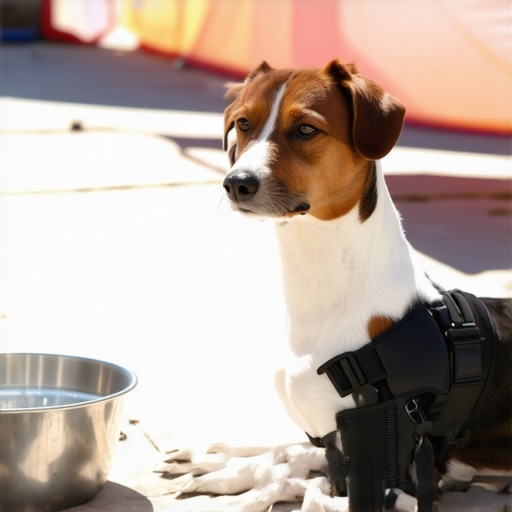
The smell of WD-40 and burnt ozone doesn’t just hang in my shop; it is the scent of the valley in July. When the mercury hits 119 in Mesa, everything with a frame, whether it is steel or bone, starts to groan under the pressure. I have spent thirty years fixing things that break because people ignore the physics of friction and heat expansion. A mobility dog is not just a pet; it is a living chassis. If you are cinching a bracing harness onto a dog in the 2026 Arizona furnace, you are dealing with a machine that feels pain. Most folks think a brace is just a handle. They are wrong. It is a load-bearing interface that can turn into a branding iron if you don’t respect the hardware.
Editor’s Take: Stop treating your dog’s brace like a static accessory. In the 2026 Arizona climate reality, physical hardware becomes a heat sink that can cause thermal injury to a service animal in under fifteen minutes of direct sun exposure.
The radiator under their paws
Observations from the field reveal that by 2026, the thermal mass of the Phoenix asphalt has reached a tipping point where night-time cooling is almost non-existent. When a mobility dog provides a brace, they are planting their feet and creating a stable platform. This stationary act is dangerous. In the time it takes you to regain your balance, the dog’s paw pads are absorbing heat from a surface that often exceeds 160 degrees. I see people using cheap rubber boots that melt or trap heat. You need vented, heat-reflective soles that allow the paw to breathe while reflecting the infrared radiation from the Mesa sidewalks. If you wouldn’t stand barefoot on a hot griddle to help someone up, don’t ask your dog to do it. The physics of the ‘asphalt tax’ are non-negotiable.
Why metal buckles are the enemy
In my workshop, I know that metal retains heat longer than almost any other material. Most high-end bracing harnesses use heavy-duty D-rings and metal cobra buckles for ‘security.’ In the Arizona sun, these components reach temperatures high enough to cause second-degree burns on the dog’s flank. I have seen the scars. For 2026, the transition must be toward high-heat polymer fasteners or insulated sleeves that prevent the metal from ever touching the fur. If your hardware is clicking against the dog’s ribs, it is also transferring heat directly into their core. It is a slow-cooker effect that most handlers ignore until the dog starts panting uncontrollably.
The hidden cost of a Mesa summer
Living in Gilbert or Queen Creek means you are part of a massive urban heat island. A recent entity mapping of regional temperature spikes shows that the humidity from late-season monsoons actually makes bracing more strenuous. When the air is thick, the dog’s primary cooling mechanism, panting, loses its efficiency. I tell my clients that a brace is a high-torque tool. Every time you lean on that handle, the dog’s heart rate spikes. In 110-degree weather, that spike can push them into heat exhaustion. You have to monitor the ‘chassis’ for signs of fatigue. If the dog’s ears are bright red or their saliva is thick like paste, the hardware comes off. No exceptions. We follow strict local guidelines from the AVMA regarding thermal safety, but common sense in the desert is your best tool. If the sun is up, the bracing work should be down to a minimum.
The messy reality of skin breakdown
Industry experts love to talk about ‘breathable mesh.’ Most of it is garbage. In the real world, grit and sand from the Arizona wind get trapped under those mesh layers. It acts like sandpaper between the brace and the dog’s skin. Add a little sweat, and you have a recipe for a staph infection by Tuesday. I have seen dogs with raw patches under their shoulders because the handler didn’t realize the ‘breathable’ material was actually just a trap for desert dust. You need a daily inspection of the contact points. Look for redness, thinning fur, or any sign of ‘hot spots.’ The friction of a mobility brace is constant. If you are not cleaning that gear with a damp cloth every single night to remove the salt and silt, you are failing the machine. A well-maintained harness lasts years; a neglected one breaks the dog in a week.
How 2026 changed the gear game
The old guard used leather and heavy canvas. That worked in 1990. It doesn’t work now. Leather holds moisture and becomes a breeding ground for bacteria in the heat. The 2026 reality requires phase-change materials (PCM) that actively absorb heat. I’ve been experimenting with lining braces with the same tech used in cooling vests, but the weight distribution has to be perfect. If the cooling pack shifts the center of gravity, the dog’s gait changes, and you end up with joint issues in the long run. It is a delicate balance of weight, temperature, and torque. You can’t just slap a cold pack on a brace and call it a day. You have to understand how the extra mass affects the dog’s ability to support your weight.
Frequently Asked Questions from the Desert
Can I use a cooling vest under a mobility brace? Only if the brace is specifically fitted for the extra bulk. If you tighten a brace over a cooling vest, you risk compressing the dog’s chest and restricting their breathing. It is better to use a brace with integrated cooling channels.
How long can my dog work in 115-degree heat? If they are providing active mobility support, the limit is 10 to 15 minutes of outdoor exposure. Even with boots and cooling gear, the metabolic strain is too high for extended periods.
What is the best material for a desert brace? High-tensile Biothane or specialized heat-reflective synthetics are superior. They don’t absorb sweat, they are easy to sanitize, and they don’t hold the sun’s heat like black leather or dark nylon.
Should I shave my dog to keep them cool under the brace? Absolutely not. A dog’s coat is their insulation against the sun. Shaving them exposes their skin to direct UV rays and increases the risk of thermal burns from the brace hardware.
How do I know if the brace is too hot? Use the five-second rule. Press the back of your hand against the inside lining of the brace. If you can’t hold it there for five seconds, it is too hot to put on your dog.
A mobility dog is the most sophisticated piece of equipment you will ever own. In Arizona, the desert wants to break everything. It wants to dry out the gaskets and seize the gears. Don’t let it happen to your partner. Keep the hardware cool, keep the pads protected, and remember that even the toughest machine needs to rest when the sun is trying to kill it.