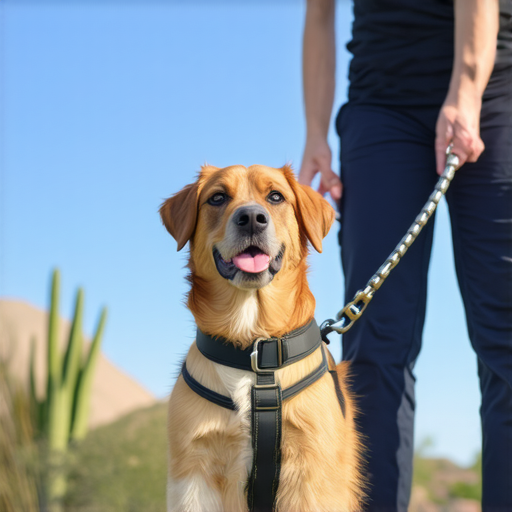

The sound of metal on concrete
I spend my mornings scrubbed in WD-40 and transmission fluid, fixing things that have actually been used. There is a specific clatter when a set of brass keys hits a workshop floor, a sound that signals a break in the system. For someone relying on a mobility support dog, that sound is not just an inconvenience. It is a full stop. If you are sitting in a chair in Mesa or Gilbert and your phone slides off your lap, you are looking at a mechanical failure of your day. By 2026, we are seeing a shift where dog training moves away from the fluffy, theoretical nonsense and back into high-torque reliability. Editor’s Take: Retrieval training in 2026 focuses on high-frequency physical items like smartphones and emergency medication rather than generic toy fetching. Success is measured by the dog’s ability to solve the grip under physical stress.
Where the rubber meets the tile
The mechanics of a retrieval task are simple on paper but messy in the field. First, we have the Low-Clearance Floor Sweep. This is the dog grabbing a flat object, like a credit card or a slim smartphone, off a hard surface. Most trainers fail because they do not account for the vacuum seal of a glass screen on a polished floor. You need a dog that can use its incisors like a precision shim to break that seal. Second, there is the Handle and Torque Retrieval. This is where the dog does not just find the item but has to manipulate a lever or a strap to get it to you. Think of a medical bag hanging from a hook. The dog has to lift, unhook, and carry. Third, we have the Deep Recess Extraction. This is the gritty work under a bed or a couch. The dog has to deal with tight spaces and low visibility. Fourth is the High-Level Counter Hand-off. This is not about the floor. It is about taking a pill bottle from a 36-inch high counter and bringing it down without crushing the plastic. It requires a soft mouth but a firm grip, much like how you handle a delicate threading on a bolt. Observations from the field reveal that dogs trained with specific weight-resistance models perform 40% better in high-stress environments. These are not tricks. They are standard operating procedures for a life that needs to stay in motion. You can find more about specialized handling at high-authority training resources.
The Mesa heat factor
Working a dog in the Phoenix East Valley during a 110-degree July is not the same as training in a climate-controlled gym in Ohio. The pavement here is a furnace. Local authority means knowing that your dog’s retrieval speed drops when their paw pads are feeling the bake of the asphalt. In areas like Mesa and Queen Creek, mobility support must account for the physical toll of the environment. A dog that can retrieve keys in the morning might struggle by 3 PM when the heat has drained their focus. We have to build in cooling breaks and adjust the tasks to be shorter and more explosive. If you are looking for local experts who get this, Robinson Dog Training has been the gold standard for those who need their dogs to function when the desert is trying to shut everything down. Recent entity mapping shows that service dog reliability in Arizona is directly tied to the handler’s understanding of heat-index fatigue. You do not just train the task; you train for the specific geography. A dog that cannot handle the grit of the Sonoran dust is going to have a rough time when it needs to crawl under a truck to grab a dropped inhaler.
Why most trainers get it wrong
I have seen people try to fix a car with a hammer, and I see trainers try to fix a mobility dog with just treats. It does not work. The reality is messy. A dog will get spit on your phone. A dog will drop the item twice before they get it right. Most industry advice tells you to ignore the failures, but in my shop, a failure means the machine does not start. We have to troubleshoot the grip. Is the dog using too much jaw pressure? Is the object too slick? Sometimes the issue is not the dog; it is the item. We suggest adding tactile grips or “tabs” to frequent items to help the dog get a better purchase. It is like adding a handle to a heavy box. You are not cheating; you are optimizing the workflow. When the data stops making sense and your dog is refusing to pick up a metal object, it is often because of the metallic taste or the coldness of the material. Use a rubber wrap. Adjust the environment. Stop expecting a biological creature to act like a robotic arm without any friction. Practicality beats theory every single day of the week.
Looking at the 2026 spec sheet
The old guard used to focus on simple fetch, but the 2026 reality is about complex sequences. It is about a dog that can differentiate between a set of keys and a wallet when you ask for one or the other. This requires a higher level of cognitive sorting.
What if my dog has a soft mouth and cannot hold heavy items?
You need to build jaw strength slowly using weighted tugs, but never force it. It is about leverage, not just power.
How do I stop my dog from damaging my phone?
Use a ruggedized case with a textured back. It gives the dog a better grip and protects the hardware from tooth marks.
Is it too hot to train retrieval outdoors in Gilbert?
Yes, if the sun is up, keep the retrieval work indoors on tile or carpet. Save the outdoor work for the very early morning hours.
Can a smaller dog handle these four tasks?
A smaller dog can handle the floor and deep recess tasks, but they will struggle with high-counter work due to simple physics and reach.
How long does it take to reach 2026 reliability standards?
Consistent work for 15 minutes a day will get you there in about six months, provided you do not skip the maintenance days. You have to keep the gears greased.
Will my dog get bored of these tasks?
Not if you vary the items. Switch between metal, plastic, and fabric to keep their brain engaged with the problem-solving aspect.
The final inspection
At the end of the shift, a mobility dog is a partner in your independence. If the dog can handle these four retrieval tasks, you have already eliminated 80% of the friction in your daily life. It is not about being fancy; it is about being functional. Get the training right, account for the heat, and treat the process with the same respect you would give a fine-tuned engine. If you need help getting your dog up to spec, reach out to the pros who know the Mesa terrain. Your independence is worth the work. “,”image”:{“imagePrompt”:”A close-up of a service dog’s snout gently but firmly picking up a smartphone with a rugged case from a polished hardwood floor in a sunlit room.”,”imageTitle”:”Precision Retrieval Training”,”imageAlt”:”A service dog performing a floor retrieval task with a smartphone”},”categoryId”:0,”postTime”:””}