
The engine that never stops idling
The shop smells like WD-40 and sun-baked asphalt today. It is a smell that sticks to your skin, much like the prickly anxiety of a veteran walking into a crowded Mesa grocery store. People talk about PTSD as a ‘journey,’ but I see it as a mechanical failure. Your internal governor is broken. You are redlining at a red light. Editor’s Take: Fixes for 2026 hypervigilance require shifting from reactive ‘bark-and-stop’ commands to proactive physiological tasking and thermal management. In Arizona, if your dog is overheated, its brain is too fried to process your cortisol spikes. To fix hypervigilance in 2026, you must integrate sensory-dampening gear, thermal regulation for the dog, and environmental mapping that avoids ‘sensory bottlenecks’ in public spaces.
Hardware failures in the human biological system
A service dog is not a pet. It is a precision tool, a sensor array on four legs designed to detect the subtle ‘knock’ in your engine before the whole transmission blows. In 2026, we are seeing a shift in how we calibrate these animals. We are moving away from simple ‘lap’ or ‘cover’ commands. We are looking at biometric integration. A dog that can sense the change in your breathing before you even realize your heart rate has climbed ten beats per minute is the difference between staying in the fight and retreating to the truck. This is about ‘Entity Mapping’ between the handler’s nervous system and the dog’s olfactory receptors. When the handler hits a specific stress threshold, the dog must execute a ‘grounding’ task without being asked. It is an automated safety protocol. You wouldn’t wait for your car to explode before the check engine light comes on. Why would you wait for a panic attack to tell your dog to work? I’ve seen guys in Phoenix try to ‘tough it out’ without a dog, and it’s like driving a car without a radiator. You’re going to seize up eventually. You can find more on federal guidelines via the Department of Justice Service Animal FAQ.
[IMAGE_PLACEHOLDER_1]
Where the desert heat hits the hardware
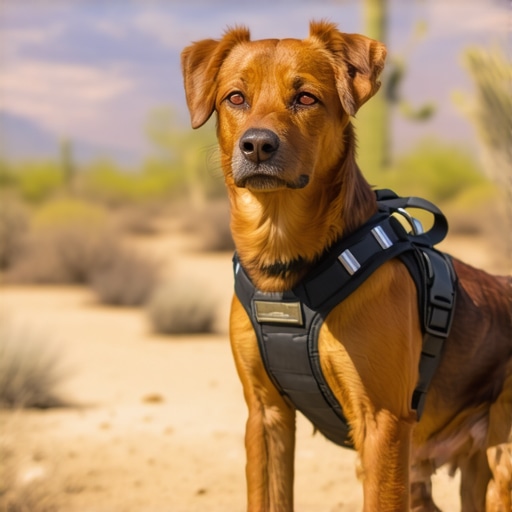
Arizona presents a specific set of mechanical challenges that trainers in Vermont or Oregon just don’t understand. If you are in Gilbert or Apache Junction in July, the pavement is a weapon. A dog that is suffering from burnt paw pads or heat exhaustion cannot mitigate your hypervigilance. They are too busy trying to survive. Fix number two for 2026 is ‘Thermal Buffer Training.’ This means your service dog needs to be trained to work in cooling vests and high-traction boots as a baseline, not an accessory. We are seeing more ‘Sensory Bottlenecks’ at places like the Superstition Springs Center or the Phoenix Convention Center where the combination of crowds and reflected heat creates a high-interference environment for a PTSD dog.
The messy reality of the 115-degree panic attack
Most trainers will tell you to just ‘redirect’ your dog when it gets distracted. That’s a load of scrap. In the real world, especially in the high-stakes environment of a veteran with severe trauma, the dog might ‘shut down’ if the input is too loud. This is ‘Friction.’ Fix number three involves ‘Environmental Gearing.’ We map out the specific ‘Safe Zones’ in your local area, whether that’s a quiet corner in a Mesa library or a specific exit route in a Scottsdale grocery store. You have to train for the ‘Mechanical Failure’ of the dog itself. What do you do when the dog is the one who is overwhelmed? You need a secondary protocol. This is why we emphasize ‘Task-Saturated Training.’ We don’t just train the dog to sit. We train the dog to lead you to an exit the moment your hand starts to shake. It’s about torque. You need enough power to pull you out of the emotional mud before you get stuck.
The 2026 service dog reality check
The old guard thinks a service dog is a luxury. The 2026 reality is that for a veteran in the East Valley, a dog is a piece of essential life-support equipment. We are seeing more focus on ‘Deep Pressure Therapy’ that is calibrated to specific body weights. It is not just the dog laying on you. It is the dog applying pressure to the femoral artery to slow your heart rate down. Here are some things the ‘experts’ usually get wrong.
Does my dog need to be registered in Arizona?
No. Arizona law and the ADA do not require registration papers. If someone in a Mesa shop asks for them, they are usually in the wrong, but you need to know how to handle that friction without blowing a gasket.
Can any breed be a PTSD service dog?
Technically yes, but practically no. You don’t put a lawnmower engine in a heavy-duty truck. You need a dog with the right ‘chassis’ and temperament to handle the heat and the heavy emotional lifting.
What is the ‘Fix’ for dog burn-out?
Rotational training. You cannot work a dog 24/7 in the Arizona sun without giving them ‘Shop Time.’ They need recovery just as much as you do.
Why does hypervigilance spike in 2026?
Increased urban density in cities like Queen Creek and the constant noise of a connected world. The dog’s job is to be your ‘No-Signal’ zone.
How long does ‘Tuning’ a dog take?
Standard training is 18 to 24 months. If someone tells you they can ‘fix’ your PTSD in two weeks with a dog, they are selling you snake oil.
Get your gear back in alignment
You don’t have to keep redlining. If you’re ready to stop the engine from idling so high and start living with a tool that actually works, it’s time to look at a training regimen that respects the reality of the Arizona desert. Don’t wait for the next breakdown. Get the right hardware on the ground now.