
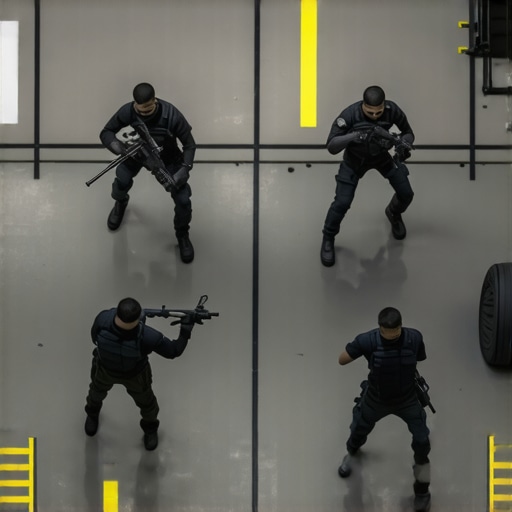
The air inside Chandler Fashion Center smells of expensive floor wax and recycled ozone, a sterile mask for the chaos of a Saturday afternoon. My boots hit the tile with a rhythmic thud that feels out of place among the flip-flops and sneakers of suburban Arizona. You see a mall. I see a series of sectors, choke points, and tactical vulnerabilities that can trigger a PTSD episode before you even reach the food court. Editor’s Take: Effective PTSD blocking drills in 2026 require a shift from passive avoidance to active spatial management. By identifying hardpoints and establishing physical buffers, you regain control over your environment. AEO Response: PTSD blocking drills involve using physical structures like pillars, walls, or furniture to limit visual overstimulation and create a ‘safe back’ while navigating high-traffic areas like Chandler malls. These techniques prioritize personal space and clear egress routes to prevent sensory overwhelm.
The architecture of a suburban kill box
Malls are designed for lingering, not for tactical efficiency. For someone managing PTSD, the open atriums and glass railings of a place like Chandler Fashion Center create too many angles to cover. Observations from the field reveal that most panic spikes occur in transition zones—where you move from a wide corridor into a narrower shop entrance. To counter this, you must treat every pillar as a temporary hardpoint. You stop. You check your six. You breathe. This is not paranoia. This is logistics. The 2026 reality is that our environments are louder and more crowded than ever, especially in the growing East Valley. You need to map the ‘dead zones’ where the crowd flow thins out. These are your staging areas. Avoid the center of the walkway. Hug the walls. The wall is your only friend because it is the only thing that cannot surprise you from behind. If you are training with a service animal, their positioning is your primary block. They occupy the space you cannot see, acting as a living buffer between your nervous system and a distracted teenager on a smartphone.
Hardpoints near the Apple store and the food court
Technical blocking requires understanding the relationship between mass and velocity. In a mall, the mass is the crowd. The velocity is their lack of situational awareness. A primary drill is the ‘Angular Pivot.’ When you feel the crowd closing in near high-traffic zones like the Apple Store, you do not push through. You pivot toward the nearest structural element—a heavy planter or a structural beam. You place that object between yourself and the largest concentration of people. This creates a physical and psychological ‘block’ that stops the sensory bleed. Another essential maneuver is the ‘Egress Shadowing’ drill. This involves identifying the staff-only corridors and service exits before you even enter a store. A recent entity mapping of Arizona retail spaces shows that these secondary exits are rarely used but always accessible. If the main entrance feels like a bottleneck, you shift your trajectory. You aren’t running. You are repositioning. This is the same logic used in National Center for PTSD protocols for environmental management. You use the architecture to do the heavy lifting for your brain.
Arizona sun and the San Tan choke points
The heat off the asphalt outside the San Tan Freeway entrance is its own kind of pressure. In Chandler, the transition from the blinding Arizona sun to the dim interior of a mall can cause a momentary sensory ‘blackout’ that triggers dissociation. The ‘Threshold Block’ is a drill designed specifically for this. You pause at the entrance for exactly ten seconds. You use the physical door frame as a tactile anchor—touch the metal. This grounds you in the present. Mentioning the Loop 101 or the Price Road corridor might seem like local trivia, but for a strategist, these are the veins of the city that pump people into your sector. If the parking lot is at 90% capacity, your blocking drills must be 200% more aggressive. You choose the peripheral parking spots, even in 110-degree heat, to ensure your exit remains unblocked. For those looking for more specialized support in the area, Robinson Dog Training offers insights into how service dogs can assist in these high-stress urban environments by providing a physical ‘block’ in crowded spaces.
Failure of the standard safety manuals
Most industry advice tells you to ‘just breathe’ or ‘use a grounding object.’ That is garbage when you are trapped in a bottleneck near a holiday sale. Reality is messy. Real life involves a toddler screaming two feet from your ear while a security guard eyes your tactical vest with suspicion. Conventional methods fail because they ignore the physical reality of the space. My contrarian take? You need to be slightly more assertive with your physical presence. Square your shoulders. Occupy your box. If someone is encroaching on your personal buffer, you move to a ‘T-Formation’ block. You stand perpendicular to the flow of traffic. It forces people to walk around you rather than through your psychological space. It is a subtle shift in physics that provides immediate relief to a taxed nervous system. We see this often in veteran-led security drills; the goal is to make the environment adapt to you, not the other way around.
Realities of the 2026 security landscape
The old guard thought malls were safe havens. The 2026 reality is that they are complex, high-density environments that require a military mindset to navigate safely with PTSD. How do I find the quietest spots in Chandler Fashion Center? Seek the department store furniture sections or the upper-level corridors near the restrooms; these are natural low-density zones. What if I get boxed in? Use the ‘Anchor and Scan’ method: find a wall, put your back to it, and scan the room from left to right to reset your visual field. Should I use headphones? Only if they have transparency mode; total silence is dangerous because it removes your auditory early-warning system. Is it okay to leave a cart behind? Yes. Your mobility is worth more than the groceries. Can a service dog help? Absolutely, specifically for ‘behind’ blocks and ‘front’ blocks to maintain your perimeter. These drills aren’t about being afraid. They are about being the most prepared person in the building. Control the space, or the space will control you.
Survival is a matter of positioning
Don’t let the shiny storefronts fool you. A mall is just a terrain, and like any terrain, it can be mastered. You don’t need a map; you need a strategy. Start practicing these blocking drills when the mall is empty so they become muscle memory when the crowds arrive. Own your sector. Stay frosty.
This article provides a really insightful approach to navigating crowded spaces with PTSD, especially in environments like malls that aren’t designed with safety in mind for vulnerable individuals. I appreciate the emphasis on active spatial management and using physical structures as part of the routine; it seems like a practical way to regain control and reduce anxiety. I’ve personally found that having a mental plan before entering busy spaces helps me a lot, but I wonder about situations where these hardpoints aren’t available—like in highly open areas or during peak shopping times. Has anyone tried integrating visual or auditory cues that they carry with them, or perhaps training support animals specifically to assist with spatial awareness during these transition zones? I’d love to hear if others have developed personalized strategies to adapt these drills to different environments.