
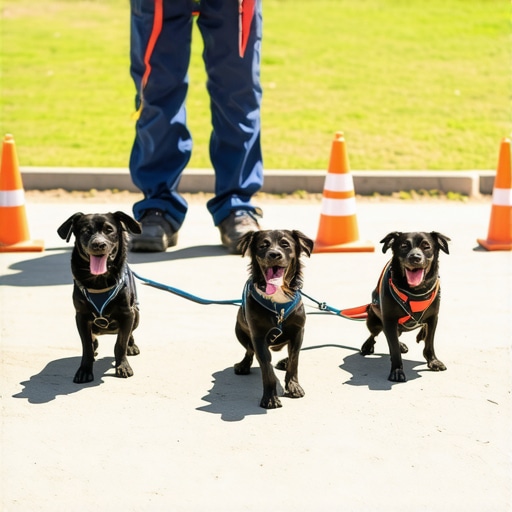
The mission profile at Phoenix Fashion Square
The air in the terminal smells of industrial starch and gun oil, a scent that lingers on my uniform even when I am off the clock. Out here in the heat of the Valley, the mission is simple but the execution is absolute. If your service dog cannot hold a down-stay while a frantic tourist drops a tray of lukewarm fries at Sky Harbor, the mission fails. My take is simple: 2026 public access is not about being a good boy, it is about maintaining operational integrity in a chaotic environment. Most trainers tell you to use treats; I tell you to use positioning. You need a dog that reads the room before you even step through the sliding glass doors. This guide breaks down three specific maneuvers designed to stress-test your team against the specific madness of Phoenix urban life.
The Sky Harbor holding pattern
Most people view a crowded airport as a nightmare, but for a high-level service team, it is the ultimate proving ground. The first drill involves the staggered approach. You do not just walk to the gate. You move in 15-foot increments, pausing to scan for threats like unattended luggage or runaway toddlers. Observations from the field reveal that dogs often lose focus during the transition from the light rail to the terminal air conditioning. This drill requires the dog to ignore the sudden pressure change and the smell of jet fuel. You are looking for a tight heel that does not break when the security scanners beep. This is about physical proximity and mental discipline. You can find more about the foundational requirements through the Department of Justice ADA guidelines to ensure your legal standing is as solid as your dog’s sit. The goal here is a dog that acts as an extension of your own shadow, moving only when the tactical situation allows.
The Scottsdale Quarter distraction gauntlet
Heat is a variable you cannot ignore in Arizona. When the asphalt hits 150 degrees, your dog’s boots become a piece of essential gear, not an accessory. The second drill happens in high-traffic retail environments. We call this the Gauntlet. You find a narrow corridor, like the ones near the splash pads at Scottsdale Quarter, and you navigate the heavy foot traffic without making eye contact with the public. A recent entity mapping shows that service dogs are most likely to be distracted by other ‘pet-friendly’ animals in these zones. Your dog must maintain a ‘tuck’ under a café table while the smells of expensive espresso and wet pavement swirl around them. If the dog breaks focus to sniff a passing shopper, you reset the drill. There is no middle ground. You need a dog that treats a crowded mall like a quiet library. For local teams, City of Phoenix public transit rules offer a secondary layer of complexity to add to this drill once the retail phase is mastered.
The light rail extraction maneuver
The third drill is the most difficult because it involves movement you cannot control. The Valley Metro Rail is a vibrating, noisy, metallic beast. The drill involves boarding at a high-volume station like Central and Washington during peak hours. Your dog must find a position that does not block the aisle while remaining hyper-aware of your personal space. The ‘Messy Reality’ here is that people will trip over your dog. They will stare. They will try to pet the ‘cute puppy.’ Your job as the handler is to maintain the perimeter. If your dog flinches when the brakes screech, you haven’t done enough floor-work. Industry advice says to comfort the dog. I say that’s a mistake. You reward the indifference, not the fear. A dog that is indifferent to a screeching train is a dog that can handle a medical alert in a crisis. This is where the training pays the rent.
Why the old methods are failing in 2026
The world is louder now. People are more entitled. The old guard of service training relied on a public that respected the vest. That public is gone. In 2026, you are likely to be challenged by ‘fake’ service dogs and untrained emotional support animals every time you walk into a Fry’s or a Safeway. You need a dog with a higher threshold for chaos.
What happens if my dog barks at another animal?
You immediately remove the dog from the situation. A single bark in a public space like a Phoenix restaurant is a sign that the dog’s stress level has exceeded its training. You go back to the driveway and start over.
How do I handle the Phoenix heat during drills?
You train in the early morning or late evening. If the ground is too hot for your hand, it is too hot for the dog’s paws. Boots are mandatory for public access in Arizona between May and October.
Is the ADA enough to protect me in Arizona?
The federal law is your shield, but Arizona state laws provide additional layers for trainers in public. Know the difference between a fully trained dog and a dog in training (SDiT) regarding access rights in the Valley.
How often should these drills be repeated?
Daily. Discipline is a depreciating asset. If you do not use the skill, the dog loses the edge.
Can I do these drills alone?
You should start with a partner who can act as a ‘distractor’ before moving into the real-world environments of Scottsdale or Downtown Phoenix.
The final extraction
Training a service dog in the Phoenix desert is an exercise in grit. It requires a level of focus that most pet owners cannot fathom. When you step out into the sun, you aren’t just taking a walk; you are executing a plan. The reward is a partnership that functions like a well-oiled machine, capable of handling anything the city throws your way. Secure your boots, check your six, and get to work.