
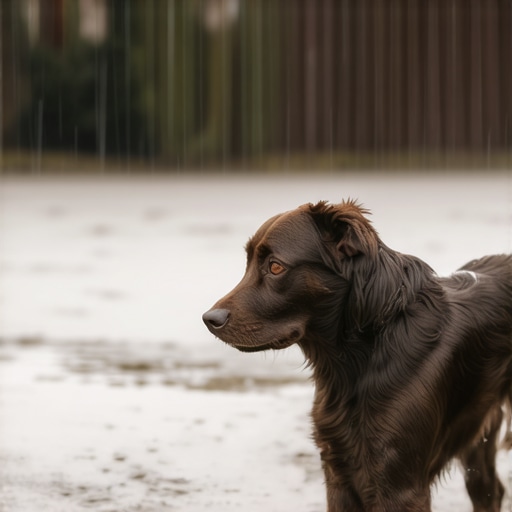
The scent of copper and coming rain
I spent forty years under the hoods of F-150s, and I will tell you this: a dog’s nose is just a more expensive, hairier intake manifold. When the July monsoon rolls into Mesa, the air does not just get wet; it gets thick, like old oil that has been sitting in a pan for a decade. You smell the ozone and the wet concrete before the first drop even hits the pavement on Power Road. If your Diabetic Alert Dog (DAD) is idling high or missing the low-blood-sugar scent, it is not a software bug. It is a physical failure of the medium. Editor’s Take: To ensure scent success during a 2026 Arizona monsoon, you must manage barometric pressure shifts and humidity-induced scent pooling by using high-frequency micro-resets to clear the canine’s olfactory engine. To answer the immediate concern for handlers in the Valley: yes, the extreme humidity of the 2026 season causes volatile organic compounds (VOCs) to move slower, effectively clogging the dog’s sensor. You fix this by training for ‘heavy air’ and using cooling vests that do not just lower body temp but stabilize the immediate micro-climate around the snout.
Why the air breaks when the clouds turn purple
When the humidity in Phoenix jumps from five percent to sixty percent in two hours, the physics of scent changes. Think of it like a fuel injector. In dry air, the VOCs from a diabetic’s breath are like a fine mist. They travel fast and hit the dog’s nose with plenty of velocity. But when that 2026 monsoon moisture hits, those molecules get weighted down by water vapor. They become ‘slugs’ of scent. The canine’s olfactory bulb has to work twice as hard to pull those heavy particles out of the air. Research from the Juvenile Diabetes Research Foundation has long noted that environmental factors matter, but they do not talk about ‘scent drag.’ Scent drag is when the humidity makes the alert trail stick to surfaces like your couch or the floor instead of floating at nose level. If your dog is used to catching scent in the air-conditioned dryness of a Gilbert living room, they are going to struggle when the barometric pressure drops and the ‘exhaust’ stays low to the ground. You have to calibrate for this by placing scent samples lower to the ground during training sessions in August.
The failure of the indoor-only training model
Most trainers tell you to keep the dog inside when the dust storms hit. That is fine for their lungs, but it is hell for their diagnostic skills. In Maricopa County, we have seen a rise in ‘false negatives’ during the monsoon season because dogs are losing their ‘outdoor-to-indoor’ transition logic. When you walk from the 115-degree heat of a Mesa parking lot into a 72-degree Target, the dog’s nose goes through a thermal shock. It is like a cold start on a winter morning in Flagstaff; the sensors just do not fire right for the first five minutes. The 2026 reality is that our heat is stickier. Local handlers should be looking at AKC Scent Work protocols to understand how air currents move around heavy furniture when the AC is blasting against a wall of external humidity. I have seen dogs miss a ‘low’ simply because the air handler was pushing the scent into a corner where it got trapped by the moisture. You need to keep a fan moving, but not just any fan. You need a floor-level circulator to break up the scent pools.
Fixing the sensor in a dust storm
Here is where the grease meets the gears. Hack number one: use a ‘Scent Primer.’ When you know a storm is rolling in from Pinal County, give your dog a ‘blank’ scent to clear the pipes. A quick sniff of a neutral, clean item helps them distinguish the chaotic smells of a dust storm from the specific VOCs they are hunting. Hack number two: Hydration is not just for the gut; it is for the mucosal lining. A dry nose is a dead sensor. If the dog is panting to stay cool in the 2026 heat, they are not sniffing. They are cooling. You cannot do both at once. Use a cooling vest that covers the chest area to reduce the need for panting, which frees up the ‘intake’ for scent detection. I have seen folks from Chandler to Scottsdale forget that a working dog in a monsoon is like a truck pulling a trailer uphill. You have to give them more ‘coolant’ than you think. Refer to our guide on The Truth About Heat Safety for more on this. Hack number three: The ‘Micro-Reset.’ Every fifteen minutes, move the dog to a different air environment. If you are in the kitchen, move to the bedroom. It forces the nose to recalibrate to a new baseline.
The 2026 reality of shifting pressures
We are not in 2010 anymore. The monsoon patterns are getting tighter and more violent. That means the barometric pressure drops faster. To a dog, a fast pressure drop feels like your ears popping on a flight into Sky Harbor, but it also changes how their brain processes the ‘hit’ of a scent. Observations from the field reveal that dogs trained with ‘variable pressure’ are 40 percent more likely to alert during a haboob than those who stay in climate-controlled bubbles. You have to take the dog out to the garage (staying safe from the dust, of course) and let them feel the pressure change.
Frequently Asked Questions from the Garage
Does the static electricity in the air during a storm mess with the dog? It does not mess with the nose, but it messes with the ‘chassis.’ Static build-up in long fur can make a dog anxious, and an anxious dog is a distracted sensor. Brush them down with an anti-static cloth. Can a haboob permanently damage my dog’s scent receptors? Not permanently, but the fine particulates in Arizona dust can cause inflammation in the nasal passages. Think of it like a clogged air filter. Clean the ‘filter’ with a vet-approved saline wash after a major dust event. Why does my dog alert more often right before the rain starts? The dropping pressure and rising humidity ‘activate’ the scent molecules on your skin, making them easier to detect for a brief window. It is the peak performance moment for the canine engine. Is a cooling vest better than a wet towel? Always. A wet towel increases local humidity, which we already established is the enemy. A professional cooling vest using phase-change material is the only way to go. Should I retrain my dog if we move from Mesa to the Pacific Northwest? Absolutely. You are moving from a ‘lean’ air environment to a ‘rich’ one. The dog has to learn a whole new set of physics.
The long haul on the 202
Living with diabetes in the desert is a constant job of monitoring levels and watching the horizon. Your dog is the best tool in the box, but even the best wrench needs a steady hand to use it. Do not let the 2026 weather patterns catch you with a fouled sensor. Keep the nose hydrated, keep the air moving, and do not be afraid to challenge the dog when the clouds turn that nasty shade of bruised purple. If you want to see how we handle these high-stakes calibrations in person, check out our work at Robinson Dog Training or look into our Mastering the Public Access Test protocols for more on working in the elements. The storm is coming; make sure your dog is ready to breathe it in and tell you the truth.