
The ozone scent of a losing argument
The office air smells of sharp ozone and crushed mint. Outside, the Phoenix sun is busy liquefying the asphalt on Washington Street, but inside, the temperature is a clinical sixty-eight degrees. I have seen three clients today who think a gold-embossed certificate from a website based in a tax haven makes their Goldendoodle a service animal. It does not. In fact, it is the quickest way to find yourself on the wrong side of a civil deposition. If you are trying to navigate the complex reality of disability law in the Grand Canyon State, you need to stop looking for a shortcut. The truth is much more grounded. Editor’s Take: Legitimate service dog status in Arizona is proven through the dog’s ability to perform specific tasks and its behavior in public, not through a paid registry or ID card. Certificates are legally meaningless for public access. To prove a service dog’s status in Arizona in 2026, you only need to satisfy the two-question inquiry allowed by the ADA: Is the dog required because of a disability, and what work or task has the dog been trained to perform? No badges, no vests, and no paperwork are required by law for entry into a Mesa bistro or a Scottsdale gallery. The evidence is the work.
The two questions that hold the line
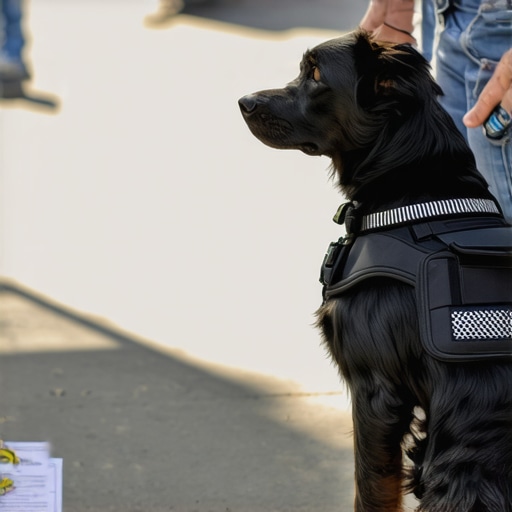
Federal law is a blunt instrument. It does not care about your feelings, it cares about access. Under the Americans with Disabilities Act, which Arizona strictly mirrors, there are exactly two questions a business owner can ask you. If the disability is obvious, they cannot even ask those. If I walk into a deposition with a guide dog, the attorney on the other side cannot ask me a thing. But if your disability is invisible, you must be ready with your answers. You must state that the dog is for a disability and name the task. A task is not ’emotional support.’ A task is ‘detecting a seizure before it happens’ or ‘providing deep pressure therapy during a panic attack.’ This is the first legitimate way to prove status. It is a verbal contract with the public. If you stumble here, you are already losing. The training must be functional. A dog that just sits there is not a service dog in the eyes of an Arizona magistrate. It has to be a tool, a living extension of your own needs. [image_placeholder_1]
Why Arizona statutes are your iron shield
The heat in Maricopa County does not just bake the ground; it bakes the patience of business owners who are tired of fake pets. This is why A.R.S. § 11-1024 is your best friend. This specific Arizona law reinforces your right to have a service animal in any public place. Whether you are in a high-rise in Phoenix or a small cafe in Flagstaff, the state protects your right to be there. This leads to the second way to prove status: the behavior of the animal. A service dog in Arizona is held to a standard of excellence. If the dog is barking at the waiter or sniffing the floor for crumbs at a Gilbert steakhouse, you have effectively disproven its status. The law allows an owner to exclude a dog that is out of control. Proof of status is found in the silence of the animal. It is found in the way it tucks under the table and ignores the world. This is tactical discipline. If the dog behaves like a professional, the law treats it like one.
The paper trail that actually matters
While public access requires zero paperwork, the third way to prove status involves the Fair Housing Act and the workplace. This is where the ‘no papers’ rule hits a wall. If you are trying to live in a pet-free apartment in Tempe, your landlord has a right to ask for a letter from a healthcare professional. Not a certificate from the internet. A real letter from a doctor who knows your history. This is the only legitimate ‘paper’ proof that exists. It establishes the nexus between your disability and the need for the animal. In 2026, Arizona courts are becoming increasingly aggressive toward fraudulent claims. If you present a fake ID card to a landlord, you are handing them the matches to burn your lease. The fourth way to prove status is through training documentation. While not required for entry, keeping a log of the hours spent training in public spaces like the San Tan Village or the Tucson Mall provides a massive evidentiary advantage if you are ever challenged in court. It shows intent. It shows work. It shows that you are not just a person with a pet, but a person with a necessity.
The reality of 2026 and the myth of the vest
The world has changed. The algorithms are watching, and business owners are more educated than they were five years ago. They know that a red vest from an online shop means nothing. They are looking for the ‘glitch’ in your story. If you tell a shopkeeper in Chandler that your dog is a service animal, and then you carry the dog in a shopping cart, you have just forfeited your legal standing. Service dogs must stay on the floor unless their task requires otherwise. We are seeing a shift where the burden of proof is moving toward the ‘demonstrable task.’
Can a business ask for a demonstration of the task?
No. Under the ADA, they cannot require you to show them the task. They have to take your word for it unless the dog’s behavior contradicts you.
What if my dog is still in training?
Arizona is one of the states that grants Service Dogs in Training (SDiTs) the same public access rights as fully trained dogs. However, they must be with a professional trainer or the person with the disability, and they must be identifiable.
Are emotional support animals the same thing?
Absolutely not. ESAs have zero public access rights in Arizona. If you try to pass an ESA as a service dog, you are committing a crime under state law.
Can a landlord charge a pet deposit?
Not for a legitimate service dog or ESA. They are not pets; they are assistive devices. Any fee charged is a violation of the Fair Housing Act.
What happens if my dog bites someone?
The ADA does not protect you from the consequences of a bite. You are liable for any damage or injury your dog causes, regardless of its status.
Do I need a doctor’s note for a restaurant?
No. Never. If a restaurant in Scottsdale asks for a doctor’s note, they are violating federal law. You should document the incident and seek legal counsel.
The closing statement for the prepared handler
The law is not a suggestion. It is a framework designed to protect those who truly need it. In Arizona, proving your service dog’s status is not about having the loudest voice or the fanciest ID card. It is about the quiet confidence of a well-trained pair. You walk in, you answer the two questions with precision, and you let the animal’s behavior speak for the rest. Anything else is just noise. If you find yourself being pushed out of a space you have a right to be in, do not argue with the manager. Take their name, record the interaction, and call a professional who knows how to use the law as a scalpel. The heat in this state is enough to deal with; do not let a legal misunderstanding add to the burn. Keep your training logs tight, your doctor’s letters current, and your dog’s focus on you. That is the only proof that holds up when the sun goes down and the paperwork hits the desk.