
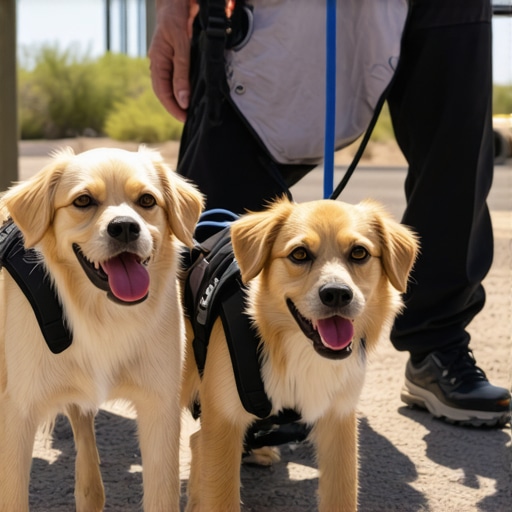
Survival of the Stoutest: Managing 2026 Arizona Heat for Working Dogs
Arizona’s Sonoran Desert has always pushed the limits of endurance, but the projected 2026 heat cycles demand a hard reset on how we equip our mobility assistance dogs. We aren’t just talking about carrying an extra bottle of water anymore. As pavement temperatures routinely soar past 160 degrees, the margin for error vanishes. For handlers relying on their canine partners for balance or retrieval, gear failure isn’t just an inconvenience—it’s a safety risk. We need to look at equipment through a lens of thermal management and durability that most standard pet stores simply don’t understand.
Building a kit that survives a Mesa or Phoenix summer requires specific, battle-tested items. The goal is to keep the dog’s internal temperature stable while ensuring their harness doesn’t become a heat sink. Most handlers make the mistake of over-insulating. In 2026, the focus shifts toward heat dissipation and rapid cooling technologies that mimic high-performance athletic wear.
The Pavement is Lava: Rethinking Bootie Ventilation
Traditional dog boots often trap heat, effectively baking a dog’s paws from the inside out. Dogs sweat through their paw pads, so sealing them in heavy rubber for three hours is a recipe for disaster. Look for boots that utilize heat-reflective soles paired with breathable mesh tops. The sole must be thick enough to provide a barrier against the blistering asphalt but flexible enough to maintain the dog’s proprioception. If your dog can’t feel the ground, their ability to provide mobility support is compromised. We recommend checking for infrared-blocking materials which have become more accessible this year. [IMAGE_PLACEHOLDER]
Phase Change Cooling: Beyond the Soaked Vest
Evaporative cooling vests are popular, but they fail in Arizona’s localized humidity spikes or when the air is simply too hot for evaporation to occur effectively. The 2026 standard is Phase Change Material (PCM). These inserts maintain a constant temperature—usually around 58 degrees—for several hours. Unlike ice packs, they won’t cause cold-induced vasoconstriction, which actually slows down a dog’s ability to cool off. A mobility harness needs to be compatible with these inserts without adding bulk that hinders the dog’s range of motion during tasks like bracing or opening doors.
How Do I Know if My Mobility Dog is Overheating?
Recognizing the early signs of heat stress is a fundamental skill for any Arizona handler. It starts with “brick red” gums and thick, ropey saliva. If your dog’s tongue is excessively wide and flattened, they are desperate to shed heat. Many people wait for a dog to stop working, but a dedicated mobility dog will often push through the pain to serve their human. You have to be the one to call it. Monitoring heart rate and respiration isn’t overkill; it’s responsible ownership in an environment that wants to cook anything that stays outside too long. If their breathing becomes ragged or they seem disoriented, you need to find shade and cool water immediately.
Beyond Water: The 2026 Standard for Canine Cellular Hydration
In the extreme climate of the Sonoran Desert, proactive hydration requires more than just a collapsible bowl and a tap. By 2026, the use of canine-specific electrolyte supplements has migrated from the niche world of racing Greyhounds to the essential toolkit of the Arizona service dog community. Pure water is necessary, but it can lead to hyponatremia if a working dog consumes massive volumes without replacing the minerals lost through metabolic stress and constant panting. We now recommend a ‘pre-loading’ strategy: providing a diluted, isotonic solution thirty minutes before departing into the Mesa midday sun. This ensures the dog’s cellular hydration is peaked before the environment begins to draw it out.
Tactical Route Planning and the ‘Shadow Jumping’ Technique
The concept of ‘shadow jumping’ has evolved into a mandatory tactical skill for handlers navigating the Phoenix metro area. This involves more than simply walking on the shady side of the street; it is the strategic timing of movements between ‘cold spots’—areas with high-albedo surfaces or significant natural airflow. [IMAGE_PLACEHOLDER] Experienced handlers are now utilizing real-time thermal mapping tools that predict building shadows based on the sun’s specific 2026 solar arc. If a route requires more than sixty seconds of exposure to direct sunlight on unshaded concrete, you are effectively gambling with your dog’s core temperature. When a transition is unavoidable, increasing the dog’s pace—without causing overexertion—minimizes the conductive heat transfer between the paws and the thermal mass of the asphalt.
Emergency Intervention: Overhauling the First Aid Kit
Emergency protocols have shifted significantly as summer temperatures continue to break records. If you suspect heat stroke, the legacy advice of draping a wet towel over the dog is now considered outdated and potentially dangerous. In the stagnant heat of a July afternoon, a wet towel can act as an insulator, trapping the heat against the dog’s skin and spiking their internal temperature further. Instead, the 2026 first aid standard focuses on high-airflow cooling. Focus on applying cool—not ice-cold—water specifically to the groin, armpits, and neck where major blood vessels are closest to the surface. During high-humidity monsoon events, where evaporative cooling fails, a portable, battery-operated high-velocity fan is no longer a luxury; it is a critical piece of medical equipment that provides the forced convection needed to shed heat.
Salt Degradation and Harness Maintenance
The physical hardware of your mobility harness requires a rigorous weekly inspection during the desert summer. The combination of the dog’s sweat, salt, and the fine dust of the Arizona basin creates an abrasive paste beneath the straps. This can lead to hidden ‘hot spots’ or friction sores that quickly become infected in the heat. Advanced 2026 gear utilizes biocompatible, friction-reducing liners that are completely removable and antimicrobial. A mobility dog distracted by skin irritation is a dog whose focus is compromised, which directly impacts the safety of the handler during tasks like bracing or navigation. Ensuring the harness remains a tool rather than a source of distress is paramount when the thermometer hits 115 degrees.
The Micro-Climate Trap: Managing Thermal Soak in Service Vehicles
By 2026, vehicle interior temperatures in the East Valley can exceed 180 degrees in under twenty minutes. For a mobility dog handler, the vehicle is often a sanctuary, but without proper management, it becomes a pre-heated oven. The misconception that “the AC is on” is enough can be fatal. Modern vehicles with start-stop engines may cycle the compressor off at long traffic lights, leading to rapid humidity spikes. Handlers must account for thermal soak—the heat retained by leather seats and metal buckles even after the cabin air has cooled. Using reflective ceramic window tints and custom-fitted thermal windshield blankets is no longer optional; it is the baseline for operating a service vehicle in the Phoenix metro area.
High-Flow Ventilation and Remote Monitoring
Relying on factory rear vents is often insufficient for a dog positioned in the cargo area or on the floor. To combat this, follow these advanced steps for vehicle prep:
- Install high-velocity 12V fans to break the boundary layer of air around the dog’s coat.
- Utilize a secondary Bluetooth thermometer placed at the dog’s head height, not the dashboard.
- Pre-cool the vehicle for a minimum of ten minutes before the dog enters to ensure surfaces are safe to touch.
[IMAGE_PLACEHOLDER]
The Double-Coat Paradox: Why Shaving Kills Efficiency
One of the most persistent and dangerous misconceptions in 2026 is that shaving a double-coated dog (like a Golden Retriever or Lab mix) helps them stay cool. In reality, the undercoat acts as a thermal buffer, trapping a layer of cooler air against the skin while the outer guard hairs reflect UV radiation. Shaving removes this insulation, exposing the skin to direct solar gain and significantly increasing the risk of heatstroke. Instead of shaving, the focus must be on de-shedding. Removing the “dead” hair allows for maximum air circulation through the coat, which is the dog’s primary defense against the dry Arizona heat.
The Cognitive Cost of High-Ambient Temperatures
Heat doesn’t just affect a dog’s muscles; it degrades their cognitive processing. By the time a mobility dog reaches a core temperature of 103 degrees, their ability to perform complex tasks—like identifying a specific button or navigating a crowded light rail platform—drops by nearly 40%. This is often mistaken for “stubbornness” or a lack of training. In the 2026 climate, handlers must recognize that heat-induced brain fog is a precursor to physical collapse. If your dog misses a cue they have known for years, it is a signal to abort the mission and seek a climate-controlled environment immediately.
Establishing a Data-Driven Recovery Protocol
Post-exposure recovery is as critical as the work itself. When returning from a high-heat environment, the “cool down” should be structured:
- Gradual transition from 110+ degrees to 75-degree indoor air to avoid shock.
- Immediate removal of all working gear to allow the skin to breathe.
- Offering small, frequent amounts of cool (not iced) water to prevent gastric torsion.
- Monitoring the dog’s capillary refill time (CRT) until it returns to under two seconds.
If recovery takes more than thirty minutes, the dog has likely exceeded their thermal threshold and requires a minimum of 48 hours of rest to allow cellular repair. Skipping this recovery period leads to cumulative heat stress, which can shorten a working dog’s career significantly.
Urban Cooling Corridors: Navigating the 2026 Heat Island
As the Phoenix-Mesa metropolitan area continues to grapple with the intensification of the urban ‘heat island’ effect, urban planning has finally begun to catch up with the needs of service animal teams. By 2026, the implementation of ‘Cool Corridors’—pathways specifically treated with high-albedo coatings—has become a lifeline for working dogs. These surfaces reflect up to 40% more solar radiation than standard asphalt, significantly reducing the thermal load on a dog’s paws. For a mobility dog, identifying these lighter-colored paths is now a core part of advanced environmental training. Handlers are no longer just looking for the shortest route; they are looking for the ‘coolest’ route, often utilizing integrated GPS overlays that highlight these climate-resilient zones throughout Mesa and downtown Phoenix.
Why do dogs stop responding to commands when it’s over 110 degrees?
Many handlers mistake a lack of response for disobedience, but in the 2026 climate, it is almost always a physiological safety mechanism. When a dog’s internal temperature rises, the brain prioritizes autonomic functions—like heart rate regulation and respiratory cooling—over higher-order cognitive tasks. This ‘neural throttling’ means the dog literally does not have the metabolic bandwidth to process complex mobility commands. If your dog begins to ‘buffer’ or stare blankly when given a task, they aren’t being stubborn; their brain is entering a survival-first state to prevent permanent neurological damage. This is why immediate cooling is more effective than repeated corrections in extreme heat.
The Shift Toward Heat-Hardy Working Breeds
The environmental shifts of the mid-2020s have forced a re-evaluation of which breeds are suitable for mobility work in the Southwest. While the Golden Retriever remains a staple, we are seeing an influx of short-haired, athletic breeds with higher surface-area-to-mass ratios. Breeds like the Vizsla or certain smooth-coated herding crosses are becoming more common in the East Valley. These dogs lack the dense undercoat of traditional service breeds, allowing for faster heat dissipation via convection. However, this comes with its own trade-off: these dogs require more frequent ‘hydration-loading’ because they lose moisture faster than their double-coated counterparts. [IMAGE_PLACEHOLDER]
Wearable Biometrics: The 2026 Digital Shield
Technology has become the primary barrier between a working dog and a heat emergency. The latest mobility harnesses in 2026 feature integrated dermal sensors that provide real-time telemetry to the handler’s smartwatch. These sensors monitor the ‘heat-flux’—the rate at which the dog is absorbing energy from the environment. If the sensor detects a spike in skin temperature that outpaces the dog’s ability to pant, it triggers a haptic alert. This takes the guesswork out of the equation. Handlers no longer have to wonder if their dog is okay; the data provides a clear, objective ‘stop’ signal before the clinical signs of heatstroke even appear. This bio-integration is the new gold standard for high-stakes mobility work in Mesa and beyond.
Adapting Public Access: The Right to Shade
Legal protections for service animals have expanded to include ‘thermal safety rights.’ By 2026, many Arizona businesses are required to provide accessible ‘cooling stations’ or allow service dogs to occupy the highest-airflow areas of an establishment, even if it deviates from standard seating charts. For a mobility handler, this means the right to sit directly under an HVAC vent or in a designated ‘shadow zone’ is now protected. Understanding these local ordinances is as vital as the training itself, ensuring that your dog is never forced to hold a ‘down-stay’ on a surface that could lead to thermal injury while you wait for services.
Frequently Asked Questions
Are cooling mats effective for outdoor use in the Arizona summer?
Standard gel-filled cooling mats are largely ineffective outdoors once the ambient temperature exceeds 100 degrees, as they eventually reach thermal equilibrium with the air. For 2026, we recommend pressurized air-flow mats or PCM-based pads that can be swapped out. Always ensure the mat is placed in a shaded area; otherwise, the solar gain will outpace the cooling capacity of the material.
Can I use human sports drinks to hydrate my mobility dog?
No. Most human sports drinks contain xylitol (which is toxic) or high levels of sugar and sodium that are not balanced for canine physiology. Stick to canine-specific isotonic solutions designed for 2026 working standards to ensure proper cellular hydration without risking gastrointestinal distress or electrolyte toxicity.
What is the legal ‘Right to Shade’ for service animals in Phoenix?
Under updated 2026 local ordinances, a service animal handler has the right to request a ‘thermally safe’ waiting area. This includes staying in air-conditioned zones or under high-velocity fans while waiting for public transport or service. Businesses in Mesa and Phoenix are increasingly trained to recognize that forcing a dog to stay on hot patio tiles constitutes a safety hazard.
How do I know if my dog’s boots are actually working?
Check the temperature of your dog’s paws immediately after removal. If the paw pads feel hot to the touch or appear damp with excessive sweat, the boots are either poorly ventilated or the sole material is conducting too much heat. The 2026 standard for high-performance boots includes infrared-reflective layering to prevent this thermal transfer.
The Bottom Line: Adapting to the New Desert Reality
Operating a mobility assistance dog in the 2026 Arizona climate is no longer a matter of simple precautions; it is a discipline of advanced environmental management. From PCM cooling inserts to real-time biometric monitoring, the tools available today provide a layer of safety that was previously impossible. However, the most critical component remains the handler’s intuition and willingness to prioritize the dog’s physiological limits over the schedule. By integrating tactical route planning and data-driven recovery, you ensure that your canine partner remains a capable, healthy, and focused teammate despite the intensifying heat of the Sonoran Desert.
Ensuring your service dog is prepared for these extremes requires specialized training and expert guidance. If you are looking to enhance your dog’s environmental resilience or need a professional assessment of your current mobility gear, reach out to the experts who understand the unique demands of the Mesa and Phoenix landscape. Contact us today to schedule a consultation and keep your team moving safely through the summer.