
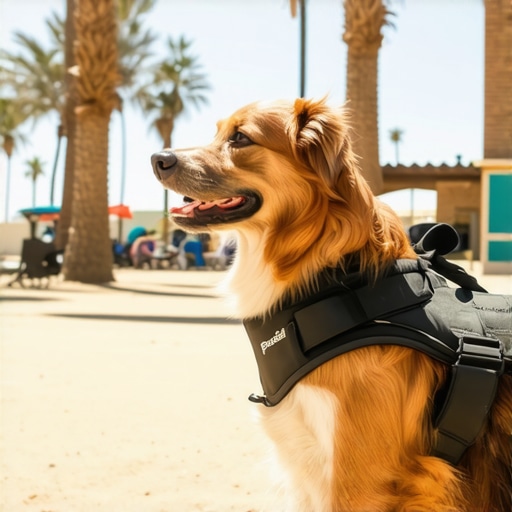
The shop floor smells like WD-40 and scorched metal today. Out there on the Phoenix pavement, it is even worse. You can hear the hum of a thousand air conditioners struggling against the desert, a rhythmic thrumming that never stops. For a service dog handler, that sound is a warning. Your dog is a machine, a finely tuned engine of assistance, but every engine has a thermal limit. When the mercury hits 115 in Scottsdale or Mesa, standard gear stops being a utility and starts being a liability. The Editor’s Take: If you are rely solely on mesh vests in the Arizona sun, you are trapping heat, not venting it. True desert survival requires phase-change materials and reflective shielding to prevent heat soak.
The radiator under the golden retriever fur
Dogs do not sweat like we do. They rely on panting and a small amount of heat exchange through their paws. Imagine trying to cool a truck engine with a single tiny fan. That is what your dog is doing. Service dogs are under higher stress because they are working, not just lounging in the shade at a park in Tempe. Heat soak happens when the core temperature rises faster than the dog can vent it. Most commercial vests claim to be breathable. That word is a trap. In the Phoenix sun, breathable often just means the sun hits the skin faster. You need a system that acts as a thermal bypass. Evaporative cooling works by using the energy of the sun to turn water into vapor, pulling heat away from the dog. But it only works if the humidity is low. Once the monsoon season hits the Valley, those wet vests become portable saunas. That is when you switch to Phase Change Material or PCM. These inserts stay at a constant 58 degrees, absorbing the dog’s heat without needing airflow. It is like having a cooling gasket for your dog. For more on the physiological limits of working dogs, check out the AKC guidelines on canine heatstroke. [image_placeholder] This technology is about managing the thermal load before the dog hits vapor lock.
Where the asphalt melts your boots in Scottsdale
The geography of Phoenix creates a unique problem called the urban heat island. Downtown Phoenix and parts of Glendale stay ten degrees hotter than the surrounding desert because the concrete acts as a giant battery. If you are walking near the Footprint Center or through the shops in Old Town Scottsdale, you are dealing with radiant heat from both above and below. Arizona law is clear about service dog access, but it does not account for the physical toll of 120-degree days. I have seen handlers try to cross the street near Sky Harbor and the dog’s gait changes within seconds. That is the asphalt reaching 160 degrees. A cooling vest must be paired with boots, but the vest is the primary heat sink. In Maricopa County, we have a specific kind of dry heat that makes evaporative vests incredibly effective for about twenty minutes. Then they bone-dry. You need a vest with a high reservoir capacity. I always tell people to look for the gear used by Phoenix service dog trainers who are actually out in the field. They know that a cheap vest from a big-box store will fail when the sun is bouncing off the glass buildings in Mid-Town. These trainers emphasize that a cooling vest is not just a comfort item. It is a piece of safety equipment as vital as a seatbelt.
The lie about breathable mesh
Most industry advice is garbage. They tell you that lightweight mesh is the best. Wrong. In the desert, thin mesh allows the UV rays to penetrate the coat and hit the skin, especially on short-haired breeds like Labs or Pointers. You want a vest with a reflective outer shell. Think of it like a sunshade for a car windshield. It reflects the radiant energy back. The friction here is that these vests are heavier. Handlers worry about the weight. But a slightly heavier vest that actually blocks the sun is better than a light mesh vest that lets the dog cook. Another messy reality is the dust. The Phoenix dust is fine, like flour. It clogs the pores of evaporative fabrics within three days of use. If you do not wash the vest, it loses its cooling efficiency. You are basically wrapping your dog in a dusty blanket. I’ve seen it happen to teams at Mesa K9 handling facilities. They think the vest is working, but the dog is still panting heavily because the fabric is suffocating the evaporation process. You have to maintain the gear like you maintain a car. Clean filters, clean fabric. If you want to know more about the veterinary side of this, the AVMA has data on thermal regulation that every handler should read.
What works when the monsoon hits
The 2026 reality is that our summers are getting longer and the humidity spikes during the monsoon are more intense. The old guard would just soak a vest and call it a day. That does not work anymore. You need a dual-system approach. In June, use evaporation. In August, use PCM inserts. The tech has evolved so that vests now have modular pockets for these inserts. Here are the common issues we see in the shop. Can a wet vest cause steam burns? Not if there is airflow, but if the dog lies down on a hot surface with a wet vest, you are creating a pressure cooker effect. Does vest color matter? Absolutely. Black vests are for the mountains. In the Valley, you want silver or light grey. How long does the cooling last? In 110 degrees, expect 30 to 45 minutes of active cooling before you need a recharge. If you are in Queen Creek or Apache Junction, where the shade is sparse, you need to be even more aggressive with your timing. Check out the Queen Creek working dog guide for local tips on finding shade. What about ice packs? Never use frozen ice directly against the dog. It causes vasoconstriction, which actually stops the dog from cooling down. You want cool, not freezing. This is about thermal balance, not a cold snap.
The long haul across the salt river
We are looking at a future where 110 is the baseline. Your service dog is your lifeline, and protecting that lifeline requires a shift in how we view gear. Do not wait for the dog to show signs of distress before you act. By the time they are lagging behind or searching for shade, they are already in the danger zone. Invest in gear that has been stress-tested in the Maricopa heat. Look for high-density evaporative layers and silver-threaded outer shells. Your dog doesn’t have a voice to tell you they are overheating, but their body mechanics will tell you the truth if you are paying attention. Keep the radiator clean, keep the coolant topped off, and keep the sun off their back. The desert is not forgiving to those who ignore the mechanics of heat. Get the right vest, get the boots, and keep working safely.
This article really highlights how critical the right cooling gear is for service dogs in Phoenix’s extreme heat. I’ve seen firsthand how a poorly chosen vest can turn into a heat trap during a long walk or search. The emphasis on reflective outer shells and PCM inserts makes a lot of sense, especially given the heat island effect in downtown areas. I’m curious about real-world durability — how do the high-tech vests hold up to dust and sweat over time? I imagine maintaining them properly is essential. Also, I wonder if there are particular brands or models recommended by trainers that offer the best balance of weight, cooling capacity, and durability? It’s clear that investing in quality gear is vital, but with prices that can vary widely, some guidance on trusted products would be helpful for handlers just starting out or on a tight budget.
This article brings up some very valid points about the importance of choosing the right cooling gear for service dogs in Phoenix’s extreme heat. From my personal experience working with working dogs in similar environments, I’ve found that durability and proper maintenance are just as critical as initial selection. Dust, sweat, and constant use can quickly degrade even the best vests if not cared for properly. I’ve been using brands that offer high-density material and reflective coatings, and I make sure to wash the gear regularly to prevent dust buildup, which can sabotage evaporation. What’s been interesting is that even the most advanced materials can fall short without proper upkeep, especially since Phoenix dust is so fine. For handlers on a budget, is there a good starting point you’d recommend, or are there affordable brands that still meet these high standards? Understanding the balance between cost, durability, and cooling efficiency is essential for ongoing safety.