
The smell of WD-40 and the reality of desert heat
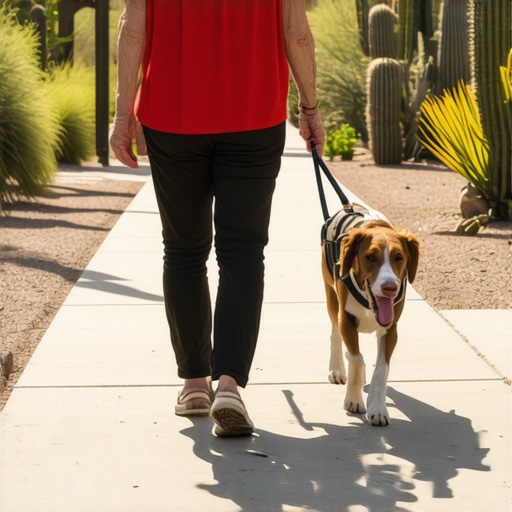
I have spent three decades in a garage in Mesa, fixing engines that the Arizona sun tried its best to weld into solid blocks of scrap. You learn one thing fast: if the cooling system fails, the whole machine is junk. Mobility assistance dogs in 2026 are no different. They are the high-performance chassis that keep people moving when their own biology decides to throw a rod. The editor’s take is simple: In 2026, an Arizona mobility dog must function as a climate-aware, tech-integrated safety system, or it is just a pet in a vest. Reliable service depends on five specific tasks that address the brutal realities of Phoenix, Scottsdale, and the surrounding Valley. We are talking about torque, reliability, and the ability to operate when the mercury hits 118 degrees without a hiccup.
The sun is a silent engine killer
An assistance dog in the Pacific Northwest has it easy. In Arizona, the pavement is a weapon. A top-tier mobility animal in 2026 needs to master high-heat situational awareness. This isn’t just about wearing boots. It is about the dog identifying when a surface is too hot for its handler to safely navigate or when the dog itself needs a cooling break before its internal temp spikes. Observations from the field reveal that handlers often miss the early signs of heat exhaustion. A dog trained to proactively signal for a ‘shade stop’ or ‘hydration check’ acts as a biological thermostat. This is the first must-have task. We aren’t looking for a dog that just follows orders; we need one that understands the environmental limits of the mission. The technical relationship between canine endurance and Arizona’s urban heat islands is the most overlooked variable in modern service work. If the dog doesn’t know how to find the path of least thermal resistance, the handler is at risk of a breakdown in the middle of a parking lot.
Precision counterbalance on weathered desert terrain
The second task is dynamic counterbalance on uneven desert surfaces. Most people think of mobility as walking on a flat linoleum floor at a grocery store. Real life in the Southwest involves cracked sidewalks, gravel-heavy landscaping, and the sudden shifts of monsoon-damaged paths. A dog must provide specific upward pressure or downward resistance that adjusts to the grade of the slope. Think of it like a suspension system. In places like Gilbert or Apache Junction, where the infrastructure meets the desert, the dog’s ability to lock its frame and provide a solid anchor during a handler’s dizzy spell is a non-negotiable spec. This requires a level of physical conditioning and spatial awareness that goes beyond the ‘old guard’ methods of simple harness pulling. We are seeing a shift toward ‘smart bracing’ where the dog anticipates the shift in the handler’s center of gravity before the handler even realizes they are tipping.
The mechanical failure of a cheap harness
The third task is tech-integrated medical signaling. By 2026, every handler should be wearing some form of biometric monitor. The dog’s job is to bridge the gap between the watch vibrating and the human taking action. A dog trained to respond to a specific alarm by fetching a medical kit or forcing the handler to sit down is the redundancy system every pilot wishes they had. I see too many ‘experts’ claiming that a dog alone is enough. That is like saying you don’t need a fuel gauge because you can hear the engine. Real safety comes from the synergy of 2026 tech and canine intuition. This is vital when dealing with conditions that cause syncope or sudden blood pressure drops common in the Arizona dry heat. For more information on federal standards, check out the ADA Service Animal Requirements which govern these interactions. If the dog isn’t integrated into the handler’s digital health ecosystem, they are leaving safety on the table.
How Mesa differs from Manhattan in the eyes of a Lab
Local laws in Arizona, specifically under the Arizona Revised Statutes (A.R.S. § 11-1024), provide strong protections for service animals, but the physical environment is what dictates the training. The fourth task is proactive hydration signaling. In the Valley, dehydration happens before you feel thirsty. A dog trained to identify a handler’s specific scent changes associated with dehydration can save a life. This is ‘on the ground’ intelligence. While a trainer in New York might focus on subway navigation, a trainer at Robinson Dog Training focuses on the dog’s ability to manage the handler’s physical state in a climate that wants to dry you out like a piece of old leather. The fifth task is advanced urban traffic safety. With Phoenix being one of the most car-centric cities in the world, a mobility dog must have a ‘traffic-stop’ reflex that is hardwired. This means the dog refuses to move into a crosswalk if it senses a vehicle approaching, even if the handler gives the command. It is a fail-safe. It is the emergency brake on a runaway train.
What happens when the joints start to creak
People often ask why standard training isn’t enough anymore. The reality is that the 2026 environment is louder, hotter, and more distracting. A dog that worked in 2010 would be overwhelmed by the stimuli of a modern Scottsdale shopping center. We see ‘messy realities’ where dogs are retired early because they weren’t conditioned for the psychological toll of high-intensity urban work. Industry advice often fails because it treats the dog like a static tool. A dog is a living system. If you don’t account for the ‘wear and tear’ of the Arizona environment, you are looking at a system failure within three years. Advanced problems require a contrarian approach: stop focusing on the dog’s obedience and start focusing on the dog’s judgment.
The 2026 diagnostic checkup
Is my dog too old to learn these tasks? No, but the learning curve is steeper for older dogs. Can I train my own dog for these 2026 standards? Possible, but highly unlikely without professional oversight for the technical bracing tasks. What is the biggest threat to a mobility dog in Arizona? Heat-induced cognitive decline from repeated micro-exposures to high temperatures. Why does tech integration matter? Because it removes human error from the emergency response equation. Does the ADA cover these specific tasks? The ADA covers any task that mitigates a disability, and these 2026 standards fall squarely within that definition. If you want a mobility dog that actually works when the chips are down, you need to look at the specs. Don’t settle for a factory model when you need a custom build. The future of mobility in the desert isn’t just about walking; it is about surviving the ride.